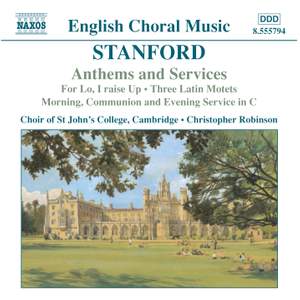


Stanford - Anthems and Services
Christopher Whitton (organ)
Choir of St. John’s College Cambridge, Christopher Robinson
The mean old saying, 'Those who can, do, and those who can't, teach', would have withered in the presence of Stanford; and no doubt one of the reasons why he was such a great teacher is that... — More…
-
Gramophone MagazineJuly 2003Editor's Choice

CD
$11.75Downloads
What are FLAC and MP3?Contents
Stanford: Morning, Evening and Communion Services in C Op. 115
- Christopher Whitton (organ)
- Choir of St John's College Cambridge
- Christopher Robinson
- Recorded: 12-13 July 2002
- Recording Venue: St. John's College Chapel, Cambridge
Te deum laudamus
Benedictus
Stanford: Three Latin Motets, Op. 38
- Choir of St John's College Cambridge
- Christopher Robinson
- Recorded: 12-13 July 2002
- Recording Venue: St. John's College Chapel, Cambridge
Justorum animae
Coelos ascendit hodie
Beati quorum via
Stanford: Morning, Evening and Communion Services in C Op. 115
- Christopher Whitton (organ)
- Choir of St John's College Cambridge
- Christopher Robinson
- Recorded: 12-13 July 2002
- Recording Venue: St. John's College Chapel, Cambridge
Magnificat
Nunc dimittis
Kyrie
Stanford: Six Short Preludes & Postludes Set 2 Op. 105
- Christopher Whitton (organ)
- Recorded: 12-13 July 2002
- Recording Venue: St. John's College Chapel, Cambridge
Organ Prelude in G minor
Stanford: Complete Morning & Evening Service in G major, Op. 81
- Christopher Whitton (organ)
- Choir of St John's College Cambridge
- Christopher Robinson
- Recorded: 12-13 July 2002
- Recording Venue: St. John's College Chapel, Cambridge
Magnificat
Nunc dimittis
Stanford: Six Short Preludes & Postludes Set 2 Op. 105
- Christopher Whitton (organ)
- Recorded: 12-13 July 2002
- Recording Venue: St. John's College Chapel, Cambridge
Organ Postlude in D minor
Stanford: For lo, I raise up, Op. 145
- Christopher Whitton (organ)
- Choir of St John's College Cambridge
- Christopher Robinson
- Recorded: 12-13 July 2002
- Recording Venue: St. John's College Chapel, Cambridge