

In stock - usually despatched within 1 working day.
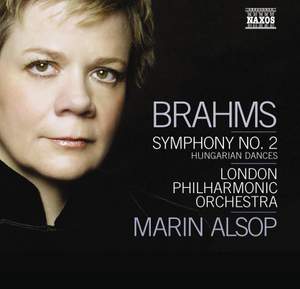
Johannes Brahms: Symphony No. 2 in D major, Op. 73
I. Allegro non troppo
II. Adagio non troppo
III. Allegretto grazioso, quasi andantino
IV. Allegro con spirito
Johannes Brahms: 21 Hungarian Dances, WoO 1 (version for orchestra)
Hungarian Dance No. 1 in G minor (orch. J. Brahms)
Hungarian Dance No. 3 in F major (orch. J. Brahms)
Hungarian Dance No. 10 in F major (orch. J. Brahms)
Hungarian Dance No. 17 in F sharp minor (orch. A. Dvorak)
Hungarian Dance No. 18 in D major (orch. A. Dvorak)
Hungarian Dance No. 19 in B minor (orch. A. Dvorak)
Hungarian Dance No. 20 in E minor (orch. A. Dvorak)
Hungarian Dance No. 21 in E minor (orch. A. Dvorak)
December 2005
****
“The second instalment of Marin Alsop's Brahms symphonies series is as authoritative, understanding and warm-hearted as the first.”
2010
“This is a late-summer idyll of a performance, easily paced, nicely judged and warmly played. For first-time buyers it will provide unalloyed pleasure; for older hands it will satisfy without necessarily enlightening or surprising. It is one of those Brahms performances whose centre of gravity is in the violas, cellos and horns. This is apt to the symphony's lyrical, ruminative character, though there are times when the music is robbed of its light and shade. In the finale, for example, one rather misses the chill-before-dawn mood of the lead-in to the recapitulation; and one needs a keener differentiation of horn and trumpet tone to catch the final page's incomparable D major blaze. Alsop's account of the third movement is strong in contrast, the oboe-led Allegrettograzioso strangely muted, the quicker 2/4 section done more or less to perfection. That said, you might think the slow movement under-characterised: insufficiently distinct in tone and temper from the first. The symphony was recorded in Blackheath Concert Hall, the Hungarian Dances in Watford's Colisseum: a bigger, brawnier acoustic that doesn't suit the music quite so well. In dance No 18 in D, one of Dvorák's orchestrations, there is a noisy, cluttered feel to the performance. By contrast, the alfresco No 3 in F, winningly and economically orchestrated by Brahms himself, is played with real charm and style.”
Click on any of the works listed above for alternative recordings.