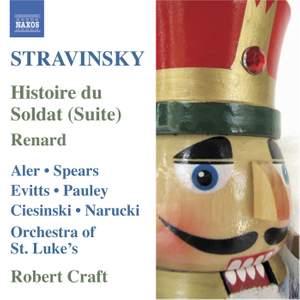

Stravinsky: L'Histoire du Soldat: Concert Suite & Renard
Catherin Ciesinski (mezzo-soprano) & Susan Naruki (soprano)
Twentieth Century Classics Ensemble, Robert Craft
Wistful is not a word one expects to use to describe a composition of Stravinsky but the Pastorale which opens this collection has just that kind of charm. Written originally as a vocal piece... — More…
CD
$13.00Downloads
What are FLAC and MP3?Contents
Stravinsky: Pastorale
- Charles Neidich (clarinet), Rolf Schulte (violin), Stephen Taylor (oboe), Melanie Feld (cor anglais), Frank Morelli (bassoon)
- Recorded: 1995
- Recording Venue: SUNY, Purchase, NY, USA
Pastorale (arr. I. Stravinsky and S. Dushkin for violin and wind quartet)
Stravinsky: L'Histoire du Soldat: Concert Suite
- Christopher Gekker (trumpet), Gordon Gottlieb (percussion), Rolf Schulte (violin), Frank Morelli (bassoon), John Feeney (double bass), William Blount (clarinet), Michael Powell (trombone)
- Robert Craft
- Recorded: 1995
- Recording Venue: SUNY, Purchase, NY, USA
I. The Soldier's March
II. Music from Scene 1
III. Music from Scene 2, "Pastorale"
Stravinsky: Three Pieces for Solo Clarinet
- Charles Neidich (clarinet)
- Recorded: 1999
- Recording Venue: SUNY, Purchase, NY, USA
No. 1. Sempre piano e molto tranquillo: quarter note = 52
No. 2. quarter note = 168
No. 3. quarter note = 160
Stravinsky: Pour Picasso
- Charles Neidich (clarinet)
- Recorded: 1999
- Recording Venue: SUNY, Purchase, NY, USA
Stravinsky: Pribaoutki (Pleasant Songs)
- Katherine Ciesinski (mezzo-soprano)
- St. Luke's Orchestra
- Robert Craft
- Recorded: 1992
- Recording Venue: SUNY, Purchase, NY, USA
No. 1. Kornilo
No. 2. Natashka
No. 3. Polkovnik (The Colonel)
No. 4. Starets i zayats (The Old Man and the Hare)
Stravinsky: Berceuses du chat (Cat's Cradle Songs)
- Katherine Ciesinski (mezzo-soprano)
- St. Luke's Orchestra
- Robert Craft
- Recorded: 1992
- Recording Venue: SUNY, Purchase, NY, USA
No. 1. Spi, kot (The Tom-Cat)
No. 2. Kot na pechi (The Tom-Cat on the Stove)
No. 3. Bay-bay (Bye-Byes)
No. 4. U kota, kota (O Tom-Cat, Tom-Cat)
Stravinsky: Renard
- John Aler (tenor), Richard O'Neill (viola), Fred Sherry (cello), Jennifer Frautschi (violin), William Purvis (horn), Gordon Gottlieb (timpani), Daniel Grabois (horn), Tara Helen O'Connor (flute), Alan R. Kay (clarinet), Stephen Taylor (cor anglais), Tom Kolor (percussion), Frank Morelli (bassoon), David Evitts (baritone), Chris Deane (cimbalom), David Bowlin (violin), Kurt Muroki (double bass), Wilbur Pauley (bass), Louis Hanzlik (trumpet), Steven Paul Spears (tenor), Daniel Druckman (percussion)
- Robert Craft
- Recorded: 2 January 2005
- Recording Venue: American Academy of Arts and Letters
Stravinsky: 2 Stikhotvoreniya Konstantina Bal'monta (2 Poems of Konstantin Bal'mont)
- Susan Narucki (soprano)
- Twentieth Century Classics Ensemble
- Robert Craft
- Recorded: 19 May 1997
- Recording Venue: SUNY, Purchase, NY, USA
No. 1. Nezabudochka tsvetochek' (The Little Forget-Me-Not Flower)
No. 2. Golub' (The Dove)
Stravinsky: Three Japanese Lyrics
- Susan Narucki (soprano)
- Twentieth Century Classics Ensemble
- Robert Craft
- Recorded: 19 May 1997
- Recording Venue: SUNY, Purchase, NY, USA
No. 1. Akahito
No. 2. Mazatsumi
No. 3. Tsaraiuki
Stravinsky: Scherzo a la russe (original Jazz band version)
- St. Luke's Orchestra
- Robert Craft
- Recorded: 1991
- Recording Venue: SUNY, Purchase, NY, USA
Scherzo a la russe (original Jazz band version, 1944)
Stravinsky: Song of the Volga Boatman (arr. Stravinsky for band)
- Philharmonia Orchestra
- Robert Craft
- Recorded: 2001
- Recording Venue: Abbey Road Studio No. 1, London