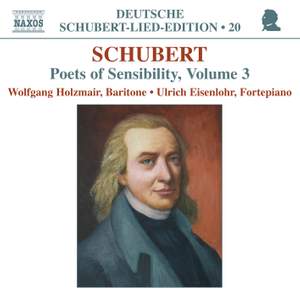


Usually despatched in 2 - 3 working days. (Available now to download.)
Franz Schubert: Der Tod und das Madchen, Op. 7, No. 3, D. 531
Der Tod und das Madchen, D. 531
Franz Schubert: Der Leidende, D. 432b
Der Leidende (3rd setting), D. 432c
Franz Schubert: Totengraberlied, D. 44 (2nd setting)
Totengraberlied, D. 44
Franz Schubert: Lied, D. 788, "Die Mutter Erde"
Lied, "Die Mutter Erde" (Des Lebens Tag...), D. 788
Franz Schubert: Der Leidende, D. 432a
Der Leidende (2nd setting), D. 432b
Franz Schubert: Die Nonne, D. 208
Die Nonne, D. 208
Franz Schubert: Taglich zu singen, D. 533
Taglich zu singen D. 533
Franz Schubert: Klage (Trauer umfliesst mein Leben), D. 371
Klage (Trauer umfliesst mein Leben), D. 371
Franz Schubert: Stimme der Liebe, D. 412
Stimme der Liebe, D. 412
Franz Schubert: Seufzer, D. 198
Seufzer, D. 198
Franz Schubert: An eine Quelle, Op. 109, No. 3, D. 530
An eine Quelle, D. 530
Franz Schubert: An die Apfelbaume, wo ich Julien erblickte, D. 197
An die Apfelbaume, wo ich Julien erblickte, D. 197
Franz Schubert: Die fruhe Liebe, D. 430
Die fruhe Liebe, D. 430
Franz Schubert: An den Mond, Op. 57, No. 3, D. 193
An den Mond (Geuss lieber Mond), D. 193
Franz Schubert: Abendlied, D. 499
Abendlied (Der Mond ist aufgegangen), D. 499
Franz Schubert: Klage (Dein Silber schien durch Eichengrun), D. 436
Klage (Dein Silber schien durch Eichengrun), D. 436
Franz Schubert: Auf den Tod einer Nachtigall, D. 201 (1st setting)
Auf den Tod einer Nachtigall (1st setting) - fragment, D. 201a
Franz Schubert: Auf den Tod einer Nachtigall, D. 399 (2nd setting)
Auf den Tod einer Nachtigall (2nd setting), D. 399b
Franz Schubert: Auf dem Wasser zu singen, Op. 72, D. 774
Auf dem Wasser zu singen, D. 774
Franz Schubert: Lied in der Abwesenheit, D. 416 (fragment)
Lied in der Abwesenheit - fragment, D. 416
Franz Schubert: Der Liebende, D. 207
Der Liebende, D. 207
Franz Schubert: Minnelied, D. 429
Minnelied, D. 429
Franz Schubert: Der Traum, Op. 172, No. 1, D. 213
Der Traum, D. 213
Franz Schubert: Seligkeit, D. 433
Seligkeit, D. 433
2010
“The pre-Romantic poets of Empfindsamkeit ('sensibility'), represented here by Hölty, Claudius and Stolberg, inspired a handful of famous Schubert settings alongside dozens of songs that are still too little known. Die Mutter Erde, for instance, written when the composer was suffering from the first symptoms of syphilis, is quintessentially Schubertian in its mingled grandeur, serenity and yearning; Stimme der Liebe, dating from 1816 but sounding 10 years later, is one of his most poignant and intense love songs (a reflection of his failed affair with Therese Grob?); An die Apfelbäume is a bel canto melody of delicious sensuous grace. Elsewhere we have what must be the jolliest song ever about death (Toten-gräberlied), a pair of solemnly archaic hymns, and charming Haydnesque settings of poems in that faintly risqué (and, to us, impossibly coy) vein beloved of the 18th century. As ever, Wolfgang Holzmair, with his plangent, tenorish (and distinctly Viennese) timbre, is a highly sympathetic Schubertian, scrupulous in enunciation, always sensitive to mood and nuance yet never prone to exaggeration. Where darker, deeper voices make Death in Der Todund das Mädchen a solemn, hieratic figure, Holzmair intones Death's chant with a gentle beneficence. The many songs of pathos or wistful longing – say, Der Leidende or the exquisite Seufzer – suit Holzmair to perfection. He brings an unforced variety to the successive verses of strophic settings like Abendlied (another littleknown gem), finds the vocal equivalent of a twinkle in the eye for Der Traum (marked to be sung 'flirtatiously'), and even compels you to listen in the potentially absurd ballad Die Nonne, in which a nun of fiery Latin temperament turns murderess. Holzmair understands, too, the virtue of simplicity in early Schubert. Reservations? Well, these days Holzmair sounds a touch strained at high-lying climaxes; and while he can spin a true legato, his line can on occasion be slightly bumpy, as in an otherwise touching (and unusually reflective) Auf demWasser zu singen. But there is nothing to detract seriously from enjoyment of a shrewdly planned recital that begins in the grip of Death and ends with an exuberant affirmation of life's pleasures (Seligkeit). Ulrich Eisenlohr is a discerning partner, drawing an array of delicate, evocative sonorities from his 1820s fortepiano, including (in, for instance, An den Mond) a hazy con sordino (muted) resonance impossible to conjure on a modern grand. Naxos provide texts and translations via their website.”
March 2006
“As ever, Wolfgang Holzmair, with his plangent, tenorish (and distinctly Viennese) timbre, is a highly sympathetic Schubertian, scrupulous in enunciation, always sensitive to mood and nuance yet never prone to exaggeration. The many songs of pathos or wistful longing - say, Der Leidende or the exquisite Seufzer - suit Holzmair to perfection. Ulrich Eisenlohr is a discerning partner, drawing an array of delicate, evocative sonorities from his 1820s fortepiano.”
Click on any of the works listed above for alternative recordings.