
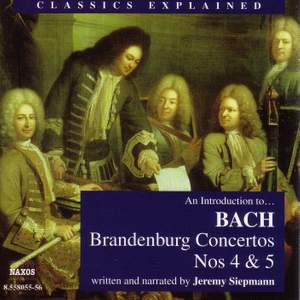

Classics Explained: BACH, J.S. - Brandenburg Concertos Nos 4 & 5

Naxos: 8558055-56

Prices shown exclude VAT. (UK tax is not payable for deliveries to United States.)
See Terms & Conditions for p&p rates.
Classics Explained: BACH, J.S. - Brandenburg Concertos Nos 4 & 5

Label:

Naxos

Catalogue No:

8558055-56
(8.558055-56)

Discs:

2

Barcode:

0636943805527

Length:

2 hours 31 minutes

Medium:

CD (download also available)

20% off Naxos

click here for full details

special offer ends 29/05/2013

| Share

Classics Explained: BACH, J.S. - Brandenburg Concertos Nos 4 & 5

An exploration of Bach's Brandenburg Concertos Nos. 4 and 5 narrated by Jeremy Siepmann


CD - 2 discs

Normally: $15.25

Special: $12.20

(also available to download from $11.00)

Usually despatched in 2 - 3 working days. (Available now to download.)

Johann Sebastian Bach: Brandenburg Concerto No. 4 in G

playThe Brandenburgs as concerti grossi

Johann Sebastian Bach: Brandenburg Concerto No. 4 in G - First Movement

playIntroduction: Melody, Theme and Motif; Bach's opening gambit

playOnwards and upwards: Motif No. 2 and its function

playThe two elements of Motif No. 2 and the effect of their combination

playThe 'motto' rhythm hidden even within the opening bar

playMotif No. 3, introduced by the two recorders, has a kind of 'hovering' character

playMotif No. 3 repeated for a second, 'directed' listen

playBach reminds us of the opening

playMotif No. 4 - a steadily rising derivative of Motif No. 1

playMotif No. 5, a lovely, bouncy, syncopated flourish, in which all the instruments join

playOpening Ritornello (complete)

playEpisode 1 begins with virtuoso entry of the solo violin, made up of alternating arpeggios

playMotif No. 3 returns, courtesy of the recorders, recently sidelined by the violin

playRitornello 2, a varied repeat of Ritornello 1, arrives after much harmonic movement

playEpisode 2, Part 1, preceded by the 'fanfare' motif from which its first theme derives

playEpisode 2 continued, with more bravura dazzle from the solo violin

playRepeat of section for purposes of hearing the harmonic movement

playRitornello 3, with the prominent participation of the soloists

playEpisode 3 proves retrospective, featuring transposed repeats of earlier material

playRitornello 4, not altogether what it might seem; solo violin takes 'motto' motif

playEpisode 4. Cue to Part 1, focusing on 'soloistic' counterpoint provided by the continuo

playReturn to Ritornello 4 to hear sources of Episode 4, Part 2

playEpisode 4 continued, with emphasis placed on conversational interchanges

playReturn to opening Ritornello in order to enhance awareness of the contrast

playRitornello 5, beginning

playRitornello 5 continued, with emphasis on the determined banishment of B minor

playCue to complete performance of First Movement

playFirst Movement (complete)

Johann Sebastian Bach: Brandenburg Concerto No. 4 in G - Second Movement

playIntroduction: Rhythmic Motif provides basis for whole movement

playThe melody not much to write home about; nor is the meek 'answer' offered by the soloists

playPutting the two together, thereby establishing a relationship

playContrast and syncopation - their relationship in opening section

playListening from the 'botton up'

playThe intertwining and alternation of solo and orchestra; the irregularity of metrical groupings

playThe next orchestral phrase; slowing the pace but not the tempo

playThe First Section (complete)

playThe next section; foreground symmetry and background variety

playThe central section's groupings are hugely asymmetrical

playCue to Second Movement as a whole

playSecond Movement (complete)

Johann Sebastian Bach: Brandenburg Concerto No. 4 in G - Third Movement

playIntroduction to the Third Movement...

playFugue subject

playFirst counter-subject

playSecond counter-subject

playBass entry of the subject

playExposition (complete)

playFirst Episode; the use of fragmentary derivatives

playThe difference a detail can make!

playHarmonic Rhythm defined; back to the beginning to find the seed...

play...and now the blossom

playThe First Solo Episode; a confusion of terms; onwards, to the introduction of the solo episode

playRitornello 2 complete

playSolo Episode 2 dominated by thrilling virtuosity from the solo violin

playRitornello 3: highly contrapuntal and dominated by subject-derivatives, with much harmonic fluidity

playRitornello 3 continues: engine of harmonic motion repeated at higher pitch

playMore on Ritornello 3: the use of long, sustained, slightly syncopated notes in upper strings

playRitornello 3 (complete)

playSolo Episode 3 - less solo than earlier ones, what with (albeit very discreet)

playThe two recorders converse in canon, accompanied for six exhilarating bars by cello 'continuo'

playFinishing Solo Exposition 3: orchestral cellos introduce what sounds

playApproaching the final Ritornello; stretto explained

playCue to Finale Ritornello, noting tension-building 'pedal point' in cellos and double bass

playCoda - the 'tail-piece', with its surprising 'hammer strokes'

playCue to Third Movement

playThird Movement (complete)

Johann Sebastian Bach: Brandenburg Concerto No. 5 in D - First Movement

playOpening Music; analysis and phony analysis; Shaw quote; music: Motif No. 1

playMusic, energy and relationship

playThe outlines of a melody emerge

playThe opening bar again

playMotif No. 2: ta / dee-ya, dee-ya, dee-ya

playMotif No. 3, and an important feature of its rhythm

playBeethoven Fifth Symphony (opening)

playMotif No. 4

playMotif No. 5

playMotif No. 6

playEpisode 1: a 'Love Duet'

playEpisode 1 continued; violin and flute reverse direction of their theme

play'False' Ritornello; soloists interrupt; rising 'sighing' motif; harpsichord continues downwards

playFour things going on at once, in violin, flute, harpsichord right hand, harpsichord left hand

playThe orchestra returns, picking up at exactly the spot where it was interrupted

playThe harpsichord intervenes with derivative of Motif 4; key shifts from A major to B minor

playThe orchestra returns to foreground and brings this section to an end

playHarpsichord emerges as virtuoso; a series of expectations are frustrated

playA backwards look; blurred distinctions between soloists and orchestra; 'Mozartian' development

playOut of the Twilight Zone; a sequence of surprises

playThe epoch-making harpsichord cadenza and the final Ritornello

playCue to First Movement

playFirst Movement (complete)

Johann Sebastian Bach: Brandenburg Concerto No. 5 in D - Second Movement

playIntroduction; the opening Ritornello

playThe first bar; the first main building block

playThe flute motif

playOpening of the first solo episode

playAn important motif; the second main building block

playThe second main theme

playRitornello 2; violin and flute as 'orchestra'

playEpisode 2; inversion of original motifs

playMore on Episode 2

playEpisode 1 and Episode 2 compared

playEpisode 2; key shifts from D major to F sharp minor

playRitornello 3: an exact transposition of Ritornello 1

playEpisode 3 contrasted with Episode 1

playEpisode 3 described in detail

playRitornello 4; second main theme's first appearance in a Ritornello

playEpisode 4: dominated by inversions

playCue to Second Movement

playSecond Movement (complete)

Johann Sebastian Bach: Brandenburg Concerto No. 5 in D - Third Movement

playIntroduction: Ritornello 1

playThe Fugue Subject: close juxtaposition of contrasting elements

playFlute takes the 'answer', with countersubject in the violin

playContrary motion as a contrapuntal device

playContrary motion as a listening aid; a new theme

playPlaying with the counter-subject; a musical game of tag

playHidden rhythms: background variety behind foreground uniformity

playFugal writing and the compatibility of parts; the Exposition

playEpisode 1, taken by soloists, contains important 'seeds'

playThe orchestra enters at last, but by stealth

playStretto and musical football

playKey changes to B minor, introducing extensive Middle Section

playThe Middle Section a precursor of the Mozartian 'development'

playThe Fugue Subject out in force: first four immediately consecutive entries yet

playAmbiguity of mode and a Scottish twist

playMiddle Section sontinued; harpsichord dominates

playCue to Last Movement

playLast Movement (complete)

Choose Format:

What is MP3 and FLAC?

Download AlbumLengthMP3 PriceFLAC Price
subtotal:$0.00$0.00
Classics Explained: BACH, J.S. - Brandenburg Concertos Nos 4 & 5 Download whole album2:31:47$11.00$12.50
Download individual works/tracksLengthMP3 PriceFLAC Price
1:28$1.05$1.45
play 1:28$1.05$1.45
27:25$28.35$39.15
play 2:15$1.05$1.45
play 0:51$1.05$1.45
play 0:29$1.05$1.45
play 1:07$1.05$1.45
play 0:27$1.05$1.45
play 0:23$1.05$1.45
play 0:17$1.05$1.45
play 0:19$1.05$1.45
play 0:23$1.05$1.45
play 1:47$1.05$1.45
play 1:15$1.05$1.45
play 0:47$1.05$1.45
play 0:43$1.05$1.45
play 0:59$1.05$1.45
play 1:05$1.05$1.45
play 0:48$1.05$1.45
play 0:47$1.05$1.45
play 0:49$1.05$1.45
play 0:48$1.05$1.45
play 0:56$1.05$1.45
play 0:37$1.05$1.45
play 0:28$1.05$1.45
play 0:53$1.05$1.45
play 0:10$1.05$1.45
play 0:56$1.05$1.45
play 0:46$1.05$1.45
play 6:20$1.05$1.45
17:26$12.60$17.40
play 1:17$1.05$1.45
play 0:14$1.05$1.45
play 0:21$1.05$1.45
play 2:18$1.05$1.45
play 2:48$1.05$1.45
play 2:14$1.05$1.45
play 0:28$1.05$1.45
play 1:37$1.05$1.45
play 1:29$1.05$1.45
play 1:12$1.05$1.45
play 0:11$1.05$1.45
play 3:17$1.05$1.45
26:19$26.25$36.25
play 4:57$1.05$1.45
play 1:04$1.05$1.45
play 0:31$1.05$1.45
play 0:51$1.05$1.45
play 0:14$1.05$1.45
play 0:33$1.05$1.45
play 0:33$1.05$1.45
play 0:15$1.05$1.45
play 1:06$1.05$1.45
play 0:21$1.05$1.45
play 1:59$1.05$1.45
play 1:11$1.05$1.45
play 1:47$1.05$1.45
play 0:47$1.05$1.45
play 0:06$1.05$1.45
play 0:21$1.05$1.45
play 0:31$1.05$1.45
play 0:28$1.05$1.45
play 0:22$1.05$1.45
play 0:34$1.05$1.45
play 0:56$1.05$1.45
play 1:02$1.05$1.45
play 0:58$1.05$1.45
play 0:20$1.05$1.45
play 4:32$1.05$1.45
36:22$24.40$33.60
play 3:08$1.05$1.45
play 0:59$1.05$1.45
play 0:42$1.05$1.45
play 0:25$1.05$1.45
play 0:11$1.05$1.45
play 0:32$1.05$1.45
play 0:20$1.05$1.45
play 0:12$1.05$1.45
play 0:05$1.05$1.45
play 0:06$1.05$1.45
play 1:39$1.05$1.45
play 1:01$1.05$1.45
play 0:59$1.05$1.45
play 0:39$1.05$1.45
play 0:28$1.05$1.45
play 0:25$1.05$1.45
play 0:42$1.05$1.45
play 2:33$1.05$1.45
play 4:36$1.05$1.45
play 1:57$1.05$1.45
play 4:51$1.05$1.45
play 0:52$1.05$1.45
play 9:00$1.30$1.70
18:32$18.90$26.10
play 2:34$1.05$1.45
play 0:16$1.05$1.45
play 0:16$1.05$1.45
play 1:04$1.05$1.45
play 0:17$1.05$1.45
play 0:33$1.05$1.45
play 0:52$1.05$1.45
play 0:38$1.05$1.45
play 0:10$1.05$1.45
play 0:21$1.05$1.45
play 0:49$1.05$1.45
play 0:47$1.05$1.45
play 0:34$1.05$1.45
play 1:05$1.05$1.45
play 0:57$1.05$1.45
play 1:34$1.05$1.45
play 0:06$1.05$1.45
play 5:39$1.05$1.45
24:15$18.90$26.10
play 0:54$1.05$1.45
play 1:21$1.05$1.45
play 0:33$1.05$1.45
play 0:23$1.05$1.45
play 0:32$1.05$1.45
play 0:51$1.05$1.45
play 0:44$1.05$1.45
play 1:35$1.05$1.45
play 0:37$1.05$1.45
play 1:19$1.05$1.45
play 1:02$1.05$1.45
play 1:24$1.05$1.45
play 3:06$1.05$1.45
play 1:51$1.05$1.45
play 0:38$1.05$1.45
play 2:11$1.05$1.45
play 0:19$1.05$1.45
play 4:55$1.05$1.45

Copyright © 2002-13 Presto Classical Limited, all rights reserved.