
In stock - usually despatched within 1 working day.
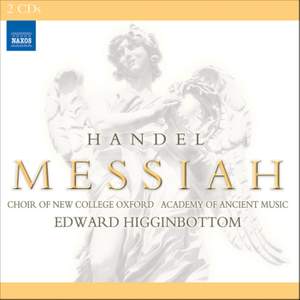
This new recording of Handel’s Messiah presents the first modern recording of a re-construction of Handel’s unique London performances of Messiah in April and May 1751, when he used treble voices from the Chapel Royal for choruses and arias.
George Frideric Handel: Messiah, HWV 56 (1751 Version)
Part I: Sinfonia
Part I: Accompanied recitative: Comfort ye, my people (Tenor)
Part I: Aria: Every valley shall be exalted (Tenor)
Part I: Chorus: And the glory of the Lord
Part I: Accompanied recitative: Thus saith the Lord of Hosts (Bass)
Part I: Aria: But who may abide the day of His coming (Countertenor)
Part I: Chorus: And He shall purify
Part I: Recitative: Behold, a virgin shall conceive, and bear a son (Countertenor)
Part I: Aria and Chorus: O thou that tellest good tidings to Zion (Countertenor)
Part I: Accompanied recitative: For behold, darkness shall cover the earth (Bass)
Part I: Aria: The people that walked in darkness (Bass)
Part I: Chorus: For unto us a Child is born
Part I: Pifa
Part I: Accompanied recitative: There were shepherds abiding in the field (Trebles)
Part I: Chorus: Glory to God in the highest
Part I: Aria: Rejoice greatly, O daughter of Zion (Tenor)
Part I: Recitative: Then shall the eyes of the blind be opened (Countertenor)
Part I: Aria: He shall feed His flock like a shepherd (Countertenor, Treble)
Part I: Chorus: His yoke is easy, His burthen is light
Part II: Chorus: Behold, the Lamb of God
Part II: Aria: He was despised and rejected of men (Countertenor)
Part II: Chorus: Surely He hath borne our griefs and carried our sorrows
Part II: Chorus: And with His stripes we are healed
Part II: Chorus: All we like sheep have gone astray
Part II: Accompanied recitative: All they that see Him, laugh Him to scorn (Tenor)
Part II: Chorus: He trusted in God that He would deliver Him
Part II: Accompanied recitative: Thy rebuke hath broken His heart (Tenor)
Part II: Aria: Behold, and see if there be any sorrow like unto His sorrow (Tenor)
Part II: Accompanied recitative: He was cut off out of the land of the living (Treble)
Part II: Aria: But thou didst not leave His soul in hell (Treble)
Part II: Chorus: Lift up your heads, O ye gates
Part II: Recitative: Unto which of the angels said He at any time (Tenor)
Part II: Chorus: Let all the angels of God worship Him
Part II: Aria: Thou art gone up on high (Countertenor)
Part II: Chorus: The Lord gave the word
Part II: Aria: How beautiful are the feet of them that preach the gospel of peace (Treble)
Part II: Chorus: Their sound is gone out into all lands
Part II: Aria: Why do the nations so furiously rage together (Bass)
Part II: Chorus: Let us break their bonds asunder
Part II: Recitative: He that dwelleth in heaven shall laugh them to scorn (Tenor)
Part II: Aria: Thou shalt break them with a rod of iron (Tenor)
Part II: Chorus: Hallelujah
Part III: Aria: I know that my redeemer liveth (Treble)
Part III: Chorus: Since by man came death
Part III: Accompanied recitative: Behold, I tell you a mystery (Bass)
Part III: Aria: The trumpet shall sound (Bass)
Part III: Recitative: Then shall be brought to pass the saying that is written (Countertenor)
Part III: Duet: O death, where is thy sting (Countertenor and Tenor)
Part III: Chorus: But thanks be to God
Part III: Aria: If God is for us, who can be against us (Countertenor)
Part III: Chorus: Worthy is the Lamb that was slain
Part III: Chorus: Amen
2010
“Taking his cue from Handel's 1751 performances, Edward Higginbottom assigns all the soprano solos to some talented boy trebles from the Choir of New College, Oxford. Otta Jones's contribution to 'He shall feed his flock' and Henry Jenkinson's 'I know that my redeemer liveth' are lovely testaments to Higginbottom's crusading 30 years with his choir. At best, Higginbottom's choir produces some marvelous moments ('All we like sheep', and one of the finest 'Amen' fugues on disc). Higginbottom's direction does not boil with dramatic intensity but instead simmers along with patience, elegant judgement and articulate tastefulness. Some familiar music bears ripe fruit when taken a shade slower than has become common in recent times ('Glory to God' is splendid rather than hurried, and all the better for it). Ex-scholar Toby Spence is on fine form in 'Rejoice greatly', and Iestyn Davies's poetic singing is another enjoyable feature, although one might hanker for a more dramatic treatment of 'shame and spitting' ('He was despised'). 'The trumpet shall sound' resounds with David Blackadder's magnificent playing, and the Academy of Ancient Music play Handel's orchestral parts immaculately. This Naxos release will appeal to those who want an affordable Messiah that is beautifully played, brightly sung, sweetly satisfying and unashamedly English in its sentimental roots.”
“This is a very special recording. Not only is it of quite outstanding quality both musically and dramatically, but, being sung entirely by male voices associated with a single institution (all the soloists are past or present members of New College Choir), it probably comes as close as modern conditions permit to a sound that Handel would have recognized.”
Click here for alternative recordings of this work.