

Usually despatched in 2 - 3 working days. (Available now to download.)
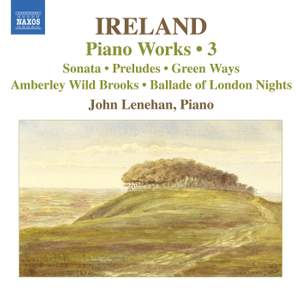
John Ireland’s piano music, some of the most appealing British piano music of the twentieth century, reflects the composer’s many interests: his love of literature, his interest in paganism and Celtic mysticism, as well as the bitter-sweet regret of the passing of love. irelanThis recording includes Ireland’s Piano Sonata, whose third movement is associated with Chanctonbury Ring on the Sussex South Downs, and the four Preludes, the third of which, The Holy Boy, written on Christmas Day 1913, is one of Ireland’s most popular and touching melodies.
John Ireland: Piano Sonata
I. Allegro moderato
II. Non troppo lento
III. Con moto moderato
John Ireland: Soliloquy
Soliloquy
John Ireland: Preludes
No. 1. The Undertone
No. 2. Obsession
No. 3. The Holy Boy
No. 4. Fire of Spring
John Ireland: The Almond Tree
The Almond Tree
John Ireland: On a Birthday Morning
On a Birthday Morning
John Ireland: Green Ways
I. The Cherry Tree
II. Cypress
III. The Palm and May
John Ireland: For Remembrance
For Remembrance
John Ireland: Amberley Wild Brooks
Amberley Wild Brooks
John Ireland: Equinox
Equinox
John Ireland: We'll to the Woods No More: III. Spring will not wait
We'll to the Woods No More: III. Spring will not wait
John Ireland: The Ballade of London Nights
The Ballade of London Nights
2010
“Comparative listening to the meaty Sonata that Ireland wrote between 1918 and 1920 (the one work common to all three releases) finds both Rowlands and Bebbington allowing themselves rather greater breathing space than the more urgently propulsive Lenehan (who whips up quite a gale in the first movement's development). Each is a mightily convincing proponent, though Rowlands's interpretation carries particular authority: during the late 1950s he studied intensively with Ireland (the booklet contains a most engaging and fascinating personal reminiscence) and it was Rowlands whom the composer recommended to Richard Itter of Lyrita for its complete recorded edition. With no editing facilities available, single takes were a necessity in sessions spanning January 1959 to March 1963 which took place in the music room of Itter's Buckinghamshire home. Captured in perfectly acceptable mono sound, Rowlands's memorably intimate performances betoken a very special empathy for this repertoire. Indeed, his playing throughout these three well filled CDs evinces a selfless dedication, recreative wonder and abundant poetic instinct. As for the two new collections, Lenehan effortlessly maintains the favourable impression left by the first two instalments in his series (reviewed above). With his pellucid, exquisitely variegated tonal palette, he makes a gorgeous thing of The Almond Trees, plumbs real depths in Spring will not wait and the central “Cypress” from Green Ways, and masterminds superbly involving accounts of the gale-tossed Equinox and mercurial Ballade of London Nights. What's more, he has been accorded crystal-clear yet nicely atmospheric engineering. For first-timers, however, Bebbington's programme provides a pretty much ideal introduction, containing two of Ireland's most popular and durable achievements, namely Decorations and London Pieces – both given with such winning aplomb, scrupulous care and heartwarming sense of new discovery that it's hard not to fall in love with them all over again (the vernally fresh 'Chelsea Reach' positively beams with joy). Elsewhere, Bebbington displays wonderful control in the leaner-textured and economically argued Sonatina, just as he is acutely responsive to the fearful undertow of the Ballade (close cousin to the riveting Legend for piano and orchestra). Somm's sound is clean and true.”
Click on any of the works listed above for alternative recordings.