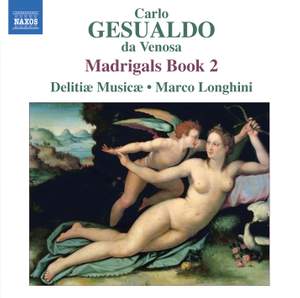


Gesualdo: Madrigali libro secondo, 1594
Alessandro Carmignani, Paolo Costa, Fabio Fùrnari, Raffaele Giordani, Marco Scavazza & Walter Testolin
Delitiæ Musicæ, Marco Longhini
I've found myself warming to the overall approach, which is relaxed and unhurried. This, combined with the ensemble's sound, securely underpinned by Walter Testolin's bass, allows points of detail... — More…
CD
$13.00Downloads
What are FLAC and MP3?Contents
Gesualdo: Caro amoroso neo
- Delitiæ Musicæ
- Marco Longhini
Caro amoroso neo
Ma se tale ha costei
Gesualdo: Hai rotto, e sciolto, e spento a poco a poco
- Delitiæ Musicæ
- Marco Longhini
Gesualdo: Se per lieve ferita
- Delitiæ Musicæ
- Marco Longhini
Se per lieve ferita
Che sentir deve il petto
Gesualdo: In piu leggiadro velo
- Delitiæ Musicæ
- Marco Longhini
Gesualdo: Se così dolce è il duolo
- Delitiæ Musicæ
- Marco Longhini
Se così dolce e il duolo
Ma se avverra ch'io moia
Gesualdo: Se taccio, il duol s'avanza
- Delitiæ Musicæ
- Marco Longhini
Gesualdo: O com'e gran martire
- Delitiæ Musicæ
- Marco Longhini
O com'e gran martire
O mio soave ardore
Gesualdo: Sento che nel partire
- Delitiæ Musicæ
- Marco Longhini
Gesualdo: Non è questa la mano
- Delitiæ Musicæ
- Marco Longhini
Non e questa la mano
Ne tien face o saetta
Gesualdo: Candida man qual neve
- Delitiæ Musicæ
- Marco Longhini