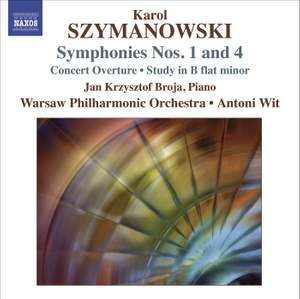


Szymanowski - Symphonies Nos. 1 & 4
Ewa Marczyk (violin solo) & Marek Marczyk (viola solo), Marek Marczyk (viola solo), Jan Krzysztof Broja (piano) & Ewa Marczyk (violin solo)
Warsaw Philharmonic Orchestra, Antoni Wit
…the Symphony No. 4… receives the slowest recorded performance I know… At the opening, with timpani tolling away underneath, the piano traces a languorously decorative line. In the middle movement,... — More…
CD
$13.00Downloads
What are FLAC and MP3?Contents
Szymanowski: Concert Overture, Op.12
Work length13:57
$3.00
$3.85
- Warsaw Philharmonic Orchestra
- Antoni Wit
- Recorded: 1, 2, 4 August 2006
- Recording Venue: Warsaw Philharmonic Concert Hall, Warsaw, Poland
Szymanowski: Symphony No. 1 in F minor, Op. 15
Work length18:37
$4.00
$5.20
- Warsaw Philharmonic Orchestra
- Antoni Wit
- Recorded: 2-3 January 2008
- Recording Venue: Warsaw Philharmonic Concert Hall, Warsaw, Poland
I. [Allegro moderato]
Track length9:49
$2.00
$2.60
II. Finale: Allegretto con moto grazioso
Track length8:48
$2.00
$2.60
Szymanowski: Symphony No. 4, Op. 60 (Sinfonia Concertante)
Work length28:02
$7.00
$9.05
- Jan Krzysztof Broja (piano)
- Warsaw Philharmonic Orchestra
- Antoni Wit
- Recorded: 4-5 September 2007
- Recording Venue: Warsaw Philharmonic Concert Hall, Warsaw, Poland
I. Moderato - Tempo comodo
Track length11:16
$3.00
$3.85
II. Andante molto sostenuto
Track length9:33
$2.00
$2.60
III. Allegro non troppo, ma agitato ed ansioso
Track length7:13
$2.00
$2.60
Excerpt,
Work length6:27
$1.00
$1.30
- Warsaw Philharmonic Orchestra
- Antoni Wit
- Recorded: 6 September 2007
- Recording Venue: Warsaw Philharmonic Concert Hall, Warsaw, Poland
Study in B flat minor, Op. 4, No. 3 (arr. G. Filtelberg for orchestra)
Track length6:27
$1.00
$1.30