

In stock - usually despatched within 1 working day.
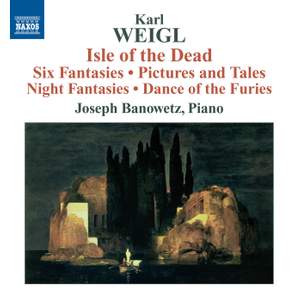
Karl Weigl was part of the rich cultural life of Vienna at the turn of the last century. One of his earliest works, Isle of the Dead was inspired by Böcklin’s famous symbolic painting and here receives its first known performance.
Nachtphantasien (Night Fantasies) relates to the two Nachtmusik movements of Mahler’s Symphony No. 7. Folklike but deceptively demanding, the Pictures and Tales were popular in their day, while Dance of the Furies was overlooked by the composer and not publicly performed until 1970. Weigl’s career was cut short by Hitler’s rise to power. Written in exile in the United States, the reflective Six Fantasies was his last piano cycle.
Grammy® nominated American pianist Joseph Banowetz has been heard as recitalist and orchestral soloist on five continents. His over thirty recordings contain a significant number of world-première discs, including first recordings of Anton Rubinstein solo piano works, all eight of Rubinstein’s piano and orchestra works, and compositions of Mily Balakirev, Leopold Godowsky and Paul Kletzki.
Karl Weigl: 6 Fantasies
No. 1. Spring Evening
No. 2. Burlesque
No. 3. Remembrance
No. 4. Capriccio
No. 5. Longing
No. 6. Halloween
Karl Weigl: Toteninsel (Isle of the Dead)
Toteninsel (Isle of the Dead)
Karl Weigl: Bilder und Geschichten (Pictures and Tales), Op. 2
I. Es war einmal (Once upon a time)
II. Schneewittchen (Snow-white)
III. Storch, Storch, Steiner (Stork, lanky long-legs)
IV. Schlaf, Kindlein, schlaf (Sleep, child, sleep)
V. Dorn roschens Grab (Sleeping beauty's grave)
VI. Im Mondschein (By moonlight)
Karl Weigl: Tanz der Erinnyen (Dance of the Furies)
Tanz der Erinnyen (Dance of the Furies)
Karl Weigl: Nachtphantasien (Night Fantasies), Op. 13
I. Langsam
II. Heftig
III. Langsam, innig
IV. Unruhig, drangend
V. Zart bewegt
Karl Weigl: 28 Variationen uber ein achttaktiges Thema, Op. 15
28 Variationen uber ein achttaktiges Thema, Op. 15