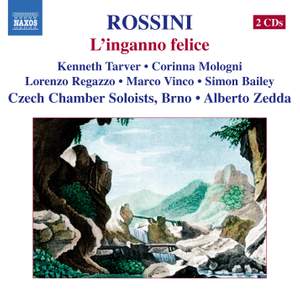


Rossini: L'inganno felice
Kenneth Tarver, Corinna Mologni, Lorenzo Regazzo, Marco Vinco & Simon Bailey
Czech Chamber Soloists, Brno, Alberto Zedda
2 CDs
$24.00Downloads
What are FLAC and MP3?Contents
Rossini: L'inganno felice, Scene 1
- Kenneth Tarver, Corinna Mologni, Lorenzo Regazzo, Marco Vinco, Simon Bailey, Czech Chamber Soloists, Brno, Alberto Zedda, Kenneth Tarver, Corinna Mologni, Lorenzo Regazzo, Marco Vinco, Simon Bailey
- Czech Chamber Soloists, Brno
- Alberto Zedda
Introduction
Rossini: L'inganno felice, Scene 2
- Kenneth Tarver, Corinna Mologni, Lorenzo Regazzo, Marco Vinco, Simon Bailey, Czech Chamber Soloists, Brno, Alberto Zedda, Kenneth Tarver, Corinna Mologni, Lorenzo Regazzo, Marco Vinco, Simon Bailey
- Czech Chamber Soloists, Brno
- Alberto Zedda
Cosa dite! Ma cosa dite! (Tarabotto, Isabella)
Rossini: L'inganno felice, Scene 3
- Kenneth Tarver, Corinna Mologni, Lorenzo Regazzo, Marco Vinco, Simon Bailey, Czech Chamber Soloists, Brno, Alberto Zedda, Kenneth Tarver, Corinna Mologni, Lorenzo Regazzo, Marco Vinco, Simon Bailey
- Czech Chamber Soloists, Brno
- Alberto Zedda
Ebben, che ascondi a Tarabatto? (Isabella, Tarabotto)
Rossini: L'inganno felice, Scene 4
- Kenneth Tarver, Corinna Mologni, Lorenzo Regazzo, Marco Vinco, Simon Bailey, Czech Chamber Soloists, Brno, Alberto Zedda, Kenneth Tarver, Corinna Mologni, Lorenzo Regazzo, Marco Vinco, Simon Bailey
- Czech Chamber Soloists, Brno
- Alberto Zedda
Qual tenero diletto (Bertrando)
Rossini: L'inganno felice, Scene 5
- Kenneth Tarver, Corinna Mologni, Lorenzo Regazzo, Marco Vinco, Simon Bailey, Czech Chamber Soloists, Brno, Alberto Zedda, Kenneth Tarver, Corinna Mologni, Lorenzo Regazzo, Marco Vinco, Simon Bailey
- Czech Chamber Soloists, Brno
- Alberto Zedda
Ebben, che tenta il Duca mio vivino? (Bertrando, Ormondo, Batone, Tarabotto, Isabella)
Rossini: L'inganno felice, Scene 6
- Kenneth Tarver, Corinna Mologni, Lorenzo Regazzo, Marco Vinco, Simon Bailey, Czech Chamber Soloists, Brno, Alberto Zedda, Kenneth Tarver, Corinna Mologni, Lorenzo Regazzo, Marco Vinco, Simon Bailey
- Czech Chamber Soloists, Brno
- Alberto Zedda
Una voce m'ha colpito (Batone)
Rossini: L'inganno felice, Scene 7
- Kenneth Tarver, Corinna Mologni, Lorenzo Regazzo, Marco Vinco, Simon Bailey, Czech Chamber Soloists, Brno, Alberto Zedda, Kenneth Tarver, Corinna Mologni, Lorenzo Regazzo, Marco Vinco, Simon Bailey
- Czech Chamber Soloists, Brno
- Alberto Zedda
Egli resto indeciso (Isabella, Tarabotto, Bertrando)
Rossini: L'inganno felice, Scene 8
- Kenneth Tarver, Corinna Mologni, Lorenzo Regazzo, Marco Vinco, Simon Bailey, Czech Chamber Soloists, Brno, Alberto Zedda, Kenneth Tarver, Corinna Mologni, Lorenzo Regazzo, Marco Vinco, Simon Bailey
- Czech Chamber Soloists, Brno
- Alberto Zedda
Quel sembiante, quello sguardo (Tarabotto, Isabella, Bertrando)
Rossini: L'inganno felice, Scene 9
- Kenneth Tarver, Corinna Mologni, Lorenzo Regazzo, Marco Vinco, Simon Bailey, Czech Chamber Soloists, Brno, Alberto Zedda, Kenneth Tarver, Corinna Mologni, Lorenzo Regazzo, Marco Vinco, Simon Bailey
- Czech Chamber Soloists, Brno
- Alberto Zedda
Oh, l'impressione e fatta, e sembra in bene! (Tarabotto, Bertrando, Ormondo)
Rossini: L'inganno felice, Scene 10
- Kenneth Tarver, Corinna Mologni, Lorenzo Regazzo, Marco Vinco, Simon Bailey, Czech Chamber Soloists, Brno, Alberto Zedda, Kenneth Tarver, Corinna Mologni, Lorenzo Regazzo, Marco Vinco, Simon Bailey
- Czech Chamber Soloists, Brno
- Alberto Zedda
Tu mi conosci e sai (Ormondo)