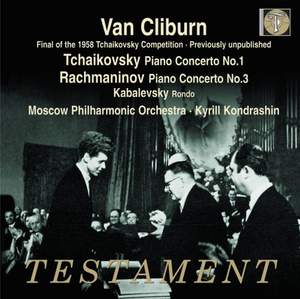
1958 was a red-letter year not only in music competition history but in the entire history of performance. In that year the USSR established the first International Tchaikovsky Competition as a showcase for its own imperial talent. Once again the USSR would demonstrate that in the sphere of great romantic piano playing (one extending from Anton Rubinstein to Richter and Gilels) they had no equals. Summoning the finest pianists and jurors they prepared for a foregone victory followed by international acclaim. But neither they nor anyone else could have expected the gauntlet thrown down by a twenty-four-year-old 6’ 4’’ blond Texan pianist called Van Cliburn. Viewed with suspicion, Cliburn’s nationality invited hostility. This was the time of the cold war and the very real possiblity of a nuclear Armageddon as the USSR and America viewed each other across a seemingly unbridgeable chasm. Pre-conceived notions of American, Juilliard-trained pianists were in the air, of a crew-cut school expressed in broken-glass sound. So that Cliburn’s performances, characterised by broad tempi, rare poetic rhapsody and freedom captured in massive and delicate tone, came like a bolt out of the blue. All possible animosity turned to awe and amazement as Cliburn’s outsize audience listened to a pianist ‘more Russian than the Russians’, one who played their own music with a rare emotional warmth and charisma. Suddenly Cliburn, an outsider from alien territory, became their beloved ‘Vanushka’, the stage and dressing-room littered with gifts and flowers. Cliburn arrived in Moscow with three suitcases and left with seventeen. Later, when both jury and audience had recovered, their comments came thick and fast and this Testament release will surely re-ignite not a controversy but a unique triumph and occasion. Sviatoslav Richter, happily oblivious to competition protocol, gave Cliburn a hundred marks, his competitors zero, remarking, ‘he is a pianist, the others are not’. Shostakovich joined in the chorus of praise and Irina Zaritskaya (herself a major prize-winner, taking second place to Maurizio Pollini in the 1960 Chopin Competition in Warsaw) spoke with a special eloquence of Cliburn’s unique quality. “For we Russians his way with Tchaikovsky and Rachmaninov in particular was uncanny. Such grandeur, romantic warmth and empathy. He came close to sentimentality, but he never quite crossed the line. His playing had an extraordinary nobility. You can’t even imagine the furore he caused and his playing is still endlessly discussed in Russia today.” Extract from the note © Bryce Morrison, 2008