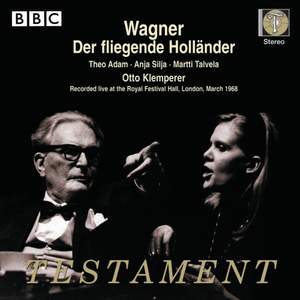
Wagner: Der fliegende Holländer

Testament: SBT21423

Prices shown exclude VAT. (UK tax is not payable for deliveries to United States.)
See Terms & Conditions for p&p rates.
Wagner: Der fliegende Holländer

Awards:

Gramophone Magazine

Disc of the Month - October 2008

Label:

Testament

Catalogue No:

SBT21423
(SBT2 1423)

Discs:

2

Release date:

7th July 2008

Barcode:

0749677142322

Medium:

CD
| Share

Wagner: Der fliegende Holländer

Recorded on 19 March 1968 at the Royal Festival Hall, London


Theo Adam, Anja Silja, Martti Talvela, James King, Kenneth Macdonald & Annelies Burmeister

BBC Chorus & New Philharmonia Orchestra, Otto Klemperer

CD - 2 discs

$31.25

Usually despatched in 4 - 5 working days.

Klemperer, recalled Anja Silja in 2008, “was always flirting, even at the Festival Hall concert – perhaps that was why many people who came to see it said that I was smiling and laughing so much. Or maybe it was because he made his long, slow entry on to the podium leaning on me – he was very heavy and it must have taken about five minutes to get there”. She was amused, however, that when it came to “the serious business of music, he forgot all about women”. She found the concert “a much more intense experience – also because we had James King there”. From the recording sessions she remembers that they had to retake the Holländer/Senta duet “about six times because Klemperer always stamped loudly at some point or did something else that made noise that in those days couldn’t be edited out”. A visitor to rehearsals was George Szell. Klemperer addressed him as “young man” (he was 11 years Klemperer’s junior), presented Silja to him as “my fiancée” and, doubtless to impress Szell, conducted a whole rehearsal standing up, something he then normally never did. Anja Silja’s début as Senta had been, famously, replacing Leonie Rysanek at Bayreuth in 1960 (she was just 20), and followed her summoning to an audition on the Wiesbaden stage accompanied by Bayreuth’s current Holländer maestro Wolfgang Sawallisch and attended, at first secretly, by Wieland Wagner. Although Silja had known about the role since the age of 10, instructed by her opera-loving (and amateur singing) grandfather, “it was the only role by Wagner that I had never studied because I didn’t like it”. Wieland was intrigued by what he heard and saw of Silja but took some time before writing to Sawallisch: “I’ve thought this matter through again really thoroughly: we should risk it with your Lolita. It’s true that her timbre is neither sensational nor of ‘international’ star quality but she’d fit the staging like a glove…”. Despite this auspicious start, Silja always felt ambivalent about Senta. “It’s definitely the first Wagner part you give up – it’s a ‘ wischenfach’ role between all the voices: there’s coloratura, then there’s very quiet and very low singing”. There was a world of difference between the swift, light tempi of a Holländer under Wolfgang Sawallisch – he was one of the ‘Latin maestros’ that Wieland so favoured in his desire to rid Bayreuth of excessive traditional German baggage – and the ‘much slower’ tempi of vintage Klemperer. “Yes”, remembers Silja, “it was very different to what I was used to but I feel nowadays that I like it better – there’s more substance”. The Observer of March 1968, in its review of the concert, obviously agreed: “From the opening bars of the overture, one was plunged into a world where man was at the mercy of wind and water, and against this tumultuous background there unfolded a story, not of cosy sentimentality and true love, but of an obsessive and selfdestructive passion that can only be consummated in annihilation”.

Extract from the booklet note Mike Ashman, 2008

Gramophone Classical Music Guide

2010

“Thanks to Testament, we now have the Royal Festival Hall performance, as broadcast by the BBC, to put alongside the Abbey Road recording (above – made by EMI at the same period) which might be justifiably deemed one of two or three great readings of the score on CD.
The two main characters are taken by the same singers, Theo Adam and Anja Silja. Martti Talvela and Annelies Burmeister can also be heard on both sets. The main difference is in the tenor department. James King, rather than Ernst Kozub, would probably have sung Erik in the studio if Decca had been willing to release him, and although this is a notoriously unrewarding part – especially when it has to be acted as well as sung – King's distinctive tonal combination of purity and weight was certainly a bonus in the Festival Hall, just as Kenneth Macdonald makes a fine Steersman. The most remarkable aspect of the performance nevertheless remains the empathy between Klemperer, Silja and Adam. Adam's Act 1 monologue seizes the dramatic high ground, but Silja raises the stakes still further with an electrifying account of Senta's Ballad, and the long duet which ends Act 2 has rarely been as intense and eloquent as it is here.
Live performance always brings risks: there is a split brass note early in Act 1, and Talvela loses his way briefly a little later on. But Klemperer's love of the music's raw edges and robust rhythms is evident throughout. Even at the stately tempo he adopts the Act 3 sailor's dance is so strongly projected that the tension never sags for a moment, and Klemperer's eccentric devotion to the threeact version of the score is far less damaging than it would be in a performance of lower voltage.
The recorded sound also comes up pretty well in this remastering. This extraordinarily 'live' reading of Wagner's windswept score now has the edge, even over the admirable studio alternative.”

Gramophone Magazine

October 2008

“The most remarkable aspect of the performance… remains the empathy between Klemperer, Silja and Adam. Adam's Act 1 monologue seizes the dramatic high ground, but Silja raises the stakes still further with an electrifying account of Senta's Ballad, ad the long duet which ends Act 2 has rarely been as intense and eloquent as it is here.”

Click here for alternative recordings of this work.

Copyright © 2002-13 Presto Classical Limited, all rights reserved.