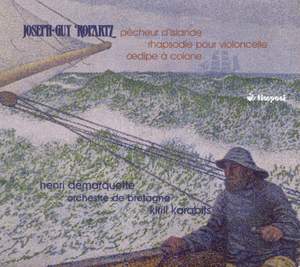


Ropartz: Pecheur d'Islande and Other Works
Henri Demarquette (cello)
Orchestre de Bretagne, Kirill Karabits
Literature, the sea and Brittany were recurrent sources of inspiration throughout the life of Joseph-Guy Ropartz. Like Bax, he had been a poet in his twenties but for Pêcheur d'Islande ('Iceland... — More…
CD
$15.75Downloads
What are FLAC and MP3?Contents
Ropartz: Pêcheur d’Islande
Work length6:03
$1.00
$1.30
- Bretagne Orchestra
- Kirill Karabits
I. La Mer d'islande
Track length6:03
$1.00
$1.30
Ropartz: Pecheur d'Islande, II. Scene d'amour
Work length6:24
$1.00
$1.30
- Bretagne Orchestra
- Kirill Karabits
Ropartz: Pêcheur d’Islande
Work length8:03
$2.00
$2.60
- Bretagne Orchestra
- Kirill Karabits
III. Les Danses
Track length8:03
$2.00
$2.60
Ropartz: Rhapsodie pour violoncelle
Work length11:38
$3.00
$3.85
- Henri Demarquette
- Bretagne Orchestra
- Kirill Karabits
Ropartz: Oedipe a Colonne, Act I
Work length5:55
$1.00
$1.30
- Bretagne Orchestra
- Kirill Karabits
Prelude
Track length5:55
$1.00
$1.30
Ropartz: Oedipe a Colonne
Work length2:26
$1.00
$1.30
- Bretagne Orchestra
- Kirill Karabits
Entree de Thesee
Track length2:26
$1.00
$1.30
Ropartz: Oedipe a Colonne, Act II
Work length7:52
$2.00
$2.60
- Bretagne Orchestra
- Kirill Karabits
Prelude
Track length7:52
$2.00
$2.60
Ropartz: Oedipe a Colonne
Work length4:21
$1.00
$1.30
- Bretagne Orchestra
- Kirill Karabits
Lamento
Track length4:21
$1.00
$1.30
Ropartz: Oedipe a Colonne, Act III
Work length3:42
$1.00
$1.30
- Bretagne Orchestra
- Kirill Karabits
Prelude
Track length3:42
$1.00
$1.30