

In stock - usually despatched within 1 working day.
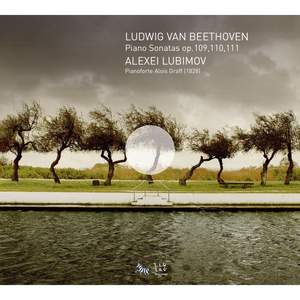
Alexei Lubimov’s 2010 disc of Impromptus by Schubert was praised in the press. During the same recording session in Haarlem in July 2009, Alexei Lubimov continued with the last three sonatas of Beethoven, Beethoven’s musical testimony which he plays with all the mastery of a great russian pianist, "a kind of russian Pollini" (Alain Lompech, Diapason).
“They must be played ‘uncomfortably’, ‘intangibly’; nothing in them reveals itself, nothing ‘plays itself’, and one must take enormous pains to ‘elucidate’ the text for oneself… these sonatas are divorced from the keyboard instrument itself… as if the musical content of these sonatas ‘disregards’ the instrument to hand, overcoming its material nature and its historical characteristics… I felt still more strongly how astonishing, how unusual the compositional material is and how tenaciously Beethoven seeks to consolidate, extend, and transform for his own idiosyncratic purposes the forms and structural principles he inherited from his predecessors.” Alexei Lubimov
Alexei Lubimov belongs both to the great Russian tradition of pianists such as Richter and Gilels (he was the one of the last pupils of Heinrich Neuhaus in Moscow) and to the generation of Early Music pioneers that includes Gustav Leonhardt and the Kuijken brothers. He is also a leading interpreter of such modern composers as Denisov, Schnittke, Silvestrov and Arvo Pärt.
With this triple cultural background, Alexei Lubimov has pursued an exceptional international career. In 1968 he was in Brussels to play Denisov when he met the Kuijkens. He gave the first performances in the USSR of John Cage and Terry Riley. In the 1970s he founded the Moscow Baroque Quartet, the first Soviet ensemble of its kind, with which he rediscovered the Baroque repertoire on period instruments. This was followed in the 1980s by the creation of the avant-garde Alternativa festival in Moscow and a modern and historical keyboard class at the Moscow Conservatory. Alexei Lubimov is also professor of fortepiano at the Salzburg Mozarteum.
Piano Sonata No.30 in E major, Op.109: I. Vivace, ma non troppo - II. Prestissimo
Piano Sonata No.30 in E major, Op.109: III. Gesangvoll, mit innigster Empfindung. Andnate molto cantabile ed espressivo
Piano Sonata No.31 in A flat major, Op.110: I. Moderato cantabile molto espressivo
Piano Sonata No.31 in A flat major, Op.110: II. Allegro molto
Piano Sonata No.31 in A flat major, Op.110: III. Adagio, ma non troppo
Piano Sonata No.31 in A flat major, Op.110: IV. Fuga. Allegro, ma non troppo
Piano Sonata No.32 in C minor, Op.111: I. Maestoso - Allegro con brio ed appassionato
Piano Sonata No.32 in C minor, Op.111: II. Arietta. Adagio molto semplice e cantabile
Ludwig van Beethoven: Piano Sonata No. 31 in A flat major, Op. 110
I. Moderato cantabile molto espressivo
II. Allegro molto
III. Adagio ma non troppo
III. Fuga: Allegro ma non troppo
Ludwig van Beethoven: Piano Sonata No. 32 in C minor, Op. 111
I. Maestoso - Allegro con brio ed appassionato
II. Arietta: Adagio molto semplice e cantabile
19th February 2011
*****
“The challenges may be forbidding but the rewards are huge...He has clearly thought long and hard about this music: without softening its strange juxtapositions and impulses, he makes sense of Beethoven’s elusive logic, and thus captures each sonata’s integrity and greatness. His magisterial grasp of the Op.110 finale is especially impressive”
24th February 2011
*****
“Lubimov uses an instrument made two years after Beethoven's death because of the tonal range it offers, and he exploits those keyboard colours, the evenness of the tone and the articulacy of its lower registers quite wonderfully, allowing him to shape his playing without a trace of self-consciousness. It's a totally enthralling disc.”
April 2011
“Lubimov's masterly pacing of the last three pages of [Op. 110] is the most convincing that I have ever heard...[in Op. 111] the changes of register and the subtle colourism seem to transport us to another world - and with trills that would make even Michelangeli envious. In short, I recommend this disc very highly. It ranks with the finest accounts of these sonatas on any instrument.”
The Independent on Sunday
10th April 2011
“The percussive delicacy of his 1828 Graf fortepiano emphasises the curious mixture of playfulness and reverence in the E major Sonata, while embracing the A flat Sonata's symphonic ambition. In the C minor Sonata, heart and mind are torn between the gravity of the work and the beauty of Lubimov's musicianship. A thrilling dilemma.”
May 2011
*****
“You may disagree with details of his performances, but there's no mistaking his intelligence, or the mastery of his pianism...These rewarding and thought-provoking performances have been very well recorded by Zig-Zag Territoires.”
Click on any of the works listed above for alternative recordings.