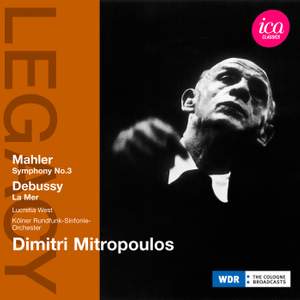


Dimitri Mitropoulos conducts Debussy & Mahler
Lucretia West (contralto)
Kölner Rundfunk-Sinfonie-Orchester, Dimitri Mitropoulos
These performances, taken from 1960 radio broadcasts, were the last Mitropoulos gave. During the symphony’s huge first movement, he suffered a heart attack; and, though he went on conducting,... — More…
2 CDs
$25.75Downloads
What are FLAC and MP3?Contents
Mahler: Symphony No. 3
Work length1:34:28
Album only
Album only
- Lucretia West (mezzo-soprano)
- Knaben des Kölner Domchores, Cologne Radio Chorus, female section, WDR Sinfonieorchester Köln
- Dimitri Mitropoulos
I. Kraftig - Entschieden
Track length34:23
Album only
Album only
II. Tempo di menuetto. Sehr massig
Track length9:10
$2.00
$2.60
III. Comodo. Scherzando. Ohne Hast
Track length15:37
$4.00
$5.15
IV. Sehr langsam. Misterioso
Track length9:22
$2.00
$2.60
V. Lustig im Tempo und keck im Ausdruck
Track length5:09
$1.00
$1.30
VI. Langsam. Ruhevoll. Empfunden
Track length20:47
Album only
Album only
Debussy: La Mer
Work length22:16
$5.00
$6.50
- WDR Sinfonieorchester Köln
- Dimitri Mitropoulos
No. 1, De l'aube a midi sur la mer
Track length7:48
$2.00
$2.60
No. 2, Jeux de vagues
Track length6:08
$1.00
$1.30
No. 3, Dialogue du vent et de la mer
Track length8:20
$2.00
$2.60
Dimitri Mitropoulos addresses the Cologne Radio Symphony Orchestra (1950s)
Work length0:59
$1.00
$1.30
- Dimitri Mitropoulos (narrator)