

In stock - usually despatched within 1 working day.
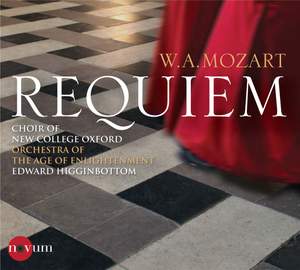
This distinctive recording of Mozart’s last great work can claim to be unique in two defining ways: the use of soloists drawn from the chorus, as in Mozart’s day – including young male singers for the soprano and alto solos – combined with a period orchestra. These are not idle historical gestures. The contemporary virtues of this approach are consistency in the sound-world between chorus and solo ensemble, and homogeneity of style between period ensemble (here the superlative Orchestra of the Age of Enlightenment) and period chorus.
The musical text employed is Süssmayr’s completion of Mozart’s unfinished score – what Christoph Wolff has called ‘the only document that represents the genuine musical truth of the unfinished work’.
Wolfgang Amadeus Mozart: Requiem in D minor, K. 626
Sequence No. 4: Recordare, Jesu pie (Soprano, Mezzo-soprano, Tenor, Baritone)
Sequence No. 5: Confutatis maledictis (Chorus)
Sequence No. 6: Lacrimosa dies illa (Chorus)
Offertory No. 1: Domine Jesu Christe (Chorus)
Offertory No. 2: Hostias et preces (Chorus)
Sanctus (Chorus)
Benedictus (Soprano, Mezzo-soprano, Tenor, Baritone)
Agnus Dei (Chorus)
Communion: Lux aeterna (Soprano, Chorus)
October 2011
“The two boy soloists acquit themselves admirably, with barely a hint of vulnerability in exposed moments such as the "Te decet hymnus" or the "Recordare", and combine well with the two men to create a more truthfully "ecclesiastical" sound than is often the case with starrier projects. The choir is full-throated and admirably secure.”
17th June 2011
***
“Edward Higginbottom has opted to ignore the plethora of more recent completions in favour of Süssmayr's "official" version, his faithfulness extending to drawing individual soloists from the choir, even using male voices for the higher parts. It's an interesting exercise which perhaps pays greatest dividends in the "Benedictus" section employing just the quartet of soloists.”
Click here for alternative recordings of this work.