Prices shown exclude VAT. (UK tax is not payable for deliveries to United States.) See Terms & Conditions for p&p rates. | |  | Beethoven - Symphony No. 4
The concert which Karajan and the Berlin Philharmonic gave in London’s Royal Festival Hall on the evening of Saturday 27 April 1985 was their first in England for four years. In May 1981 they had played Bruckner’s Fifth Symphony in the Royal Festival Hall and given an unforgettable concert of music by Bach, Mozart and Richard Strauss in Oxford’s Sheldonian Theatre. London had not been included in the orchestra’s itinerary in its centenary year in 1982 and for much of 1983-84 Karajan and the orchestra had barely been on speaking terms. Since the centenary year had been something of a high water mark in this hitherto sensationally successful 27-year partnership, the breakdown in relations came as something of a shock to the musical world. There were times in 1984 when it looked as if the two parties would go their separate ways; finally, a reconciliation was effected in the late summer of that year ahead of a scheduled tour of Japan and South Korea. The Krach was ostensibly over the appointment of a new clarinettist but there were other factors too, not least Karajan’s advancing years and stirrings among a contingent of mainly younger players keen to assert their independence and exploit the financial strength which the orchestra’s sky-high reputation now conferred on them. Throughout his life, Karajan had been noted for his extraordinary mental and physical prowess. Now in his mid-70s, he was troubled by a painful and ultimately irreversible spinal condition that had nearly cost him his life in the winter of 1975-76. He had soldiered on but even his energies were finite. In April 1985, he had invited Klaus Tennstedt to share the conducting burden at the Salzburg Easter Festival. ‘It was good to have Karajan and the Berlin Philharmonic, happily reunited after a prolonged disagreement, pay their first visit to the Festival Hall – an event said to have caused prices of black market tickets to reach astronomical heights,’ wrote Peter Stadlen in the Daily Telegraph. The audience was clearly shocked to see how frail Karajan had become as he edged towards the rostrum. (He himself likened his experience of walking unaided in his later years to stepping on sheet ice.) The Times reported a slight stumble in the advance, at which point ‘the applause hiccupped in a breathless unison’. Yet once settled on the podium, Karajan was, as ever, fully in control, master of all he surveyed. Extract from the booklet note © Richard Osborne, 2008 “For anyone lucky enough to have secured a ticket few orchestral concerts have remained so vividly in the memory as the one given by Karajan's incomparable Berlin Philharmonic in London's Royal Festival Hall on April 27, 1985. The surprises began with the conductor's own physical frailty. Edging unsteadily towards the rostrum and propping himself up against the railing, he adopted the peculiar posture that enabled him to remain upright and in command notwithstanding a debilitating spinal condition. In truth the Beethoven was and is a gift to his many detractors. With the maestro unwilling or unable to lift his arms, the band turns in its patented imitation of a gramophone record. Surfaces are immaculate but it's like being trapped in a pudding without air in the texture. Phrases, even whole sections glide by with no intake of breath and the first two movements in particular may induce feelings of claustrophobia in younger listeners. They should persevere. No superlatives can convey the inevitability, conviction and sweep of Karajan's Heldenleben which makes even this notoriously shrill-sounding venue resound in glory. The original BBC sound team of producer Misha Donat and balance engineer John McCulloch capture a paradoxical sonority, rich yet transparent, 'lambent in its beauty, never cloying or opaque' as described by Richard Osborne in his characteristically generous booklet-notes. The battle scene may be slow but was it ever more incisively chronicled? The Strauss at least is indispensable.” Gramophone Classical Music Guide, 2010 “Karajan's Beethoven Fourth was recorded when the Berlin Philharmonic came to London in 1985. Its excellent speaks for itself and the coupling is equally memorable.” Penguin Guide, 2011 edition | | | In stock - usually despatched within 1 working day. |
|
|
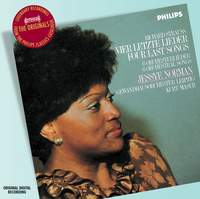
| |  | R.Strauss - Vier letzte Lieder and Other Lieder
“[Norman is] grand, impassioned, noble, dignified, unmannered in this unforgettable interpretation” Gramophone Magazine | | | In stock - usually despatched within 1 working day. |
|
|
| |  | Directed by Götz Friedrich
Subtitles: German/English/French/Spanish/Chinese “Stratas's sinuous child-woman comes close to the ideal in Friedrich's glitzy but unnerving film, strongly cast throughout and superbly conducted.” BBC Music Magazine, August 2007 **** “Götz Friedrich's Vienna studio film of Strauss's spooky study of necrophiliac lust (and much else) created quite a stir when it was first shown on TV more than 30 years ago. It has dated badly – largely on account of the porn-shop leather costumes (Jan Skalický), the director's then inexperience in film and penchant for phallic imagery, and Gerd Staub's plexiglass scenery. The 'Carry On Cappadocia' atmosphere is not improved by Salome's clumsily choreographed and over-veiled dance, which Terry Scott would at least have made funny. At the start of her international career, Teresa Stratas's poor German, aurally evident struggle (even in overdubs) with a part that was in real terms much too heavy for her, and overdone gesturing get in the way of her normally matchless acting. She (and Friedrich) never find the fey terror lurking behind the readings of Welitsch or Cebotari. Weikl sounds well but, when the camera's not looking salaciously at his legs, he seems lost. The star performers here are the veterans who, one suspects, do brilliantly what they've always done: Beirer's unnervingly sympathetic Herod, and Varnay's horrific Herodias (look at her eyes as she watches her daughter dance or backs her demand for Jokanaan's head) – every inch a vicious queen. Böhm and the orchestra are, of course, ducks to water in this score but their reward is an unexceptional and rather squeezed sound picture. No extras are offered but there is a readable retrospective essay by Friedrich.” Gramophone Classical Music Guide, 2010 “It is now almost certainly the best Salome either on CD or DVD...Stratas really looks the part as well as singing it...Above all, Gotz Friedrich's production evokes the atmosphere and dramatic intensity of Strauss's opera” Penguin Guide, 2011 edition “The Unitel production of Richard Strauss’ Salome is the most extraordinary instance of televised opera I’ve ever encountered” Washington Post | | | In stock - usually despatched within 1 working day. |
|
|
| |  |
Gwyneth Jones (Marschallin), Brigitte Fassbaender (Octavian), Lucia Popp (Sophie), Manfred Jungwirth (Baron Ochs), Benno Kusche (Faninal), Francisco Araiza (Italian Singer), Anneliese Waas (Marianne Leitmetzerin), David Thaw (Valzacchi), Gudrun Wewezow (Annina), Albrecht Peter (Polizeikommissar) Orchester der Bayerischen Staatsoper, Carlos Kleiber “Although it is 27 years old, this unforgettable performance has lost nothing of its power to delight eye and ear, and is in almost every way superior to Carlos Kleiber's 1994 remake in Vienna. Schenk's direction is finely judged, strong in detail, in Jürgen Rose's handsome, traditional sets. Eschewing fashionable modernities, its has stood the test of time. Kleiber's reading has that essential mix of warmth and élan the score demands, and a lightness of touch allied to controlled but never effusive sentiment. The Bavarian State Opera Orchestra plays with the brio and confidence gained from long experience of Kleiber's impulsive ways. The shots of the conductor in the pit during the preludes to Acts 1 and 3 show how incisive his beat can be and how much he actually enjoyed conducting the piece. The instinctive interaction of the principal singers is another indication of the rapport achieved in this wonderful staging. The intimacy of the Act 2 dialogues between the Marschallin and Octavian and between Sophie and Octavian, and the interplay among the three in the closing scene of Act 3, is rewarding and deeply moving. In the name part, Fassbaender acts the ardent, impetuous youth to the life, sensual with the Marschallin in Act 1, lovestruck with Sophie in Act 2 and wittily amusing in the Mariandl disguise, the eyes conveying all the character's changes of mood. Nothing is exaggerated, everything rings true in an ideal assumption. Popp conveys all the shy charm called for in the Silver Rose scene, indignation at Ochs's boorish behaviour, and in Act 3 confusion as her emotions are torn apart; she sings with the right blend of purity and sensuousness. Dame Gwyneth, in one of her best roles, looks appealing and girlish in Act 1, and then becomes all dignified authority and resignation in Act 3. She is right inside the role, and suggests all the heartbreak at the end, adapting her large voice throughout to the work's conversational style. Jungwirth is a ripely experienced, echt Viennese Ochs, for the most part avoiding excessive boorishness. Kusche is a tetchy old Faninal, Araiza a mellifluous Italian Tenor. The smaller parts are taken by long-serving members of the Munich company. The picture comes up fresh on DVD and the sound is mostly first-rate, as is the video direction. This is a must-buy.” Gramophone Classical Music Guide, 2010 “Kleiber's conducting is spacious, transparent and warm. Brigitte Fassbaender is ideal as Octavian, Gwyneth Jones a moving Marschallin, Lucia Popp a sweet-voiced if mature Sophie, and Manfred Jungwirth a dignified but funny Ochs.” BBC Music Magazine, October 2005 “Kleiber gets some ravishing sounds from the Vienna Philharmonic, and his reading of the score is as Straussian and as perfect as you are likely to encounter in this world. The sound is very natural and lifelike” Penguin Guide, 2010 edition **** | | | In stock - usually despatched within 1 working day. |
|
|
| |  |
“Hildegard Behrens' voice has rarely sounded so beautiful on record. The Vienna Philharmonic surpass themselves ... this superb recording is unlikely to be matched, let alone surpassed, for many years. Solti himself is inspired throughout.” Penguin Guide, 2010 edition **** “This was the most ambitious project on which Strauss and his librettist Hugo von Hofmannsthal collaborated. It's both fairy tale and allegory with a score that's Wagnerian in its scale and breadth. This Solti version presents the score absolutely complete in an opulent recording that encompasses every detail of the work's multi-faceted orchestration. Nothing escapes his keen eye and ear or that of the Decca engineers. The cast boasts splendid exponents of the two soprano roles. Behrens's vocal acting suggests complete identification with the unsatisfied plight of the Dyer's Wife and her singing has a depth of character to compensate for some tonal wear. Varady gives an intense, poignant account of the Empress's taxing music. The others, though never less thanadequate, leave something to be desired. Domingo sings the Emperor with vigour and strength but evinces little sense of the music's idiom. José van Dam is likewise a vocally impeccable Barak but never penetrates the Dyer's soul. Runkel is a mean, malign Nurse as she should be, though she could be a little more interesting in this part. It benefits from glorious, dedicated playing by the VPO.” Gramophone Classical Music Guide, 2010 | | | (Sorry, download not available in your country) | Usually despatched in 8 - 10 working days. |
|
|
| |
|