Prices shown exclude VAT. (UK tax is not payable for deliveries to United States.) See Terms & Conditions for p&p rates. | |  | Albinoni & Telemann: Oboe Concertos
Han de Vries (oboe), Bob van Asperen (harpsichord), Wouter Möller (cello) Alma Musica Amsterdam | | | In stock - usually despatched within 1 working day. |
|
|
| |  | Albinoni: Oboe Concertos
| | | In stock - usually despatched within 1 working day. |
|
|
| |  | Albinoni: Oboe Concertos
| | | (Sorry, download not available in your country) | Usually despatched in 2 - 3 working days. |
|
|
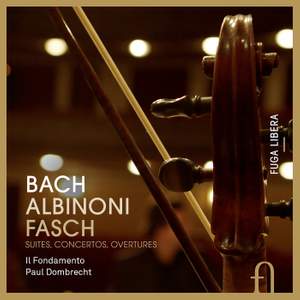
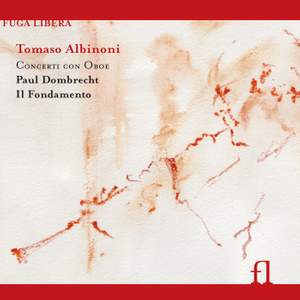
| |  | Albinoni - Concerti con Oboe
The Il Fondamento Ensemble, which was involved in the debut of the Fuga Libera label back in the spring of 2004, is back to celebrate 20 years of existence and the 5th anniversary of the label. Paul Dombrecht, founder of the Ensemble is considered by many to be the baroque oboist of baroque oboists.We encounter him here as a soloist, full of refinement and verve, in a most intriguing programme:Tommaso Albinoni's eight oboe concerti! Those looking for an adagio won't be disappointed, but they will also find numerous fast movements in this new recording, to be enjoyed with the summer sunshine. | | | (also available to download from $10.75) | Usually despatched in 4 - 5 working days. (Available now to download.) |
|
|
| |  |
| | | (Sorry, download not available in your country) | Usually despatched in 2 - 3 working days. |
|
|
| |  |
| | | (Sorry, download not available in your country) | Usually despatched in 2 - 3 working days. |
|
|
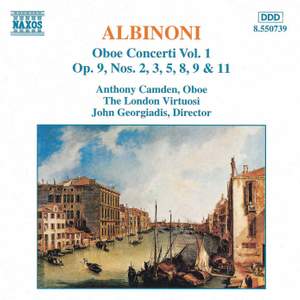
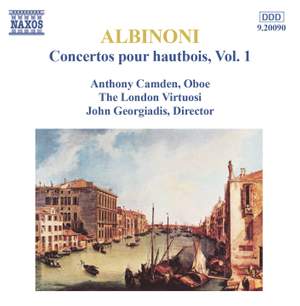
| |  | Albinoni: Oboe Concertos, Vol. 1
Anthony Camden (oboe) London Virtuosi, John Georgiadis “Anthony Camden and Julia Girdwood produce liquid sounds from their modern instruments and are as meltingly expressive in the slow movements as they are light on their feet in the flanking ones.” Gramophone Magazine | | | (also available to download from $6.00) | Usually despatched in 2 - 3 working days. (Available now to download.) |
|
|
| |  | Albinoni: Oboe Concertos
“Albinoni's Op 7 and Op 9 consist of four concertos with (rather than for, as the composer insisted) one oboe, four with two oboes and four for strings only. Overall, the last show a strong family resemblance, with vivacious outer movements and suave slow movements that tend to be more chromatic; but the Op 9 string concertos include a solo violin part, at times very elaborate. The first volume contains the works for solo oboe and strings. Albinoni treats the oboe like a voice and the slow movements have tunes that stay in the mind. The second volume contains the string and doubleoboe concertos. All are three-movement dachiesa works, with cheerful outer movements and slow ones that often remind you that Albinoni wrote a good deal of vocal music. The two oboes 'sing' together for the most part, either in thirds or in unison. The concertos on Vol 3 for two oboes display rather more individuality – the joyous finale of Op 7 No 11 intriguingly sharpens the fourth of the scale, Op 9 No 9 allows the oboes more independence of each other, while in the outer movements of Op 9 No 12 the oboes put up a good pretence at being trumpets. Anthony Robson and Catherine Latham contribute deftly to the spirit of enjoyment that emanates from the whole of this disc. Collegium Musicum 90 is one of the very best Baroque bands around and here the players are in their element. The recorded balance is just right, keeping soloists and strings in equal perspective.” Gramophone Classical Music Guide, 2010 | | | (also available to download from $10.75) | Usually despatched in 2 - 3 working days. (Available now to download.) |
|
|
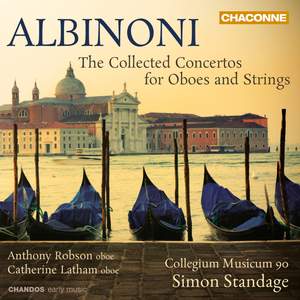
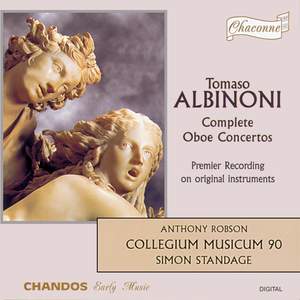
| | .jpg) | Albinoni: Concertos for Oboes and Strings
During the 1990s, Collegium Musicum 90 and Simon Standage released several volumes of Albinoni concertos, which proved popular with critics and public alike. The concertos were released as discs of single oboe concertos, double oboe concertos, and string concertos. In this re-issue on the Chaconne label, the concertos are presented in opus number order, showing the contrasting colours and tonalities of the concertos as they originally appeared. Dating back to the second decade of the eighteenth century, Albinoni’s twenty-four Concerti a cinque, Opp. 7 and 9 – eight for a single oboe, eight for two oboes, and eight for strings alone – were the earliest such works by an Italian composer to be published. Here the oboe functions, in its relationship with the strings, almost like a singer. The fact that the composer entitled these works ‘Concerti con oboe’ (with oboe), not ‘per oboe’ (for oboe), signifies that the strings (and in particular the first violin) play a role nearly as important as the wind instrument. An interesting contrast between the opus numbers can be found within the double oboe concerto form, with those belonging to Op. 7 boasting an almost Vivaldian vigour and much variety in texture, while the later works are consistently larger in scale, and more regular in form. Among string concertos, Op. 9 No. 7 is the most elaborate concerto for solo violin by Albinoni, and Op. 9 No. 10 the last example of its type in the composer’s œuvre. Founded by Simon Standage and the late Richard Hickox, Collegium Musicum 90 has a well-established reputation for its performances of baroque and classical music using period instruments, its repertoire ranging from chamber pieces to large-scale works for choir and orchestra. Under its exclusive contract with Chandos Records, Collegium Musicum 90 has made more than sixty critically acclaimed CDs. The ensemble is joined here by the two oboe soloists Catherine Latham and Anthony Robson. Internationally recognised as a leader in the field of performance on historical oboes, Robson is Principal with both Collegium Musicum 90 and the Orchestra of the Age of Enlightenment. | 
| | | (also available to download from $26.50) | In stock - usually despatched within 1 working day. |
|
|
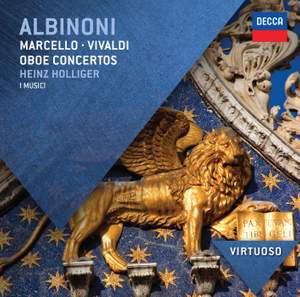
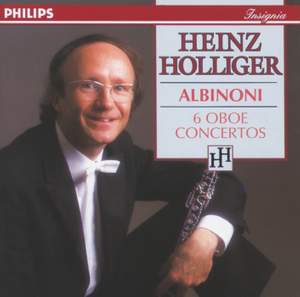
| |  | Holliger - The Baroque Oboe
Albinoni: | Concerto Op. 9 No. 8 for oboe & strings in G minor | Bach, J S: | Oboe Concerto in F major, BWV1053 Oboe Concerto in D minor, BWV1059 Oboe d'amore Concerto in A major, BWV1055 | Benjamin, A: | Concerto in C minor for oboe and strings on themes of Domenico Cimarosa | Lotti: | Concerto for Oboe d'amore and Strings in A | Marcello, A: | Oboe Concerto in D Minor | Sammartini, G: | Concerto for Oboe and Strings in D | Telemann: | Concerto TWV 51:e1 in E minor for oboe, strings & b.c. Concerto TWV 51:d1 in D minor for oboe, strings & b.c. Concerto TWV 51:c1 in C minor for oboe, strings & b.c. Concerto TWV 51:f2 in F minor for oboe, strings & b.c. Concerto TWV 51:D5 in D major for oboe, strings & b.c. |
Heinz Holliger, the Swiss composer and oboist has made a huge contribution to the rediscovery of little known and neglected works for the instrument. He has also been responsible for many new compositions for the oboe, and his repertoire ranges from the baroque as heard on these 3 CDs, through the classical era of Stamitz, Krommer, Hummel, Moscheles, Mozart, Bellini and Fiala to the avant-garde where he has worked closely with Pierre Boulez. The oboe was developed from the medieval Shawn, which was a development of the Arabic instruments that would have been heard by crusaders in the Middle East during the 12th-14th centuries. The earliest ‘modern’ oboes appeared in the 1660s, and it had by this time adopted a more flexible and softer sound making it possible to play together with violins. Its popularity spread from France where these innovations to the instrument took place, to Germany and importantly to centres of musical excellence in Italy – notably Venice where composers such as Lotti, Marcello and Albinoni worked. The Venetian musical scene inspired Bach – he adapted Vivaldi concertos for the keyboard, and Marcello’s concertos may well have provided the inspiration for his own concertos BWV1053/5/9. Booklet essay. Recordings made in 1981, 1982 and 1986. ‘I found plenty of things to enjoy in Holliger’s performances of these oboe concerto reconstructions. His sensibility to Bach’s melodic line together with a formidable technique to sustain it make for playing which is anything but routine – his account of the slow movement of the F major Concerto (BWV1053) is as lyrical as one could wish for’ (Bach) Gramophone, January 1986 ‘I thoroughly enjoyed this LP, especially on account of Holliger’s mastery of his instrument and for the opportunity of hearing three unfamiliar concertos’ (Telemann) Gramophone, May 1983 “Period-instrument purists might find the performing style...rather old-fashioned, but Holliger is so technically impeccable and musically intelligent that such niceties fade into insignificance.” The Guardian, 29th July 2010 **** “There’s a meticulousness about everything [Holliger] does. The tone is sinewy and lean, but exquisitely beautiful, the phrasing charged with the nervous intensity that is his hallmark. It’s good now to be able to relish guiltlessly the warm support of the lush string playing...This is a delightful recital.” Sunday Times, 12th September 2010 | | | In stock - usually despatched within 1 working day. |
|
|
| |
|