Prices shown exclude VAT. (UK tax is not payable for deliveries to United States.) See Terms & Conditions for p&p rates. | |  | Leif Ove Andsnes - Shadows of Silence
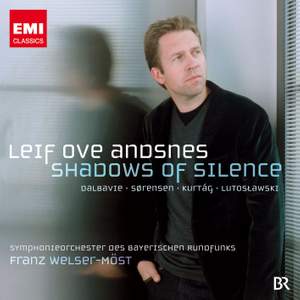
“His enviably natural, unforced clarity and musicianship shine through every bar.” Gramophone Leif Ove Andsnes’s new CD for EMI Classics features performances of some of his favourite contemporary repertoire including world premiere recordings of two 21st century compositions written for him: Bent Sørensen’s The Shadows of Silence for solo piano, and the Piano Concerto by Marc-André Dalbavie. Andsnes also performs Witold Lutoslawski’s Piano Concerto and selections from Játékok (Games) by Gyorgy Kurtág. The Symphonieorchester des Bayerischen Rundfunks and Franz Welser-Möst join Andsnes in the two piano concertos, both recorded live. The Piano Concerto by Marc-André Dalbavie (b. 1961, France) was a co-commission of the BBC Proms, the Cleveland Orchestra and the Chicago Symphony Orchestra. Andsnes performed the world premiere with the BBC Symphony Orchestra/Jukka-Pekka Saraste at the 2005 Proms and subsequently performed the concerto with the Cleveland Orchestra, the Chicago Symphony/David Robertson and the Tokyo Philharmonic/Marc-André Dalbavie. "I love working with him. I love his imagination." says Andsnes of Dalbavie. "He has such a colourful mind and always comes up with interesting thoughts and ideas which are very much reflected in his music. I love how one sound transforms itself into another through a musical chain of events. When he was resident composer in Risør in 2003, it was impressive how Dalbavie had it clear in his mind exactly what he wanted to hear." Preparing for the composition, Dalbavie met with Andsnes several times and heard him in concert often. “I've had a great experience with this pianist, his musicality, and powerful sound. He's both very strong and very soft, which is important to me. His sound is very lyrical, which I wanted to integrate into the concerto, and the lyrical sound of his playing is brought forth through the different materials. When he plays pianissimo, he doesn't make the sound low, but changes its colour. I was very surprised to find a pianist who could play so closely what I thought the music should sound like." Following the performances with the Bayerischer Rundfunk Orchestra, the Abendzeitung wrote, “Pianist Leif Ove Andsnes convincingly played with energy and lyrical sensitivity. (...) the applause was just like after a Tchaikovsky (concerto), with great cheers for the soloist.” The CD’s title work, The Shadows of Silence by the Danish composer Bent Sørensen (b. 1958), was commissioned by Carnegie Hall for performance by Leif Ove Andsnes in his prestigious 2004-2005 “Perspectives” series. "The Shadows of Silence is an engaging and unusually textured piece, filled with hushed, trembling sonorities drawn from the extremes of pitch at both ends of the keyboard. … evocative of an arctic landscape, with glistening watery surfaces stretching across vast spaces. Jagged chords slice through the calm, but there are also impressionistic washes of colour, infinite shades of white. … The music grows ruminative and halting as it drifts into the distance, blurring into silence. Mr. Andsnes played it with immense subtlety.” (The New York Times) Leif Ove Andsnes has said, “I play Shadows of Silence a lot in recitals because I love it so much. … It is very difficult … because [Sørensen] demands that you play the same notes many times, very fast but very soft. … there’s a kind of dreamlike landscape to it, which I really love being in. … There is one thing I have to do which is quite unusual: I have to hum along at the end of the piece. … When I played it in Carnegie Hall for the first time, the artistic administrator … offered me a vocal recital the next time…. which I’m not sure I will accept.” Witold Lutoslawski’s Piano Concerto, composed in 1987-88, is considered the great piano concerto of the second half of the 20th century. In four connected movements, it combines twelve-tone techniques, tonal and polytonal harmonies with hints of Chopin, Ravel, Bach and Eastern European folk music. “With its large, sweeping gestures and dramatic interplay between the soloist and the orchestra, the piano concerto pays homage to this most popular of concert music genres. Yet even while writing a public piece hardly less accessible than the concertos of Prokofiev, Lutoslawski finds ingenious ways to make the music fresh, original and intellectually challenging.” (The New York Times, reviewing a performance by Leif Ove Andsnes with the New York Philharmonic) The Times went on to describe Andsnes’s playing as “commanding, elegant, incisive, rich with wondrous colours and full of imagination.” György Kurtág began his Játékok series (Játékok means Games in Hungarian) in 1973. When he had completed his Opus 7 in 1968, Kurtág had a case of ”writer’s block” and decided to set himself the task of analysing works by other composers such as Beethoven, Bartók, Schubert and Debussy. One result was his ongoing series Játékok, short works for piano solo or piano four hands in which Kurtag comments on the works of these aforementioned composers and on questions that he feels they left behind. The Játékok are witty, understated, informal works in which the composer plays with ideas and familiar sounds in unfamiliar ways. Andsnes has often included the works on his recital programmes and has chosen eight of them for this recording. Leif Ove Andsnes is one of today’s most sought-after performers. During the first half of 2009, he performs the Dalbavie Piano Concerto in Paris and Amsterdam, gives recitals with Heinrich Schiff in Italy and solo recitals in Austria, France, Germany and Luxembourg. He is also preparing an exciting new project entitled Pictures at an Exhibition Reframed, in which he performs the Mussorgsky work alongside the South African visual artist Robin Rhode, who simultaneously creates an onstage installation. The Pictures at an Exhibition Reframed project will be unveiled in November 2009 in New York and will subsequently tour the major European cities before continuing to Beijing and Abu Dhabi in 2010. The development and realisation of the project will be captured on a film made by Norwegian television (commissioning sponsor StatoilHydro) and issued as a CD and DVD by EMI Classics. Leif Ove Andsnes, an exclusive EMI artist for over a dozen years, has won four Gramophone Awards and the 2006 and 2007 Classical Brit Awards. His discography includes a wide variety of repertoire ranging from solo sonatas by Haydn, Chopin, Schubert and Schumann to piano concertos by Grieg, Haydn, Mozart, Brahms, Rachmaninov, Schumann, Shostakovich, Bartók and Britten. He has recorded Schubert Lieder with Ian Bostridge, Bartók Sonatas with Christian Tetzlaff and Brahms and Schumann Piano Quintets with the Artemis Quartet (for Virgin Classics). The Brahms and Schumann Piano Quintets CD won a 2008 Gramophone Award. Also released in 2008 were a CD and DVD, each titled Ballad for Edvard Grieg, commemorating the centenary of the composer’s death (The DVD won the Golden Prague “Grand Prix”) and a second Mozart concertos disc featuring Piano Concertos Nos. 17 & 20 (K453 and K466) in which Leif Ove also conducts the Norwegian Chamber Orchestra. “…this is a notable addition to Andsnes's discography. All his virtues are in display here, from the bravura of his flourishes and crispness of his chordal delivery in the two concertos to the intimacy and sensitivity to the tiniest resonances in the solo pieces.” BBC Music Magazine, April 2009 ***** “Sørensen's music is refined even at its most aggressive, and as such it beautifully complements the eight miniatures from Kurtág's Játékok ("Games") which need only a few seconds to create complex worlds of starkly delineated yet imaginative allusion. ...Andsnes and Welser-Möst give it their all, and in well engineered sound this is a disc which, for the most part, can be cherished for being on the side of the angels, where contemporary repertoire is concerned.” Gramophone Magazine, June 2009 *** The Times, 14th March 2009 “This substantial demonstration of Leif Ove Andsnes's commitment to contemporary composers is framed by two fine Bent Sørensen pieces which underline the programme's governing concern with music that echoes, or shadows, other music. Lullabies is brief but its spirit of troubled nostalgia carries over into The Shadows ofSilence itself. The title may be paradoxical – surely it is sound, not silence, that is being shadowed? – but the music is superbly crafted and powerfully expressive, ranging in mood between fluttering, melancholy reticence and tolling menace. Sørensen's music is refined even at its most aggressive, and as such it beautifully complements the eight miniatures from Kurtág's Játékok (“Games”) which need only a few seconds to create complex worlds of starkly delineated yet imaginative allusion. But the meat of Andsnes's double-decker sandwich is provided by two sizeable concertos, both of which acknowledge the apparent impossibility of escaping from the aura of romantic warhorses that, from Beethoven to Rachmaninov, still provide a staple diet for concert audiences (and record buyers). The Lutoslawski – written for Krystian Zimerman and recorded by him with the composer conducting soon after the premiere – is an intricate tapestry referencing virtuoso and poetic concerto traditions in an ironic yet never cynically exploitative fashion, and Andsnes manages to avoid po-faced downplaying of its parodic aspects while not exaggerating them either. After this, Marc-André Dalbavie's concerto is a disappointment, taking far too long to turn time-honoured pianistic conventions into clichés. But Andsnes and Welser-Möst give it their all, and in well-engineered sound this is a disc which, for the most part, can be cherished for being on the side of the angels, where contemporary repertoire is concerned.” Gramophone Classical Music Guide, 2010 | | | In stock - usually despatched within 1 working day. |
|
|
| |  | Kurtag / JS Bach: Play with Infinity
Jean-Sébastian Dureau & Vincent Planès (piano) Parallel to Játékok (Games), his eight volumes of miniature pieces for piano, György Kurtág also transcribed a number of chorales by Bach for two pianos or four-hand piano. Juxtaposing the Hungarian composer’s original works with his transcriptions entices us to listen beyond all historical and stylistic references. | | | Usually despatched in 2 - 3 working days. |
|
|
| |  | Kurtág: Játékok - Selection 2
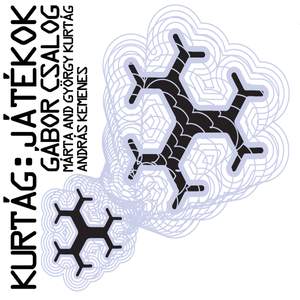
Gábor Csalog (piano), György Kutág (piano), Márta Kurtág (piano), György Kurtág (piano), Alíz Asztalos (piano/speaking voice), András Kemenes (piano) | | | Usually despatched in 4 - 5 working days. |
|
|
| |  | Kurtág: Játékok (excerpts)
Gabor Csalog (piano), András Kemenes (piano), Márta Kurtág (piano), György Kurtág (piano), Ha Neul-Bit (piano), Aliz Asztalos (piano) “Recording a complete edition of György Kurtág's Játékok is no small undertaking: the combined eight volumes comprise myriad pieces of often extreme brevity, with the range of expression traversed similarly all-encompassing. This is music which is poised between the discipline of an exercise and spontaneity of a whim: 'Games' played out as a fruitful interchange between technique and inspiration. A previous recording covered the first four volumes, and the most pleasurable way to encounter this music has hitherto been through the miscellany from György and Márta Kurtág (ECM). Both make brief appearances here, along with other Kurtág protegés, but the bulk of the enterprise is entrusted to Gábor Csalog, his dexterous pianism and scrupulous attention to dynamic nuance being vital components in the success of the disc. The 58 individual pieces are arranged into two parts – 34 and 31 minutes each – that together offer a conspectus of the conceptual and emotional territory explored by this music: a diary in sound with no obvious parallels in its stark directness and vehement honesty. Newcomers could profitably sample an insouciant 'Prelude and Fugue in C' (No 5), the contemplative 'Hommage à Ferenc Berényi' (29), the rediscovery of sound in 'Fundamentals' (44), or a serene rendering of the BWV106 Sinfonia – one of numerous Bach transcriptions that can be integrated into the selection. Vividly realistic sound and pertinent notes, as always from BMC. Further discs are planned, and the complete edition should soon be available for download: iPod-friendly Kurtág could prove a whole new listening experience.” Gramophone Classical Music Guide, 2010 | | | Usually despatched in 4 - 5 working days. |
|
|
| |  | Kurtág: Játékok (excerpts)
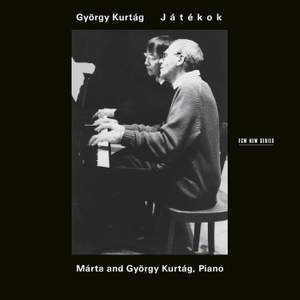
György Kurtág (Piano); Márta Kurtág (Piano) “If any contemporary composer can persuade the musical world that compositions of between 30 seconds and four minutes in length are the natural vehicle for progressive post-tonal music, that composer is Kurtág. This sequence of pieces, the longest of which lasts just over five minutes, offers a very special experience. The disc contains a selection from his ongoing sequence of 'games' (Játékok) for solo piano and piano duet. They're a mixture of studies and tributes, not explicitly pedagogic in Mikrokosmos mode, but ranging widely in technical demands and style, from fugitive fragments, in which even the smallest element tells, to the extraordinary flamboyance of a Perpetuummobile containing nothing but glissandos. Most are sombre in tone, and even the more humorous items have a bitter side. For access to another musical world, Kurtág has included four Bach transcriptions, music whose serenity and confidence speaks immediately of utter remoteness from the real present. The performances risk overprojection but they're supremely characterful, and the close-up recording reinforces the impression of music that's mesmerically persuasive in its imagination and expressiveness.” Gramophone Classical Music Guide, 2010 | | | Usually despatched in 4 - 5 working days. |
|
|
| |  | Kurtág: 80
Budapest Music Center celebrated György Kurtág’s 80th birthday in February 2006 with a five-day series of concerts held in the Budapest Palace of Arts and the Music Academy. Important and rarely played Kurtág works were heard, including Hipartita and Zwiegespräch, then played for the first time in Hungary. | | | This item is currently out of stock at the UK distributor. You may order it now but please be aware that it may be six weeks or more before it can be despatched. |
|
|
| |  | Piano Four Hands - Two Pianos In The Xx Century
Paola Biondi, Debora Brunialti Whether it be a question of metaphysics or simply one of ”physics”, piano writing which multiplies hands and fingers on the keyboard of a piano must necessarily experience a fatal syndrome of splitting and of highly fertile ”uncertainty”. An exceptionally rich and fruitful ”philosophical” doubt, for it is around it that many composers created some of the most vital piano pages in the nineteenth and twentieth centuries. Here thus are Lutoslawski’s prodigious Paganini Variations, Kurtag’s sentimental and visionary Játékok (Games), Ligeti’s Three pieces for two pianos (Monument - Selbsportrait - Bewegung) and Berio’s Linea. Tackling these difficult works are pianists Biondi and Brunialti, forming a solid duo. | | | Usually despatched in 2 - 3 working days. |
|
|
| |  | Haydn: Die Sieben Letzte Worte Unseres Erlosers Am Kreuze
| | | Usually despatched in 2 - 3 working days. |
|
|
| |
|