Chopin: Mazurka No. 58 in A flat major

This page lists all recordings of Mazurka No. 58 in A flat major, by Frédéric François Chopin (1810-49) on CD & download (MP3 & FLAC). Generally, more recent releases are listed first, but with priority given to those that are in stock.

Prices shown exclude VAT. (UK tax is not payable for deliveries to United States.)
See Terms & Conditions for p&p rates.

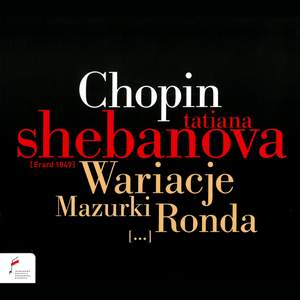
Chopin: Variations, Mazurkas & Rondos

Chopin: Variations, Mazurkas & Rondos


Chopin:

Largo in E flat major, BI 109

Variations brilliantes in B flat major on 'Je Vends des Scapulaires', Op. 12

Rondo a la Mazurka, Op. 5

Rondo in C major for two pianos, Op. 73

Jaroslaw Drzewiecki

Marche Funebre, Op. 72 No. 2

Fugue in A minor

Mazurka No. 56 in B flat major, K.IIa/3

Mazurka No. 58 in A flat major

Mazurka No. 57 in C major

Mazurka No. 55 in G major, K.IIa/2

Moderato in E, KKIVb/12

Variations in D major for 2 pianos

Stanislaw Drzewiecki

Variations in A - Souvenír de paganini

Variations on a March from Bellini's I Puritani

Polonaise No. 16 in G flat major B36/KKIVa:8

Allegretto in F sharp major

Waltz No. 17 in E flat major, Op. post., KKIVa:14, B 46

Wiosna B117


Tatiana Shebanova graduated from the Pyotr Tchaikovsky Conservatory in Moscow with a Gold Medal and is a Grand Prix winner of international music competitions in Prague, Geneva and Brussels. She has led an intensely musical life and, as well as being a soloist, has performed piano duets with her husband and son. She is performing on an Erard 1849 fortepiano.

Frederick Chopin Institute - The Real Chopin - NIFCCD017

(CD)

$17.50

Usually despatched in 2 - 3 working days.

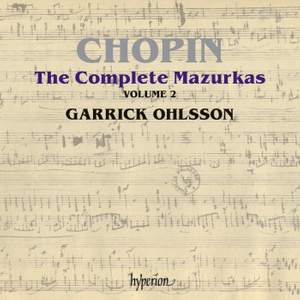
Chopin - The Complete Mazurkas Volume 2

Chopin - The Complete Mazurkas Volume 2


Chopin:

Mazurkas Op. 50 Nos. 1-3

Mazurkas Op. 56 Nos. 1-3

Mazurkas Op. 59 Nos. 1-3

Mazurkas Op. 63 Nos. 1-3

Mazurka No. 50 in A minor 'Notre Temps'

Mazurka No. 51 in A minor 'Émile Gaillard'

Four Mazurkas, Op.67

Mazurkas, Op. 68

Mazurka in B flat major (1832)

Mazurka No. 55 in G major, K.IIa/2

Mazurka No. 54 in D major

Mazurka No. 59 in B flat major, K.IVb/1

Mazurka No. 61 in C major, K.IVb/3

Mazurka No. 58 in A flat major


It has been said that the mazurkas are the soul of Chopin, revealing facets of his personality and emotions more directly than any other of his compositions. Of all the forms in which he wrote throughout his career, Chopin turned most frequently to the mazurka, so that the whole collection forms a kind of musical diary, one in which he could confide his most private thoughts, and which, coincidentally, charts his progress as a composer. His modulations, harmonies and use of counterpoint become (generally) more adventurous with each new set. Some later examples verge on the experimental.

Chopin preserved the various quintessential elements of this Polish folk dance—the sudden changes of emotion, for instance, or the drone bass of the bagpipes—and, as with the waltz, polonaise and nocturne, elevated an established form into the realm of high art. They are startlingly original—even eccentric sometimes—for the form inspired in him a freedom to explore without inhibition. For all their brevity (few last longer than four minutes) and the variations based on a simple ABA structure (sometimes with a coda), these miniatures have the same narrative cohesion and depth as the more extended Ballades.

Volume 2 of the complete mazurkas combines the four late sets of Opp 50, 56, 59 and 63, followed by fifteen individual dances composed between 1826 and 1849. Though Chopin left instructions for them to be destroyed, the two sets published as Opp 67 and 68 were issued after Chopin’s death in 1855 by his friend Julian Fontana with the approval of the composer’s family.

The Op 50 set and the three groups that follow share similar structures: an imposing opening dance succeeded by a simpler one and culminating in a contrapuntal finale. On average, they are longer than the earlier mazurkas with more development and use of counterpoint (Op 50 No 3 in C sharp minor and Op 56 No 3 in C minor, for instance, reflect Chopin’s fondness for Bach and the Well-Tempered Clavier). And are they bagpipes we hear in Op 56 No 2? The set was dedicated to his Scottish pupil Catherine Maberly, a friend of his benefactor Jane Stirling.

If the three mazurkas of Op 59 (1846) are less ambitious in scope, they seem more spontaneous and at ease, yet with some of Chopin’s most daring modulations (No 1 in A minor) and beautiful melodies (No 2 in A flat major). Also present, and not mentioned hitherto, is another element used frequently throughout the mazurkas—the (sometimes obsessive) use of repeated patterns, as in the well-known final mazurka of the set in F sharp minor.

Op 63 was the last set that Chopin published (1847). It is dedicated to the Countess Laura Czosnowska from Warsaw, the flirtatious friend of Chopin’s sister Ludwika. No 1 is certainly vivacious (note a repetitive figure again in the central section). No 3 in C sharp minor is justly celebrated, its poignant melody cleverly worked as a canon in the coda.

Of the Opp 67 and 68 mazurkas, the best are Op 67 No 4 in A minor (composed in 1846) and Op 68 No 4 in F minor, to which Fontana affixed the following: ‘Cette Mazurka est la dernière inspiration que Chopin ait jetée sur le papier peu de temps avant sa mort; il était déjà trop malade pour l’essayer au piano.’ (‘This Mazurka is the last inspiration that Chopin committed to paper shortly before his death; he was already too ill to try it out on the piano.’)

Wilhelm von Lenz recalled in 1872 the experience of hearing Chopin play his mazurkas: ‘There his playing was truly at home; in them resided Chopin’s originality as a pianist.’ Berlioz agreed. As early as December 1833 (in Le Rénovateur), he was aware of this unique style of playing. ‘Virtually nobody but Chopin himself can play his music and give it this unusual turn’ with ‘a thousand nuances … which are impossible to convey by instructions. There are unbelievable details in his Mazurkas; and he has found how to make them doubly interesting by playing them with the utmost degree of softness, piano in the extreme, the hammers merely brushing the strings, so much so that one is tempted to go close to the instrument and put one’s ear to it as if to a concert of sylphs or elves.’

Chopin played his mazurkas with a rubato so free that some took it to be erratic timing. Meyerbeer called on Chopin one day while he was playing the Mazurka Op 63 No 3, took a seat and commented that Chopin was playing in 2/4. No, Chopin insisted, he was playing in 3/4. No, countered Meyerbeer calmly, beating time, it’s in 2/4. Chopin, who normally never raised his voice, is then reported to have screamed in rage at the suggestion he was playing in anything other than strict time. The two composers held their own and, sadly, parted on bad terms. On another occasion some years later, Karl Halle (better known subsequently as Sir Charles Hallé) made the same observation as Meyerbeer, suggesting that a particular mazurka appeared to be written in 4/4. He obviously caught Chopin in a better mood, for while Chopin initially denied that he was playing in 4/4, in the end had to admit that Halle was right, laughing that it was ‘the national character of the dance which created the oddity’.

“Not only does he catch the rhythm, but his feel for nuance and colour misses no element of Chopin’s infinite imagination, and the balance of earthiness and elegance is well-nigh ideal…Ohlsson brings a phenomenal variety of expression and depth of characterisation to these exquisite miniatures - an approach that manages to capture the folk elements of the composer's style to quite hypnotic effect.” BBC Music Magazine, February 2010 *****

Helios - CDH55392

(CD)

$8.75

Usually despatched in 2 - 3 working days.

Chopin - Piano Works

Chopin - Piano Works


Chopin:

Études (12), Op. 10

Études (12), Op. 25

Impromptus Nos. 1-4

Piano Sonata No. 2 in B flat minor, Op. 35 'Marche funèbre'

Piano Sonata No. 3 in B minor, Op. 58

Mazurka No. 54 in D major

Introduction and Variations on a German National Air, Op. post.

Mazurka No. 58 in A flat major

Berceuse in D flat major, Op. 57

Polonaise No. 6 in A flat major, Op. 53 'Héroïque'

Piano Concerto No. 1 in E minor, Op. 11

Piano Concerto No. 2 in F minor, Op. 21

Mazurka No. 44 in C major, Op. 67 No. 3

Mazurka No. 47 in A minor, Op. 68 No. 2

Mazurka No. 5 in B flat major, Op. 7 No. 1


Tamás Vásary (piano)

Berliner Philharmoniker, Jerzy Semkow & Janos Kulka

DG Trio - 4775510

(CD - 3 discs)

$22.50

(Sorry, download not available in your country)

Usually despatched in 2 - 3 working days.

Chopin - Solo Piano Works

Chopin - Solo Piano Works


Chopin:

Preludes (24), Op. 28

Prelude Op. 45 in C sharp minor (No. 25)

Prelude Op. posth. in A flat major (No. 26)

Impromptus Nos. 1-4

Ballades Nos. 1-4

Scherzi Nos. 1-4

Nocturnes Nos. 1-21 (complete)

Études (12), Op. 10

Études (12), Op. 25

Polonaises (16)

Waltzes Nos. 1-19

Mazurkas Nos. 1-51

Mazurka No. 54 in D major

Mazurka No. 55 in G major, K.IIa/2

Mazurka No. 56 in B flat major, K.IIa/3

Mazurka No. 58 in A flat major

Mazurka No. 59 in B flat major, K.IVb/1

Mazurka No. 61 in C major, K.IVb/3

Mazurka No. 63 in A flat major, Op. 7, No. 4 (first version)

Mazurka No. 64 in D major, K.IVa/7

Mazurka No. 49 in F minor, Op. 68 No. 4

revised version

Piano Sonata No. 2 in B flat minor, Op. 35 'Marche funèbre'

Piano Sonata No. 3 in B minor, Op. 58

Fantasia in F minor, Op. 49

Piano Sonata No. 1 in C minor, Op. 4

Introduction and Variations on a German National Air, Op. post.

Rondo in C minor Op. 1

Écossaises (3), Op. 72 No. 3

Rondo a la Mazurka, Op. 5

Marche Funebre, Op. 72 No. 2

Contredanse in G flat major, KKAnh.Ia/4

Rondo in C major, Op. 73

Variations in D major for 2 pianos

with Vovka Ashkenazy (piano)

Variations in A - Souvenír de paganini

Variations brilliantes in B flat major on 'Je Vends des Scapulaires', Op. 12

Rondo in E flat major, Op. 16

Bolero, Op. 19

Cantabile in B Flat Major (Andantino)

Hexaméron KKIIb/2

Largo in E flat major, BI 109

Allegro de Concert in A major Op. 46

Trois Nouvelles Études

Tarantella in A flat major, Op. 43

Fugue in A minor

Albumblatt in E major

Wiosna B117

Two Bourrees B160B

Galop in A flat major 'Marquis', WN 59

Berceuse in D flat major, Op. 57

Barcarolle in F sharp major, Op. 60


Decca Collectors Edition - 4782282

(CD - 13 discs)

$69.50

(Sorry, download not available in your country)

In stock - usually despatched within 1 working day.

Chopin: The Piano Works

Chopin: The Piano Works


Chopin:

Preludes (24), Op. 28

Prelude Op. 45 in C sharp minor (No. 25)

Prelude Op. posth. in A flat major (No. 26)

Impromptus Nos. 1-4

Ballades Nos. 1-4

Scherzi Nos. 1-4

Nocturnes Nos. 1-21 (complete)

Études (12), Op. 10

Études (12), Op. 25

Polonaises (16)

Waltzes Nos. 1-19

Mazurkas Nos. 1-51

Mazurka No. 56 in B flat major, K.IIa/3

Mazurka No. 55 in G major, K.IIa/2

Mazurka No. 58 in A flat major

Mazurka No. 61 in C major, K.IVb/3

Mazurka No. 59 in B flat major, K.IVb/1

Mazurka No. 54 in D major

Mazurka No. 64 in D major, K.IVa/7

Piano Sonata No. 2 in B flat minor, Op. 35 'Marche funèbre'

Piano Sonata No. 3 in B minor, Op. 58

Fantasia in F minor, Op. 49

Piano Sonata No. 1 in C minor, Op. 4

Introduction and Variations on a German National Air, Op. post.

Rondo in C minor Op. 1

Écossaises (3), Op. 72 No. 3

Rondo a la Mazurka, Op. 5

Marche Funebre, Op. 72 No. 2

Contredanse in G flat major, KKAnh.Ia/4

Rondo in C major, Op. 73

Introduction, Theme and Variations on a Theme of Moore

Variations in A - Souvenír de paganini

Variations brilliantes in B flat major on 'Je Vends des Scapulaires', Op. 12

Rondo in E flat major, Op. 16

Bolero, Op. 19

Cantabile in B Flat Major (Andantino)

Hexaméron KKIIb/2

Largo in E flat major, BI 109

Allegro de Concert in A major Op. 46

Trois Nouvelles Études

Tarantella in A flat major, Op. 43

Fugue in A minor

Albumblatt in E major

Wiosna B117

Two Bourrees B160B

Galop in A flat major 'Marquis', WN 59

Berceuse in D flat major, Op. 57

Barcarolle in F sharp major, Op. 60


Decca Collectors Edition - 4437382

(CD - 13 discs)

$104.00

(Sorry, download not available in your country)

Usually despatched in 2 - 3 working days.

The Complete Chopin Edition - 200th anniversary

The Complete Chopin Edition - 200th anniversary


Chopin:

Piano Concerto No. 1 in E minor, Op. 11

Garrick Ohlsson (piano)

Polish Radio National Symphony Orchestra, Jerzy Maksymiuk

Piano Concerto No. 2 in F minor, Op. 21

Garrick Ohlsson (piano)

Polish Radio National Symphony Orchestra, Jerzy Maksymiuk

Fantasia in A major on Polish Airs, Op. 13

Garrick Ohlsson (piano)

Polish Radio National Symphony Orchestra, Jerzy Maksymiuk

Krakowiak - Concert Rondo in F, Op. 14

Garrick Ohlsson (piano)

Polish Radio National Symphony Orchestra, Jerzy Maksymiuk

Variations on Mozart's 'La ci darem la mano' in B flat major, Op. 2

Alexis Weissenberg (piano)

Orchestre de la Société des Concerts du Conservatoire, Stanislaw Skrowacewski

Andante spianato & Grande Polonaise, Op. 22

Alexis Weissenberg (piano)

Orchestre de la Société des Concerts du Conservatoire, Stanislaw Skrowacewski

Mazurkas Nos. 1-51

Ronald Smith (piano)

Mazurka No. 56 in B flat major, K.IIa/3

Ronald Smith (piano)

Mazurka No. 59 in B flat major, K.IVb/1

Ronald Smith (piano)

Mazurka No. 58 in A flat major

Ronald Smith (piano)

Mazurka No. 55 in G major, K.IIa/2

Ronald Smith (piano)

Mazurka No. 54 in D major

Ronald Smith (piano)

Mazurka No. 64 in D major, K.IVa/7

Ronald Smith (piano)

Mazurka No. 61 in C major, K.IVb/3

Ronald Smith (piano)

Preludes (24), Op. 28

Garrick Ohlsson (piano)

Nocturnes Nos. 1-21 (complete)

Garrick Ohlsson (piano)

Polonaises (16)

Garrick Ohlsson (piano)

Andante spianato & Grande Polonaise, Op. 22

Garrick Ohlsson (piano)

Fantasia in F minor, Op. 49

Garrick Ohlsson (piano)

Barcarolle in F sharp major, Op. 60

Garrick Ohlsson (piano)

Variations brilliantes in B flat major on 'Je Vends des Scapulaires', Op. 12

Ronald Smith (piano)

Bolero, Op. 19

Ronald Smith (piano)

Tarantella in A flat major, Op. 43

Ronald Smith (piano)

Écossaises (3), Op. 72 No. 3

Ronald Smith (piano)

Waltzes Nos. 1-19

Augustin Anievas (piano)

Impromptus Nos. 1-4

Augustin Anievas (piano)

Études (12), Op. 10

Andrei Gavrilov (piano)

Études (12), Op. 25

Andrei Gavrilov (piano)

Trois Nouvelles Études

Danielle Laval (piano)

Cantabile in B Flat Major (Andantino)

Tzimon Barto (piano)

Contredanse in G flat major, KKAnh.Ia/4

Tzimon Barto (piano)

Berceuse in D flat major, Op. 57

Daniel Barenboim (piano)

Piano Sonata No. 2 in B flat minor, Op. 35 'Marche funèbre'

Cécile Ousset (piano)

Scherzi Nos. 1-4

Cécile Ousset (piano)

Piano Sonata No. 3 in B minor, Op. 58

Cécile Ousset (piano)

Ballades Nos. 1-4

Cécile Ousset (piano)

Piano Sonata No. 1 in C minor, Op. 4

Leif Ove Andsnes (piano)

Introduction & Variations ‘Der Schweizerbub’ KKIVa/4

Paolo Bordoni (piano)

Variations on a March from Bellini's I Puritani

Paolo Bordoni (piano)

Variations in A - Souvenír de paganini

Daniel Barenboim (piano)

Rondo in C minor Op. 1

Danielle Laval (piano)

Rondo a la Mazurka, Op. 5

Danielle Laval (piano)

Rondo in E flat major, Op. 16

Danielle Laval (piano)

Rondo in C major for two pianos, Op. 73

Danielle Laval (piano), Teresa Llacuna (piano)

Allegro de Concert in A major Op. 46

Claudio Arrau (piano)

Pieóni i piosnki (17) (Seventeen Polish Songs), Op. 74

Eugenia Zareska (soprano), Giorgio Favaretto (piano)

Czary (Charms), KK.IVa/11

Lukas Jakobski (bass), Simon Lepper (piano)

Dumka (Reverie), KK.IVb/9

Lukas Jakobski (bass), Simon Lepper (piano)

Cello Sonata in G minor, Op. 65

Natalie Clein (cello), Charles Owen (piano)

Polonaise brillante Op. 3 for cello & piano

Natalie Clein (cello), Charles Owen (piano)

Grand Duo for Cello and Piano (on themes from Meyerbeer's Robert le Diable)

Andreas Brantelid (cello), Marianna Shirinyan (piano)

Piano Trio in G minor Op. 8

Vilde Frang (violin), Andreas Brantelid (cello), Marianna Shirinyan (piano)

Variations in D major for 2 pianos

Benjamin Grosvenor, Anna Tilbrook (piano)

Marche Funebre, Op. 72 No. 2

Benjamin Grosvenor (piano)

Largo in E flat major, BI 109

Benjamin Grosvenor (piano)

Allegretto in F sharp major

Benjamin Grosvenor (piano)

Wiosna B117

Benjamin Grosvenor (piano)

Waltz No. 18 in E flat major 'Sostenuto', Op. post., KKIVb:10, B 133

Benjamin Grosvenor (piano)

Fugue in A minor

Benjamin Grosvenor (piano)

Albumblatt in E major

Benjamin Grosvenor (piano)

Two Bourrees B160B

Benjamin Grosvenor (piano)

Galop in A flat major 'Marquis', WN 59

Benjamin Grosvenor (piano)


Chopin is universally acclaimed as one of the most original and innovative composers of music for the piano, especially in the romantic and lyrical field. Much of his music is deeply patriotic and infused with a love of his native Poland. 2010 marks the 200th anniversary of the composer’s birth.

Whilst it is well known that Fryderyk Franciszek Chopin, born in 1810, left his native country of Poland for Paris at 21, never to return, it may be interesting to speculate how much he knew about the country of his immediate forefathers before he left. His grandfather, François, came from a peasant-family which had established itself in the Vosges growing vines. It was in Marainville that Chopin’s father, Nicolas, was born in 1771. It was by chance that the landowner was a Polish Count whose Polish steward befriended him and offered him the chance to improve his prospects in Poland. Thus it was, aged 16, he departed intending it only as a temporary visit but a letter home three years later shows that he was staying to avoid conscription in to the Revolutionary army. His life did certainly improve in Poland, first as a clerk and then in the Polish Guard where he rose to the rank of Captain. He became a children’s tutor for aristocratic families where his knowledge of French proved highly valuable. It was in the service of a Count on an estate near Warsaw that he met his wife and Ludwika was born in 1807 followed by Fryderyk three years later on 1st March. The family then moved to Warsaw where Nicolas became the teacher for French language and literature in the new high school. Two further daughters were born of which one died of consumption at the age of 14.

Although his father taught French he increased his reputation by adopting the language and culture of Poland and this dual national inheritance was crucial in forming the young Chopin’s views and future career. When the boy was only five the final defeat of Napoleon meant that Warsaw was to suffer under the oppressive rule of Russia. As with all prodigies Chopin took to music early, even crying with emotion when his mother played the piano or sang to him. At the age of six he was given a thorough basic knowledge of the music of Bach and the Viennese Classics. He seems to have taught himself how to play the piano and his teacher would write down his improvisations for him. His first to be published in 1817 was a polonaise in G minor (CD 8 [2]). It was dedicated to a Countess, the daughter of his godparents and similar such acts gave him access to the aristocratic salons where his father’s native tongue rather than Polish was spoken, being the language of culture. His music also impressed the military commander of the occupying forces, the Tsar’s brother, who arranged for a march of Chopin’s to be orchestrated and played by his band.

Besides his musical education his other studies took place at the high school where his father taught and he obtained his diploma in 1826.

Before that he had taken lessons with Jósef Elsner who, amongst other things, taught him how to write out his own compositions. His first work given an Opus number was the Rondo (CD 13 [8]) which was published in 1825. The Sonata Op. 4 (CD 13 [1]-[4]) followed in 1828 but Chopin’s real interest at this time were the dance forms of the mazurka and polonaise together with the Rondo. With Elsner he also completed his first Nocturne (later published as Op. 72 No. 1, CD 6 [12]). It was in this year that he had first experience of foreign travel when a zoology professor and friend of his father’s, took him to Berlin. On his return journey he was able to try out the first movement of his piano trio with Prince Antonin Radziwill, a cellist; he was to be the dedicatee of the work. He also completed the first two studies of Op. 10 (CD 10 [2&3]).

The Berlin experience clearly whetted Chopin’s appetite for more as Warsaw, under Russian rule, gave him little chance to hear the latest music although there were the occasional visits by Hummel and Paganini.

In July 1829, after completing his final exams at the Conservatory he set off with three friends for Vienna. He wanted to see his publisher, Tobias Haslinger, and it was he who was the mastermind in arranging two concerts for him. These were immensely successful particularly those pieces which allowed his improvisatory skills to shine. He returned home in August via Prague and Dresden.

Although his concerts at home were successful and he was now regarded as a burgeoning national figure he craved the international life which only a move to a major city would bring. In November the following year he returned to Vienna but the succeeding eight months were frustrating. His two concerts were not successful and no more works were published. It was natural for him, with his French ancestry and knowledge, to desire to go to Paris and he eventually arrived there in September 1831.

He quickly established himself and was immediately recognised as a pianist of quality by his fellows including Liszt and Mendelssohn; the famous remark “Hats off, a genius” by Schumann appeared in the Allgemeine musikalische Zeitung that December. The local Parisians were less forthcoming and his concerts were financially not successful; so he limited his performances and found that he was just as able to obtain both fame and fortune by not appearing before the public. He was supported by the aristocracy whose judgements were based more on musicality and not the mere technical wizardry of the spectacular virtuosos who used this for effect whereas the musical content was comparatively limited.

For the next few years he both toured – primarily Germany – and wrote; his compositions of this time included all the dance forms he made famous together with nocturnes, preludes and studies many of them being his popular compositions in those styles. In August 1835 he met his parents for the last time in Karlsbad; they returned to Poland whilst he went on to Dresden where he joined the family whose three sons had been at school with Chopin; one of the daughters, Maria, aged 16, took a fancy to Chopin and, even though there were nine years between them, he did not dismiss the idea of a relationship as he was struck by her youth and beauty. A present of his Waltz “L’Adieu” (Op, 69 No, 1, CD 9 [12]) was made to her on his departure for Leipzig where Mendelssohn introduced him to Schumann and Clara Wieck, whom he regarded as ‘the only woman in Germany who can play my music’. On visiting Heidelberg he became ill – indeed he struggled with ill health throughout his life – and rumours of his death appeared in newspapers in Warsaw. The following year he took up the pursuit of Maria and proposed marriage in September; although the parents liked him their opposition grew probably on the grounds of his health and the engagement was terminated in the summer of 1837.

The keyboard instrument that we now call the piano was undergoing a major part of its development and Chopin, through his friendship with a major manufacturer, Pleyel, was a pivotal influence in this; he and Pleyel came to London and visited John Broadwood, the manufacturer who had supplied Beethoven with a number of pianos.

In late 1836 Liszt introduced Chopin to the novelist Baroness Aurore Dudevant who was immediately attracted to him. Chopin, on the other hand, thought her, who had been brought up as a boy, too masculine in appearance and manner. She was six years older and already had had numerous lovers and one husband by whom she had had two children. She had left him five years earlier as she had inherited considerable wealth including an estate and chateau to which she now invited Chopin.

Gradually she wore down his reticence and finally seduced him, this was the start of the nine year affair with the Baroness whose pen name was George Sand. Her son, Maurice, suffered from rheumatic fever and had been recommended a warmer climate so for the winter of 1838 they went to Palma, Majorca. They had to leave when Chopin, who had been for some years suffering from latent tuberculosis, became seriously ill. Their relationship became more of a friendship with Sand acting like a mother.

In May 1839 he finally went to her estate and chateau and was entranced, it was the only country house in which he ever made a permanent home.

Several productive years followed but in 1846 Sand’s children and an adopted daughter showed open hostility towards Chopin and his friends and a family crisis developed; the relationship was finally terminated when Sand’s daughter, Solange, became pregnant, not by her then fiancé, whom Chopin liked, but by another man whom Sand preferred and who, in the end, married the girl.

The last years of Chopin’s life were marked by few compositions caused, no doubt, by the loss of the tranquil atmosphere of earlier years and his rapidly worsening health. There was a brief revival of his activity as a concert pianist but the Paris Revolution of February 1848 terminated that as well as his teaching engagements. He took up a long-standing invitation to visit Britain giving some concerts including one attended by Queen Victoria. Besides London he visited Manchester, Glasgow and Edinburgh before returning to France. Throughout his time in France he never contacted his father’s relations in the Vosges, not even now, when he needed assistance. He turned to his family by asking his sister, Ludwika, to come with her husband; she nursed him through his last two painful months, dying on 17 October 1849 aged only 39. After a funeral at the Madeleine, attended by nearly 3000 people, at which his own funeral march from the B flat minor sonata in an orchestral arrangement was played, he was buried at the cemetery of Père-Lachaise.

EMI Composer Boxes - 9671172

(CD - 16 discs)

$51.25

In stock - usually despatched within 1 working day.

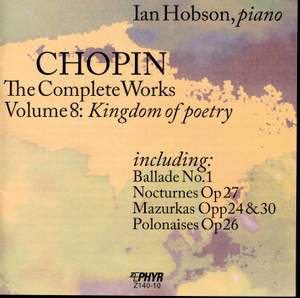
Chopin - The Complete Works

Chopin - The Complete Works


Chopin:

Piano Sonata No. 1 in C minor, Op. 4

Piano Sonata No. 2 in B flat minor, Op. 35 'Marche funèbre'

Piano Sonata No. 3 in B minor, Op. 58

Preludes (24), Op. 28

Prelude Op. posth. in A flat major (No. 26)

Prelude Op. 45 in C sharp minor (No. 25)

Marche Funebre, Op. 72 No. 2

Fugue in A minor

Rondo in C minor Op. 1

Rondo a la Mazurka, Op. 5

Études (12), Op. 10

Études (12), Op. 25

Trois Nouvelles Études

Fantasia in F minor, Op. 49

Ballades Nos. 1-4

Rondo in E flat major, Op. 16

Rondo in C major, Op. 73

Scherzi Nos. 1-4

Hexaméron KKIIb/2

Introduction & Variations ‘Der Schweizerbub’ KKIVa/4

Variations brilliantes in B flat major on 'Je Vends des Scapulaires', Op. 12

Allegro de Concert in A major Op. 46

Polonaise No. 3 in A major, Op. 40 No. 1 'Military'

Polonaise No. 4 in C minor, Op. 40, No. 2

Polonaise No. 5 in F sharp minor, Op. 44

Polonaise No. 6 in A flat major, Op. 53 'Héroïque'

Polonaise No. 7 in A flat major, Op. 61 'Polonaise-fantaisie'

Bolero, Op. 19

Tarantella in A flat major, Op. 43

Impromptus Nos. 1-4

Nocturnes Nos. 1-21 (complete)

Cantabile in B Flat Major (Andantino)

Moderato in E, KKIVb/12

Largo in E flat major, BI 109

Variations in A - Souvenír de paganini

Berceuse in D flat major, Op. 57

Barcarolle in F sharp major, Op. 60

Waltzes Nos. 1-19

Waltz No. 20 in F sharp minor, Op. posth., KK Ib/7 'Mélancolique'

Contredanse in G flat major, KKAnh.Ia/4

Écossaises (3), Op. 72 No. 3

Mazurkas Nos. 1-51

Mazurka No. 54 in D major

Mazurka No. 55 in G major, K.IIa/2

Mazurka No. 56 in B flat major, K.IIa/3

Mazurka No. 58 in A flat major

Mazurka No. 59 in B flat major, K.IVb/1

Mazurka No. 61 in C major, K.IVb/3

Mazurka No. 63 in A flat major, Op. 7, No. 4 (first version)

Mazurka No. 64 in D major, K.IVa/7

Variations on Mozart's 'La ci darem la mano' in B flat major, Op. 2

Piano Concerto No. 2 in F minor, Op. 21

Piano Concerto No. 1 in E minor, Op. 11

Fantasia in A major on Polish Airs, Op. 13

Krakowiak - Concert Rondo in F, Op. 14

Andante spianato & Grande Polonaise, Op. 22

Grand Duo in E KKIIb/1

Piano Trio in G minor Op. 8

Pieóni i piosnki (17) (Seventeen Polish Songs), Op. 74

Czary (Charms), KK.IVa/11

Dumka (Reverie), KK.IVb/9

Variations on Rossini's 'Non piu mesta' in E major

for flute & piano


“This monumental recording project first came about when the American record company Arabesque approached me with an irresistible offer to record the complete works of Chopin. I accepted with enthusiasm and an awareness of the magnitude of the task. My total immersion in the Chopin project was enhanced by a concurrent series of recitals of the complete solo works in the US and several European capitals from 1995 to 1997. I am delighted that these recordings are now available again as a boxed set on Hyperion.” GARRICK OHLSSON

Since his triumph as winner of the 1970 Chopin International Piano Competition, pianist Garrick Ohlsson has established himself worldwide as a musician of magisterial interpretive and technical prowess.

“This is an oustanding achievement, which any genuine Chopin lover and student of Romantic music should own … A landmark in the recording of Chopin’s music … Garrick Ohlsson and Hyperion deserve the greatest success in bringing this important undertaking to such a consistently impressive conclusion” International Record Review

“An attractively priced box set … Ohlsson is in a class of his own” Pianist Magazine

Hyperion - CDS44351/66

(CD - 16 discs)

$92.00

Usually despatched in 2 - 3 working days.

The Complete Chopin Edition

The Complete Chopin Edition


Chopin:

Piano Concerto No. 1 in E minor, Op. 11

Krystian Zimerman (piano)

Polish Festival Orchestra

Piano Concerto No. 2 in F minor, Op. 21

Krystian Zimerman (piano)

Polish Festival Orchestra

Variations on Mozart's 'La ci darem la mano' in B flat major, Op. 2

Claudio Arrau (piano)

London Philharmonic Orchestra, Eliahu Inbal

Fantasia in A major on Polish Airs, Op. 13

Claudio Arrau (piano)

London Philharmonic Orchestra, Eliahu Inbal

Krakowiak - Concert Rondo in F, Op. 14

Claudio Arrau (piano)

London Philharmonic Orchestra, Eliahu Inbal

Andante spianato & Grande Polonaise, Op. 22

Claudio Arrau (piano)

London Philharmonic Orchestra, Eliahu Inbal

Ballades Nos. 1-4

Krystian Zimerman (piano)

Fantasia in F minor, Op. 49

Krystian Zimerman (piano)

Etude No. 25 in F Minor Op. Posth

Anatol Ugorski (piano)

Etude No. 26 in A-flat major, Op. posthumous

Anatol Ugorski (piano)

Étude Op. 25 No. 8 in D flat major

Anatol Ugorski (piano)

Marche Funebre, Op. 72 No. 2

Anatol Ugorski (piano)

Écossaises (3), Op. 72 No. 3

Anatol Ugorski (piano)

Études (12), Op. 10

Maurizio Pollini (piano)

Études (12), Op. 25

Maurizio Pollini (piano)

Barcarolle in F sharp major, Op. 60

Maurizio Pollini (piano)

Berceuse in D flat major, Op. 57

Maurizio Pollini (piano)

Mazurkas Nos. 1-51

Vladimir Ashkenazy (piano)

Mazurka in C major (1833)

Vladimir Ashkenazy (piano)

Mazurka No. 49 in F minor, Op. 68 No. 4

Revised version

Vladimir Ashkenazy (piano)

Nocturnes Nos. 1-21 (complete)

Maria João Pires (piano)

Andante spianato & Grande Polonaise, Op. 22

Martha Argerich (piano)

Polonaises (16)

Anatol Ugorski (piano)

Two Bourrees B160B

Anatol Ugorski (piano)

Galop in A flat major 'Marquis', WN 59

Anatol Ugorski (piano)

Albumblatt in E major

Anatol Ugorski (piano)

Cantabile in B Flat Major (Andantino)

Anatol Ugorski (piano)

Fugue in A minor

Anatol Ugorski (piano)

Largo in E flat major, BI 109

Anatol Ugorski (piano)

Preludes (24), Op. 28

Rafal Blechacz (piano)

Prelude Op. posth. in A flat major (No. 26)

Rafal Blechacz (piano)

Prelude Op. 45 in C sharp minor (No. 25)

Rafal Blechacz (piano)

Impromptus Nos. 1-4

Yundi Li (piano)

Scherzi Nos. 1-4

Maurizio Pollini (piano)

Rondo in C minor Op. 1

Lilya Zilberstein (piano)

Rondo a la Mazurka, Op. 5

Lilya Zilberstein (piano)

Rondo in E flat major, Op. 16

Mikhail Pletnev (piano)

Rondo in C major for two pianos, Op. 73

Kurt Bauer, Heidi Bung (pianos)

Piano Sonata No. 1 in C minor, Op. 4

Lilya Zilberstein (piano)

Piano Sonata No. 2 in B flat minor, Op. 35 'Marche funèbre'

Maurizio Pollini (piano)

Piano Sonata No. 3 in B minor, Op. 58

Maurizio Pollini (piano)

Introduction and Variations on a German National Air, Op. post.

Vladimir Ashkenazy (piano)

Variations in A - Souvenír de paganini

Vladimir Ashkenazy (piano)

Variations brilliantes in B flat major on 'Je Vends des Scapulaires', Op. 12

Vladimir Ashkenazy (piano)

Introduction, Theme and Variations on a Theme of Moore

Vladimir Ashkenazy, Vovka Ashkenazy (pianos)

Hexaméron KKIIb/2

Vladimir Ashkenazy (piano)

Allegro de Concert in A major Op. 46

Vladimir Ashkenazy (piano)

Bolero, Op. 19

Vladimir Ashkenazy (piano)

Tarantella in A flat major, Op. 43

Vladimir Ashkenazy (piano)

Waltzes Nos. 1-19

Vladimir Ashkenazy (piano)

Piano Trio in G minor Op. 8

Beaux Arts Trio

Introduction and Polonaise Brillante in C, Op. 3

Mstislav Rostropovich (cello), Martha Argerich (piano)

Grand Duo for Cello and Piano (on themes from Meyerbeer's Robert le Diable)

Anner Bijlsma (cello), Lambert Orkis (piano)

Cello Sonata in G minor, Op. 65

Mstislav Rostropovich (cello), Martha Argerich (piano)

Zyczenie (The Maiden's Wish), Op. 74 No. 1

Elzbieta Szmytka (soprano), Martin Martineau (piano)

Wiosna (Spring), Op. 74 No. 2

Elzbieta Szmytka (soprano), Martin Martineau (piano)

Smutna rzeka (The Sad River), Op. 74 No. 3

Elzbieta Szmytka (soprano), Martin Martineau (piano)

Hulanka (Merrymaking), Op. 74 No. 4

Elzbieta Szmytka (soprano), Martin Martineau (piano)

Gdzie lubi (What She Likes), Op. 74 No. 5

Elzbieta Szmytka (soprano), Martin Martineau (piano)

Precz z moich oczu (Out of My Sight!), op. 74 No. 6

Elzbieta Szmytka (soprano), Martin Martineau (piano)

Posel (The Messenger), Op. 74 No. 7

Elzbieta Szmytka (soprano), Martin Martineau (piano)

Sliczny chlopiec (Handsome Lad), Op. 74 No. 8

Elzbieta Szmytka (soprano), Martin Martineau (piano)

Melodia (Melody), Op. 74 No. 9

Elzbieta Szmytka (soprano), Martin Martineau (piano)

Wojak (The Warrior), Op. 74 No. 10

Elzbieta Szmytka (soprano), Martin Martineau (piano)

Dwojaki koniec (The Double End), Op. 74 No. 11

Elzbieta Szmytka (soprano), Martin Martineau (piano)

Moja pieszczotka (My Sweetheart), Op. 74 No. 12

Elzbieta Szmytka (soprano), Martin Martineau (piano)

Nie ma czego trzeba (I Want What I Have Not), Op. 74 No. 13

Elzbieta Szmytka (soprano), Martin Martineau (piano)

Pierscien (The Ring), Op. 74 No. 14

Elzbieta Szmytka (soprano), Martin Martineau (piano)

Narzeczony (The Bridegroom), Op. 74 No. 15

Elzbieta Szmytka (soprano), Martin Martineau (piano)

Piosnka litewska (Lithuanian Song), Op. 74 No. 16

Elzbieta Szmytka (soprano), Martin Martineau (piano)

Spiew z mogilky (Leaves Are Falling), Op. 74 No. 17

Elzbieta Szmytka (soprano), Martin Martineau (piano)

Czary (Charms), KK.IVa/11

Elzbieta Szmytka (soprano), Martin Martineau (piano)

Dumka (Reverie), KK.IVb/9

Elzbieta Szmytka (soprano), Martin Martineau (piano)

Mazurka No. 58 in A flat major

Vladimir Ashkenazy (piano)

Mazurka No. 53 in G major

Vladimir Ashkenazy (piano)

Mazurka No. 52 in B flat major

Vladimir Ashkenazy (piano)

Mazurka in D major (1820)

Vladimir Ashkenazy (piano)

Mazurka in D major (1832)

Vladimir Ashkenazy (piano)


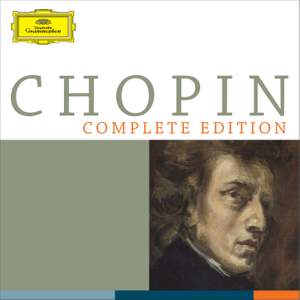
A completely reworked version of the 1999 DG Edition, now split between DG and Decca recordings.

17 CDs, non-limited, in capbox.

Pollini recordings backbone of collection (Etudes, Sonatas, Polonaises, Scherzos)

New DG Highlights: Zimerman's Concertos, Blechacz's Preludes, Pires's Nocturnes

New from Decca: Arrau - Piano Works with orchestra, Ashkenazy - Mazurkas and Waltzes.

Available for the Chopin 200th anniversary in March 2010.

“The quality, both of DG's chosen recordings and the set's general presentation, is just about as good as it gets. To have in one box such wonders as Zimmerman's Ballades, Pollini's Etudes, Pires's Nocturnes, Ashkenazy's Mazurkas and Waltzes, and the Cello Sonata incandescently performed by Rostropovich and Argerich is a treat indeed and could scarcely by bettered. The Concertos are Zimmerman's second recording. ...it is gorgeously romantic, with every string slide cherished and each note turned like wrought gold. This is a set to treasure...” BBC Music Magazine, February 2010 *****

Building a Library

First Choice - November 2010

DG - 4778445

(CD - 17 discs)

$87.00

(Sorry, download not available in your country)

Usually despatched in 2 - 3 working days.

Copyright © 2002-13 Presto Classical Limited, all rights reserved.