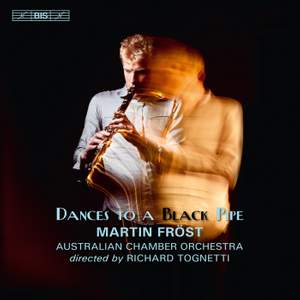
All recordingsPrices shown exclude VAT. (UK tax is not payable for deliveries to United States.) See Terms & Conditions for p&p rates. | |  | Martin Fröst: Dances to a Black Pipe
Martin Fröst’s latest releases have featured core repertoire for his instrument from the 18th and 19th centuries, and most recently a disc of his wide-ranging encores. All of these offerings have been singularly well received by reviewers and record buyers alike, and have contributed to Fröst’s flourishing concert career. On this disc, accompanied by the Australian Chamber Orchestra under Richard Tognetti, Fröst presents a wide-ranging selection of works all connected with dancing. The principal work on this disc is Copland’s Clarinet Concerto, and with special permission from the Copland Fund, the disc ends with the fireworks of the original and later revised, dazzling ending of the Concerto. Fröst also includes on this disc works by Lutoslawski, Anders Hillborg and Piazzolla, as well as an arrangement of Brahms’ Four Hungarian Dances arranged by his brother, Göran. “His virtuosity lies in his exceptional dexterity and agility…and in his daring control of the instrument’s dynamic and expressive extremes.” The Times “almost every piece is a novelty in Martin Fröst's dance-themed programme...This partnership of soloists and orchestra is an inspired one, not least in the smaller-scale pieces...There is a quirky and highly personal essay in lieu of booklet-note from Fröst himself.” Gramophone Magazine, March 2012 “No point in pulling my punches: this is a wonderful disc. The playing is superb, and these dance-inspired pieces will put a skip in your own step...It's obvious that Frost and his Australian colleagues must have had enormous fun recording this programme and their enjoyment bubbles through at every turn. Frost's virtuosity is a delight in its own right, but it's deployed in the service of unquenchable good humour.” International Record Review, February 2012 “Performed in both the original and revised versions, Copland's hot, slick Clarinet Concerto bookends a programme that incorporates waltz, schmaltz, tango and klezmer. Not all of it works. Brahms's Hungarian Dances are downgraded to vehicle status as a showcase for Fröst's dexterity. But elsewhere (Piazzola, Hillborg, Högberg) soloist and orchestra sizzle.” The Independent on Sunday, 8th January 2012 **** | | | (also available to download from $10.50) | In stock - usually despatched within 1 working day. |
|
|
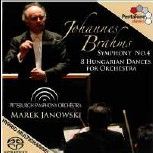
| |  | Brahms - Symphony No. 4 & Hungarian Dances
This release marks the completion of the Brahms symphony cycle with The Pittsburg Symphony Orchestra conducted by Marek Janowski. This series has been warmly applauded. “Classics Today” awarded previous releases in this cycle ‘10 out of 10’ and Classic FM Magazinze awarded the recordings of symphonies 2 & 3 “Disc of the Month”. “…the Pittsburgh Symphony - increasingly one of the nation's finest - could easily be mistaken for a top German orchestra, like Leipzig or Dresden, in this music. The refulgence of the playing is a constant source of pleasure and any conductor who is as mindful of Brahm's ingenuity, invention and sheer vision as Janowski demands to be heard. The Hungarian Dances... are earthy and sinewy with plenty of surge factor in the lower strings and the requisite cheekiness in the phrasing exemplified by those traditionally tantalising hesitations and stompling downbeats.” Gramophone Magazine, March 2009 “It's been true for many years now that American orchestras have been sounding more middle- European, but the Pittsburgh Symphony could easily be mistaken for a top German orchestra, like Leipzig or Dresden, in this music. Listen to the slow movement of the Fourth Symphony where Marek Janowski really has his players leaning into the harmonic radiance of the writing. All those wondrous transfigurations evolve so naturally and so dreamily that the brawny exuberance of the Scherzo – tough and resilient in Janowski's hands – really does come as an unexpected blast. Approaches differ greatly with regard to the highly innovative first movement, the whole of which constitutes a development of sorts. So, how soon do the darkening clouds descend? For some they cannot descend soon enough. But here it's as if Janowski is delaying the inevitable right through to the high anxiety of the final pages. He tightens the screw relatively late in the movement. The slow movement then restores some sense of prior well-being and inner calm, as does the still centre of the finale with its tranquil flute and trombone-led chorale variation. The refulgence of the playing is a constant source of pleasure. The Hungarian Dances come in Brahms and Dvorák's orchestrations, their kinship self-evident. They are earthy and sinewy with plenty of surge factor in the lower strings and the requisite cheekiness in the phrasing exemplified by those traditionally tantalising hesitations and stomping downbeats.” Gramophone Classical Music Guide, 2010 | | | In stock - usually despatched within 1 working day. |
|
|
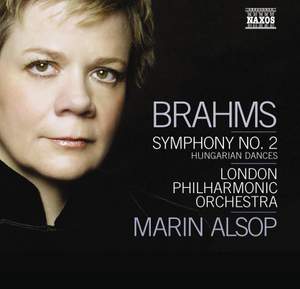
| |  |
“The second instalment of Marin Alsop's Brahms symphonies series is as authoritative, understanding and warm-hearted as the first.” BBC Music Magazine, December 2005 **** “This is a late-summer idyll of a performance, easily paced, nicely judged and warmly played. For first-time buyers it will provide unalloyed pleasure; for older hands it will satisfy without necessarily enlightening or surprising. It is one of those Brahms performances whose centre of gravity is in the violas, cellos and horns. This is apt to the symphony's lyrical, ruminative character, though there are times when the music is robbed of its light and shade. In the finale, for example, one rather misses the chill-before-dawn mood of the lead-in to the recapitulation; and one needs a keener differentiation of horn and trumpet tone to catch the final page's incomparable D major blaze. Alsop's account of the third movement is strong in contrast, the oboe-led Allegrettograzioso strangely muted, the quicker 2/4 section done more or less to perfection. That said, you might think the slow movement under-characterised: insufficiently distinct in tone and temper from the first. The symphony was recorded in Blackheath Concert Hall, the Hungarian Dances in Watford's Colisseum: a bigger, brawnier acoustic that doesn't suit the music quite so well. In dance No 18 in D, one of Dvorák's orchestrations, there is a noisy, cluttered feel to the performance. By contrast, the alfresco No 3 in F, winningly and economically orchestrated by Brahms himself, is played with real charm and style.” Gramophone Classical Music Guide, 2010 | | | (also available to download from $6.00) | In stock - usually despatched within 1 working day. |
|
|
| |  | Brahms: Hungarian Dances
| | | (Sorry, download not available in your country) | Usually despatched in 2 - 3 working days. |
|
|
| |  | Eastern Europe: A Musical Journey
Alda Dizdari (violin) & Tom Blach (piano) “When not aiming at ferocity, Dizdari's tone is notably rich and expressive - especially in the Part, played with a very modest degree of slowish vibrato. The Hungarian Dances are given with great panache but the highlight of the programme, for me, is the Enescu...Dizdiri and Blach seem to get both the spirit and the letter just right.” Gramophone Magazine, October 2011 | | | Usually despatched in 2 - 3 working days. |
|
|
| |  | Brahms: Liebesliederwalzer & 10 Hungarian Dances
Piano music for 4 hands could be considered as the highest expression of friendship. Under the golden fingers of such major artists such as Boris Berezovsky and Brigitte Engerer, the ever-popular Hungarian Dances, are tenderly outlined with poetry, and their alternate moods of seriousness and happiness. The Hungarian Dances also reflect the deep expression of reverie as well as the rhythmic energy of Hungarian folklore. Boris Berezovsky and Brigitte Engerer give us some of Brahms best-loved piano pieces in all their beauty. | | | Usually despatched in 3 - 4 working days. |
|
|
| |  | Berliner Symphoniker: Live in Concert
| | | (also available to download from $10.50) | Usually despatched in 2 - 3 working days. (Available now to download.) |
|
|
| |  | Piano Duo Anna & Ines Walachowski
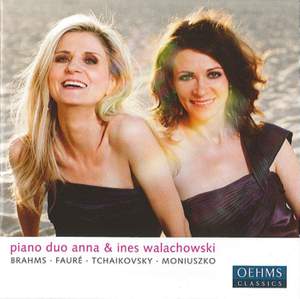
Anna & Ines Walachowski (piano duo) The Walachowski duo plays arrangements and original works for piano duo on their second CD for Oehms Classics (OC566). This CD includes Brahms Hungarian Dances, Fauré “Dolly” Suite, Rachmaninov’s arrangement of Tchaikovsky’s Sleeping Beauty and a rarity; the six Contredanses by Stanislav Moniuszko, the founder of the Polish National Opera. | | | (also available to download from $10.50) | Usually despatched in 2 - 3 working days. (Available now to download.) |
|
|
| |  | NBC Symphony Orchestra - Anthology 1
| | | Usually despatched in 2 - 3 working days. |
|
|
| |  | Sir Adrian Boult Conducts the BBC SO Volume 2
Recorded 1932-36 | | | Usually despatched in 2 - 3 working days. |
|
|
| |
|