All recordingsPrices shown exclude VAT. (UK tax is not payable for deliveries to United States.) See Terms & Conditions for p&p rates. | |  | Per AmoreOpera Arias
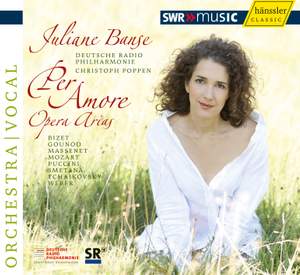
In her debut for Haenssler, the talented young soprano Juliane Banse is joined by Christoph Poppen. She has selected a highly intelligent recital including arias by Weber, Tchaikovsky, Massenet, Mozart and Puccini. She has distinguished herself not only for the beauty of her singing, but for the depth of her characterisations and deep empathy with the emotional world of the women she is portraying. “The voice is a full lyric and quite beautiful, with plenty of warmth, security at all dynamic levels and a clear, even line from top to bottom...Her Mimì is sung directly and sweetly...Her Tatyana is breathless and girlish, and she sounds utterly sincere in every mood change and moment of self-doubt. Micaëla's aria is simply gorgeous, the tone solid, the legato ideal.” International Record Review, March 2011 “this latest recital from Hänssler is a classic in every way...Banse consistently uses her exceptionally sweet and pure voice with extraordinary precision, hitting exposed top notes effortlessly and shading her tone most subtly...When it comes to Tatyana's Letter Scene, [she] is masterly in drawing the contrasted sections together, helped by Christoph Poppen and his Saarbrucken orchestra, with its glorious horn section.” Gramophone Magazine, April 2011 “Banse sings with silvery clean, gently warmed beauty. However, her character analyses are occasionally rather odd. Take Lauretta, the love-struck innocent of Puccini's Gianni Schicchi. Banse has branded her a duplicitous fibber, and transformed her tender 'O mio babbino caro' into a hammed-up parody. However, there's still much to be savoured, including a particularly profound reading of Weber's 'Leise, leise, fromme Weise'.” Gramophone Magazine, May 2011 *** | | | (also available to download from $10.50) | In stock - usually despatched within 1 working day. |
|
|
| |  | Opera de Montreal: Le Gala du 30e anniversaire
Bizet: | Près des remparts de Séville (Séguedille) (from Carmen) Nora Sourouzian (mezzo-soprano) L’orage s’est calmé (from Les pêcheurs de perles) Phillip Addis (baritone) | Delibes: | Viens, Mallika...Sous le dôme épais (from Lakmé) Aline Kutan (soprano), Alison McHardy (mezzo-soprano) Où va la jeune Indoue? 'Bell Song' (from Lakmé) Raphaelle Paquette (soprano), | Gagnon: | Le vaisseur d'or Marc Hervieux (tenor) | Gershwin: | My man's gone now (from Porgy and Bess) Marie-Josee Lord (soprano) | Gounod: | O sainte médaille... Avant de quitter (from Faust) Etienne Dupuis (baritone) | Handel: | Tornami a vagheggiar (from Alcina) Marianne Lambert (soprano) | Massenet: | Allons! Il le faut pour lui-même!... Adieu, notre petite table (from Manon) Layla Claire (soprano) Vision fugitive (from Hérodiade) Gaetan Laperriere (baritone) | Mozart: | E Susanna non vien! … Dove sono i bei momenti (from Le nozze di Figaro) Lyne Fortin (soprano) La ci darem la mano (from Don Giovanni) Pascale Beaudin (soprano), Aaron St. Clair Nicholson (baritone) | Puccini: | Dunque è proprio finita! (from La Bohème) Antoine Belanger (tenor), Marianne Fiset (soprano), Etienne Dupuis (baritone), Gianna Corbisiero (soprano) O mio babbino caro (from Gianni Schicchi) Marianne Fiset (soprano) Chi il bel sogno di Doretta (from La Rondine) Gianna Corbisiero (soprano) | Rossini: | Cruda sorte! Amor tiranno! (from L'Italiana in Algeri) Allyson McHardy (mezzo) Largo al factotum (from Il barbiere di Siviglia) Aaron St. Clair Nicholson (baritone) | Strauss, R: | Marie Theres'! ... Hab mir's gelobt (from Der Rosenkavalier) Lyne Fortin (soprano), Marianne Lambert (soprano), Stephanie Marshall (mezzo) | Tchaikovsky: | Lyubvi fse vozrastï pokornï 'Gremin's aria' (from Eugene Onegin) Randall Jakobsh (bass) Jan ye sposobna k grusti tomnoy (from Eugene Onegin) Annamaria Popescu (mezzo-soprano) | Thomas, Ambroise: | Ah, pour ce soir...Je suis Titania (from Mignon) Raphaelle Paquette (soprano) | Verdi: | Cortigiani, vil razza dannata (from Rigoletto) Gregory Dahl (baritone) Saper vorreste (from Un Ballo in Maschera) Pascale Beaudin (soprano) Imponete (from La Traviata) Caroline Bleau (soprano), Gaetan Laperriere (baritone) Bella figlia dell'amore (from Rigoletto) Aline Kutan (soprano), Annamaria Popescu (mezzo), Antoine Belanger (tenor), Alexandre Sylvestre (baritone) | Wagner: | O du, mein holder Abendstern (from Tannhäuser) Alexandre Sylvestre (baritone) |
Metropolitan Orchestra, Alain Trudel Celebrating the thirtieth anniversary of the Opera de Montreal with a stunning two disc set (at the price of one), the Directors said about this release: “Our great annual celebration of opera gives us the opportunity to present a magnificent showcase of Canadian talent. Brought together on the same stage are some of our finest voices who, along with the Orchestre Metropolitain conducted by Alain Trudel, perform some of the most beautiful arias and ensembles in the repertoire.” | 
| | | (also available to download from $21.25) | Usually despatched in 2 - 3 working days. (Available now to download.) |
|
|
| |  | Edita Gruberova: Vienna State Opera 1977-2010
Bellini: | La dama d'Arturo... Oh, vieni al tempio (from I Puritani) Deh! Con te li prendi ... Mira,o Norma (from Norma) | Donizetti: | Quel guardo il cavaliere (from Don Pasquale) sung in German as 'O jene Glut in Blicken ... Auch ich versteh' die feine Kunst ' Quando di luce rosea (from Maria Stuarda) Regnava nel silenzio...Quando rapito in estasi (from Lucia di Lammermoor) Sulla tomba che rinserra (from Lucia di Lammermoor) Ah! tardai troppo...O luce di quest'anima (from Linda di Chamounix) Com' e bello! (from Lucrezia Borgia) Scellerato!...Va! La morte sul capo ti pende (from Robert Devereux) Pronta son; purch'io non manchi (from Don Pasquale) sung in German as 'Ich bin bereit' | Massenet: | Allons! Il le faut pour lui-même!... Adieu, notre petite table (from Manon) Suis-je gentille ainsi? ... Je marche sur tous les chemins ... Obéissons quand leur voix appelle (from Manon) Ces murs silencieux...Toi! Vous!...Oui, c'est moi (from Manon) | Mozart: | Fuggi, crudele, fuggi! (from Don Giovanni) Vanne, t'affretta… Ah se il crudel periglio (from Lucio Silla) Martern aller Arten (from Die Entführung aus dem Serail) | Strauss, J, II: | Mein Herr Marquis (from Die Fledermaus) | Strauss, R: | Grossmächtige Prinzessin (from Ariadne auf Naxos) | Verdi: | Un dì felice, eterea (from La traviata) Sempre libera (from La Traviata) |
If opera enthusiasts had to choose a singer as the quintessential coloratura soprano, the name of Edita Gruberova would be bound to come up. To the delight of her audiences, she has spent the last four decades exploring every corner of the coloratura repertory. The fact that throughout this period she has retained her timbre, flexibility and an upper range extending above top C is due to two factors: her sovereign technique and her intelligent choice of repertoire. After making her professional début with a provincial company in her native Slovakia, Gruberova joined the Vienna State Opera, which remains her artistic home to this day. This new compilation of high points from Orfeo's Wiener Staatsoper Live series showcases her earliest decisive successes in the sort of lighter coloratura roles often sung by soubrettes: Norina in 'Don Pasquale' and above all Zerbinetta in 'Ariadne auf Naxos', a role to which she returned for 35 years. Lucia stayed for 30 years, allowing her to cast a powerful spell on audiences not only in Vienna but all over the world. Starting with Lucia and with three of Mozart’s soprano roles, Donna Anna, Konstanze and Giunia in the rarely heard 'Lucio Silla', she began to develop in the direction of dramatic coloratura roles, a development that finally enabled her to tackle Bellini’s 'Norma'. Between these two extremes, Edita Gruberova’s career contains many other milestones that may all be enjoyed in this portrait from Vienna. Roles represented here include the titular heroine of Verdi’s 'La traviata' (with Alfredo Kraus as one of her many world-class partners), the flighty Manon in Massenet’s opera of the same name – one of only a handful of excursions into the French repertory – and her irresistible Adele in Johann Strauss’ operetta, 'Die Fledermaus'. Central to the second half of Edita Gruberova’s 40-year reign at the Vienna State Opera are leading roles in bel canto operas, operas which without her be even more of a rarity: Elvira in 'I Puritani' and four of Donizetti’s dramatic coloratura roles, Elisabetta in 'Roberto Devereux' plus Maria Stuarda, Linda di Chamounix and, most recently, Lucrezia Borgia. “an excellent portrait of the artist” International Record Review, October 2012 | | | Usually despatched in 3 - 4 working days. |
|
|
| |  | Licia Albanese
“One of the most delicate, sighing, judiciously used women’s voices one might ever hear.” That was the verdict of the tenor Giacomo Lauri-Volpi, writing in his fascinating study of the leading singers of his time, Voci parallele (Bologna ed. 1977). “Licia Albanese,” he says, “would move on stage purposefully, with precision, painting her tones with careful control of her means and a clear perception of their end”. Audiences were captivated by an effect of modesty, simplicity and tenderness but behind that effect was a solid mastery of her art. He, the senior artist, is full of admiration. But he has a warning: we should not suppose that these fixed, fossilised, mummified objects we call records can convey the individuality, the true character of such singers. So: caveat emptor. Lauri-Volpi had his own way of putting things (that adjective ‘sighing’ surprises us, not so much in itself as in its placing, second among the primary characteristics of the singer he is describing, and one may well object that records, however ‘fixed’, can at least sing to us, which is more than fossils and mummies can do). There is still something in what he says. He is thinking of Albanese’s particular kind of art: that delicate, ‘sighing’ quality which he hears inwardly, summoned up in a memory that is visual as well as aural and which is scarcely to be ‘fixed’, held still. Its essence lies in the moving, breathing individual. He speaks of her strong intuitive faculties. She knew what she was going to do next, vocally and dramatically – but what the audience experienced was the sense of an assured spontaneity. In the theatre you felt that her singing and her movements might take any number of forms: in a recording it will always take one. The living being is caught, pinned-down, captured; and that’s not the way she was. Extract from the booklet note John Steane, 2008 “The Italian born, American soprano enjoyed a mammoth Met career and the endorsement of Toscanini. Both are understandable on the evidence of this attractive collection.” BBC Music Magazine, August 2008 **** | | | Usually despatched in 4 - 5 working days. |
|
|
| |  | Renata Scotto: The French Album Vol. 1
| | | Usually despatched in 4 - 5 working days. |
|
|
| |  | Lucia Popp: The Unforgotten
Bach, J S: | Cantata BWV51 'Jauchzet Gott in allen Landen' | Brahms: | Mädchenfluch (No. 9 from Neun Gesänge, Op. 69) Vorschneller Schwur (No. 5 from Sieben Lieder, Op. 95) Mädchenlied, Op. 107 No. 5 Mädchenlied (No. 6 from Sieben Lieder, Op. 95) Mädchenlied, Op. 85 No. 3 Das Mädchen spricht, Op. 107 No. 3 Die Trauernde, Op. 7 No. 5 Sehnsucht 'Mein Schatz ist nicht da', Op. 14 No. 8 Wie komm ich denn zur Tur herein (No. 34 from Deutsche Volkslieder, WoO 33) In stiller Nacht (No. 42 from Deutsche Volkslieder, WoO 33) Es steht ein Lind (No. 41 from Deutsche Volkslieder, WoO 33) Regenlied, WoO23 | Charpentier, G: | Depuis le jour (from Louise) sung in German | Dvorak: | Mesícku na nebi hlubokém 'Song to the Moon' (from Rusalka) sung in German In Folk Tone - four songs, Op. 73 | Goetz: | Die Kraft versagt | Handel: | Samson: Let the bright seraphim | Janacek: | Moravian Folk Songs (15), JW VIII/23: excerpts | Kodály: | Hungarian Folk Songs | Lortzing: | Die Eifersucht ist eine Plage (from Zar und Zimmermann) | Mahler: | Frühlingsmorgen (Lieder und Gesänge aus der Jugendzeit) Ich ging mit Lust (Lieder und Gesänge aus der Jugendzeit) Nicht wiedersehen (Lieder und Gesänge aus der Jugendzeit) Scheiden und Meiden (Lieder und Gesänge aus der Jugendzeit) Um schlimme Kinder artig zu machen (Lieder und Gesänge aus der Jugendzeit) Hans und Grete (Lieder und Gesänge aus der Jugendzeit) Starke Einbildungskraft (Lieder und Gesänge aus der Jugendzeit) Ablösung im Sommer (Lieder und Gesänge aus der Jugendzeit) Erinnerung (Lieder und Gesänge aus der Jugendzeit) | Massenet: | Allons! Il le faut pour lui-même!... Adieu, notre petite table (from Manon) | Monteverdi: | L'Orfeo: excerpts | Mozart: | E Susanna non vien! … Dove sono i bei momenti (from Le nozze di Figaro) Ach, ich fühl's (from Die Zauberflöte, K620) | Prokofiev: | Russian Folksongs, Op. 104 | Puccini: | O mio babbino caro (from Gianni Schicchi) sung in German | Smetana: | Endlich allein (from Die verkaufte Braut) | Telemann: | Arias from Psalm 111 "Ich danke dem Herrn von ganzem Herzen" | Verdi: | Caro nome (from Rigoletto) sung in German | Weber: | Wie nahte mir der Schlummer … Leise, leise, fromme Weise (from Der Freischütz) |
Soprano Lucia Popp (1939-1993) was one of the most acclaimed singers of her generation. In this four-CD set she is heard in arias from operas by Weber, Mozart, Lortzing, Puccini, Verdi, Massenet and Monteverdi, songs by Brahms, Mahler, Prokofiev, Dvorak, Kodaly, Janacek, and sacred music by Telemann and Bach. After making her debut at the Vienna State Opera in the modest role of Barbarina in The Marriage of Figaro, Lucia Popp worked with all the great conductors of her day including Leonard Bernstein, Sir George Solti, Rafael Kubelik, Lorin Maazel, Sir Neville Marriner, Bernard Haitink and Carlos Kleiber. The State Operas of Vienna and Munich honoured Lucia Popp with the title of Kammersängerin and the Vienna Philharmonic Orchestra awarded her the “Silver Rose”. In 2007 she was placed 7th on BBC Music Magazine's list ‘20 All-time Best Sopranos’ based on a poll of 21 British critics and BBC presenters. | | | (also available to download from $16.25) | Usually despatched in 4 - 5 working days. (Available now to download.) |
|
|
| |  | Victoria de los Ángeles: The Voice of an Angel
Bach, J C: | Ah! lamenta, oh bella Irene | Barbieri, F: | Canción de Paloma (from El Barberillo de Lavapiés) Profesores de la Orquesta Nacional de España, Rafael Frühbeck de Burgos | Barrera Saavedra: | Adiós Granada (from Emigrantes) arr. de los Angeles Victoria de los Angeles (guitar) | Beethoven: | Oh! would I were but that sweet linnet, WoO. 154 No. 9 Eduard Drolc (violin), Irmgard Poppen (cello) He promised me at parting, WoO. 154 No. 12 They bid me slight my Dermot dear, WoO. 152 No. 8 Eduard Drolc (violin), Irmgard Poppen (cello), Gerald Moore (piano) | Bizet: | Carmen (highlights) Nicolai Gedda (Don Jose), Denise Monteil (Micaela), Marcelle Croisier (Frasquita), Monique Linval (Mercédès) Chœurs et Orchestre National da la Radiodiffusion Française, Sir Thomas Beecham | Brahms: | Wiegenlied, Op. 49 No. 4 (Lullaby) Dein blaues Auge, (No. 8 from Acht Lieder und Gesänge, Op. 59) Vergebliches Ständchen, Op. 84 No. 4 Gerald Moore (piano) Sapphische Ode, Op. 94 No. 4 Gerald Moore (piano) | Caballero: | Romanza de Pilar (from Gigantes y cabezudos) Profesores de la Orquesta Nacional de España, Rafael Frühbeck de Burgos | Canteloube: | Songs of the Auvergne Orchestre des Concerts Lamoureux, Jean-Pierre Jacquillat | Catalani: | Ebben? Ne andrò lontana (from La Wally) Orchestra del Teatro dell’Opera di Roma, Giuseppe Morelli | Chapí: | Canción de Pastora (from La patria chica) Rafael Frühbeck de Burgos Canción de la gitana (from La chavala) Profesores de la Orquesta Nacional de España, Rafael Frühbeck de Burgos Carceleras from Las hijas de Zebedeo Sinfonia of London, Rafael Frühbeck de Burgos | Chueca: | La gran vía: Tango de la menegilda Rafael Frühbeck de Burgos La gran vía: Chotís del eliseo madrilène Profesores de la Orquesta Nacional de España, Rafael Frühbeck de Burgos | Debussy: | Fêtes galantes - Set 1 Gonzalo Soriano (piano) | Delibes: | Les filles de Cadix | Duparc: | L'Invitation au voyage Orchestre de la Société des Concerts du Conservatoire, Georges Prêtre | Dvorak: | Als die alte Mutter (No. 4 from Zigeunermelodien, op. 55) Moglichkeit Der Apfel, Op. 38 No. 2 Gerald Moore (piano) | Falla: | La vida breve: ‘Vivan los que rien!' Alli está! Riyendo (from La vida breve) Philharmonia Orchestra, Stanford Robinson El sombrero de tres picos: Overture Philharmonia Orchestra with Chorus, Rafael Frühbeck de Burgos El Amor Brujo: excerpts Philharmonia Orchestra, Carlo Maria Giulini Siete Canciones populares españolas Gonzalo Soriano (piano) | Fauré: | Tristesse, Op. 6 No. 2 Au bord de l'eau, Op. 8 No. 1 (Prudhomme) Les roses d'Ispahan Op. 39 No. 4 Toujours!, Op. 21 No. 2 Gonzalo Soriano (piano) | Gounod: | Ah! Je ris de me voir (from Faust) Il se fait tard ! Adieu ! (from Faust) Nicolai Gedda (Faust), Boris Christoff (Mephistopheles) Orchestre du Théâtre National de l’Opéra, André Cluytens | Granados: | Tonadillas: No. 2, Callejeo Tonadillas: No. 11, El tra la la y el punteado Gerald Moore (piano) Goyescas: Quejas ó La Maja y el Ruiseñor New Philharmonia Orchestra, Rafael Frühbeck de Burgos Iban al pinar Gracia mía Alicia de Larrocha (piano) | Grieg: | Ich liebe Dich, Op. 5 No. 3 | Guridi Bidaola: | Jota (from Six canciones castellanas) Gerald Moore (piano) | Hahn, R: | L'Enamourée Trois jours de vendange Le rossignol des lilas Gonzalo Soriano (piano) | Handel: | Joshua: Oh! had I Jubal's lyre Gerald Moore (piano) | Haydn: | Schlaf in deiner engen Kammer Eduard Drolc (violin), Irmgard Poppen (cello) | Leoncavallo: | Qual fiamma avea nel guardo!.... Hui! Stridono lassù (from I Pagliacci) RCA Victor Orchestra, Renato Cellini | Lleó Balbastre: | Couplets babilónicos (from La corte del Faraón) Profesores de la Orquesta Nacional de España, Rafael Frühbeck de Burgos | Lorca: | Canciónes (13) españolas antiguas: Anda, jaleo Canciónes (13) españolas antiguas: Los cuatro muleros Canciónes (13) españolas antiguas: Las tres hojas Canciónes (13) españolas antiguas: Los mozos de Monleón Canciónes (13) españolas antiguas: Las morillas de Jaén Canciónes (13) españolas antiguas: Sevillanas del Siglo XVIII Miguel Zanetti (piano) | Luna, P: | El Niño Judío: De España vengo Profesores de la Orquesta Nacional de España, Rafael Frühbeck de Burgos | Martini, J P: | Plaisir d'amour | Mascagni: | Voi lo sapete o mamma (from Cavalleria rusticana) Orchestra del Teatro dell’Opera di Roma, Giuseppe Morelli | Massenet: | Allons! Il le faut pour lui-même!... Adieu, notre petite table (from Manon) Je marche sur tous les chemins (from Manon) Chœurs et Orchestre du Théâtre National de l’Opéra-Comique, Pierre Monteux Werther! Werther!…Je vous écris de ma petite chambre (from Werther) Va! Laisse couler mes larmes (from Werther) Orchestre de Paris, Georges Prêtre | Mendelssohn: | Auf Flügeln des Gesanges, Op. 34 No. 2 | Montsalvatge: | Canciones negras (5) Orchestre de la Société des Concerts du Conservatoire, Rafael Frühbeck de Burgos | Mozart: | Porgi amor (from Le nozze di Figaro) Orchestra del Teatro dell’Opera di Roma, Giuseppe Morelli Ecco quel fiero istante, K346 Elisabeth Schwarzkopf (soprano), Dietrich Fischer Dieskau (baritone), Gerald Moore (piano) | Nin: | Granadina (from Cantos populares españoles) Gerald Moore (piano) | Offenbach: | Elle a fui, la tourterelle (from Les Contes d' Hoffmann) Orchestre de la Société des Concerts du Conservatoire, André Cluytens | Ovalle: | Azulao Profesores de la Orquesta Nacional de España, Rafael Frühbeck de Burgos | Puccini: | Si, mi chiamano Mimi (from La Bohème) O soave fanciulla (from La Bohème) Donde lieta usci (from La Bohème) Jussi Björling (Rodolfo), Robert Merrill (Marcello) RCA Victor Orchestra, Sir Thomas Beecham O mio babbino caro (from Gianni Schicchi) Orchestra del Teatro dell Opera di Roma, Tullio Serafin Ancora un passo…Spira sul mare (from Madama Butterfly) Jussi Björling (Pinkerton), Mario Sereni (Sharpless) Bimba dagli occhi pieni di malia (from Madama Butterfly) Jussi Björling (Pinkerton) Un bel di vedremo (from Madama Butterfly) Con onor muore (from Madama Butterfly) Coro e Orchestra del Theatro dell’Opera di Roma, Gabriele Santini | Purcell: | Let us Wander not Unseen (from The Indian Queen, Z630) Lost is my quiet for ever, Z502 Gerald Moore (piano) | Ravel: | La Flûte enchantée (Shéhérazade No. 2) Orchestre de la Société des Concerts du Conservatoire, Georges Prêtre | Rossini: | Nacqui all'affanno, al pianto...Non più mesta (from La Cenerentola) Giuseppe Morelli Una voce poco fa (from Il barbiere di Siviglia) Royal Philharmonic Orchestra, Vittorio Gui | Sadero: | Era la vo Profesores de la Orquesta Nacional de España, Rafael Frühbeck de Burgos | Scarlatti, A: | Le violette Gerald Moore (piano) | Schubert: | Der Tod und das Mädchen, D531 Wohin? (No. 2 from Die schöne Müllerin, D795) An die Musik D547 Gerald Moore (piano) | Serrano: | Cancion de la gitana (from Le alegria del battallon) Rafael Frühbeck de Burgos Escena lírica (Los claveles) Rafael Frühbeck de Burgos Romanza de Gloria (Los de Aragón) Profesores de la Orquesta Nacional de España, Rafael Frühbeck de Burgos | Stanford: | An Irish Lullaby | Tchaikovsky: | Schottische Ballade, Op. 46 No. 2 Gerald Moore (piano), Dietrich-Fischer Dieskau (baritone) | Toldrá: | Cançó de grumet (A l’ombra del Leidoner) Gonzalo Soriano (piano) | Turina: | Saeta en forme de Salve a la Virgen de la Esperanza, Op. 60 Poema en forma de canciones, Op. 19: No. 3, 'Cantares' Philharmonia Orchestra, Walter Susskind | Valls Gorina: | Canciones Sefarditas Jean-Claude Gérard (flute), Oscar Ghiglia (guitar) | Valverde: | Clavelitos Gerald Moore (piano) | Verdi: | Surta è la notte...Ernani! Ernani, involami (from Ernani) Era più calmo? (from Otello) Mia madre aveva...Piangea cantando...Ave Maria (from Otello) Orchestra del Teatro dell’Opera di Roma, Giuseppe Morelli Come in quest'ora bruna (from Simon Boccanegra) Orchestra del Teatro dell’Opera di Roma, Gabriele Santini Libiamo, ne' lieti calici (from La Traviata) È strano! è strano!...Ah! fors è lui (from La traviata) Teneste la promessa...Addio, del passato (from La Traviata) Carlo del Monte (Alfredo) Coro e Orchestra del Teatro dell’Opera di Roma, Tullio Serafin | Villa-Lobos: | Bachianas Brasileiras No. 5: Aria (Cantilena) Bachianas brasileiras no 5 ; Dança (martelo) Orchestre National de la Radiodiffusion Française, Heitor Villa-Lobos | Wagner: | Dich, teure Halle (from Tannhauser) Einsam in trüben Tagen (from Lohengrin) Orchestra del Teatro dell’Opera di Roma, Giuseppe Morelli | Yradier: | La Paloma Profesores de la Orquesta Nacional de España, Rafael Frühbeck de Burgos |
| | | In stock - usually despatched within 1 working day. |
|
|
| |  | Leontyne Price: The Complete Collection of Operatic Recital Albums
Barber, S: | He has come, he has come! (from Vanessa) Do not utter a word (from Vanessa) Give Me Some Music (from Antony and Cleopatra, Op. 40) Give me my robe (from Antony and Cleopatra) Knoxville: Summer of 1915, Op. 24 | Beethoven: | Abscheulicher! Wo eilst du hin? (from Fidelio) | Bellini: | Sediziose voci (from Norma) Casta Diva (from Norma) Mira, o Norma (from Norma) with Marilyn Horne (mezzo) | Berlioz: | La Damnation de Faust: D'amour l'ardente flamme | Bizet: | Je dis que rien ne m'épouvante (from Carmen) | Boito: | L'altra notte in fondo al mare (from Mefistofele) | Britten: | On rivalries 'tis safe for kings...O God, my King (from Gloriana) | Charpentier, G: | Depuis le jour (from Louise) | Cilea: | Ecco: respiro appena. Io son l'umile ancella (from Adriana Lecouvreur) Poveri fiori (from Adriana Lecouvreur) | Debussy: | L'annee en vain...Cependent les soirs (from L'enfant Prodigue) | Dvorak: | Mesícku na nebi hlubokém 'Song to the Moon' (from Rusalka) | Flotow: | The Last Rose of Summer (Martha) | Gershwin: | Porgy and Bess (highlights) | Giordano, U: | La mamma morta (from Andrea Chénier) | Gluck: | Divinités du Styx (from Alceste) | Handel: | Care selve (from Atalanta) Semele: Where'er you walk Vivi, tiranno, io t'ho scampato (from Rodelinda) Marilyn Horne (mezzo) Fermati! No, crudel! (from Rinaldo) | Korngold: | Glück, das mir verbleib 'Marietta's Lied' (from Die Tote Stadt) | Leoncavallo: | Qual fiamma avea nel guardo!.... Hui! Stridono lassù (from I Pagliacci) | Mascagni: | Voi lo sapete o mamma (from Cavalleria rusticana) | Massenet: | Allons! Il le faut pour lui-même!... Adieu, notre petite table (from Manon) Dis-moi que je suis belle (from Thaïs) | Menotti: | While I waste these precious hours (from Amelia Goes to the Ball) | Meyerbeer: | In grembo a me [Sur mes genoux] (from L'Africaine) Sung in French Non, non, non, vous n'avais jamais, je gage (from Les Huguenots) Marilyn Horne (mezzo) | Mozart: | E Susanna non vien! … Dove sono i bei momenti (from Le nozze di Figaro) Don Ottavio, son morta!...Or sai chi l'onore (from Don Giovanni) Ch'io mi scordi di te?... Non temer, amato bene, K505 Porgi amor (from Le nozze di Figaro) Se il padre perdei (from Idomeneo) Ach, ich fühl's (from Die Zauberflöte, K620) Giunse alfin il momento... Deh, vieni, non tardar… (from Le nozze di Figaro) L'amerò, sarò costante (from Il re pastore) Bella mia fiamma, addio... Resta, oh cara, K528 Crudele? Ah no, mio bene! ... Non mi dir, bell'idol mio (from Don Giovanni) Oh smania! oh furie!...D'Oreste, d'Aiace (from Idomeneo) Ah, guarda, sorella (from Così fan tutte) with Marilyn Horne (mezzo) Dove sono i bei momenti (from Le nozze di Figaro) | Offenbach: | Tu n'es pas beau, tu n'es pas riche (from La Périchole) | Poulenc: | Mes filles, voilà que s'achève (from Dialogues des Carmelites) | Puccini: | Un bel di vedremo (from Madama Butterfly) Tu? Tu? Piccolo iddio (from Madama Butterfly) Chi il bel sogno di Doretta (from La Rondine) Vissi d'arte (from Tosca) Signore, ascolta! (from Turandot) Tu che di gel sei cinta (from Turandot) Senza mamma, o bimbo (from Suor Angelica) O mio babbino caro (from Gianni Schicchi) Si, mi chiamano Mimi (from La Bohème) Donde lieta usci (from La Bohème) Quando me'n vo (from La Bohème) Addio, addio mio dolce amor! (from Edgar) Ore dolci e divine (from La Rondine) Vissi d'arte (from Tosca) In quelle trine morbide (from Manon Lescaut) Sola, perduta, abbandonata (from Manon Lescaut) Se come voi piccina io fossi (from Le Villi) Un bel di vedremo (from Madama Butterfly) L'amore e un altra cosa (from La Fanciulla del West) Laggiù nel Soledad (from La Fanciulla del West) Oh, sarò la più bella...Tu, tu, amore? (from Manon Lescaut) with Placido Domingo (tenor) Bimba, bimba, non piangere (from Madama Butterfly) with Placido Domingo (tenor) In questa reggia (from Turandot) Chi il bel sogno di Doretta (from La Rondine) Una nave da guerra...Scuoti quelle fronda (from Madama Butterfly) with Marilyn Horne (mezzo) | Purcell: | Thy hand, Belinda … When I am laid in earth (from Dido & Aeneas) | Rossini: | Non temer, d' un basso affetto (from Maometto II) Marilyn Horne (mezzo) | Strauss, J, II: | Klänge der Heimat (from Die Fledermaus) | Strauss, R: | Zweite Brautnacht! (from Die Ägyptische Helena) Salome: Dance of the Seven Veils Salome: Zwischenspiel Ah! Du wolltest mich nicht deinen Mund küssen lassen (from Salome) Es gibt ein Reich (from Ariadne auf Naxos) | Tchaikovsky: | Puskay pogibnu ya 'Tatiana's Letter Scene' (from Eugene Onegin) | Verdi: | Ritorna vincitor! (from Aida) Qui Radamès verrà!... O patria mia (from Aida) Tacea la notte (from Il Trovatore) D'amor sull'ali rosee (from Il Trovatore) Teneste la promessa...Addio, del passato (from La Traviata) Era più calmo? (from Otello) Mia madre aveva...Piangea cantando...Ave Maria (from Otello) Vegliammo invan due notti (from Macbeth) Una macchia è qui tutt'ora (from Macbeth) O madre, dal cielo …Se vano, se vano è il pregare (from I Lombardi) Come in quest'ora bruna (from Simon Boccanegra) È strano! è strano!...Ah! fors è lui (from La traviata) Sempre libera (from La Traviata) Tu che la vanità (from Don Carlo) Giá nella notte densa (from Otello) with Placido Domingo (tenor) Teco io sto (from Un ballo in maschera) with Placido Domingo (tenor) La luce langue (from Macbeth) Caro nome (from Rigoletto) Silenzio! Aida verso noi s'avanza (from Aida) with Marilyn Horne (mezzo) Pace, pace mio Dio! (from La forza del destino) | Wagner: | Du bist der Lenz (from Die Walküre) Dich, teure Halle (from Tannhauser) Mild und leise 'Isolde's Liebestod' (from Tristan und Isolde) | Weber: | Wie nahte mir der Schlummer … Leise, leise, fromme Weise (from Der Freischütz) Ozean, du Ungeheuer (from Oberon) | Zandonai: | Paolo, datemi pace! (from Francesca Da Rimini) |
Leontyne Price is simply one of the best sopranos of all time. Hailed as the “Stradivarius of singers” she had a unique, unmistakable and unforgettable voice which graced the stage of the Met an astonishing 164 times throughout her career. The Leontyne Price catalogue is divided into two “Complete Collections”; Song and Spiritual Albums and Operatic Recital Albums. These collections are housed in original LP design cardboard slipcases and presented in a hardback boxset. “her core stage repertoire was restricted to a dozen or so roles...These 14 recital albums extend her range from Purcell’s Dido to Menotti’s Amelia: her Handel and Mozart may have dated stylistically, but few Countess Almavivas or Donna Annas have sounded more temperamental and voluptuous...All in all, a banquet for opera-lovers.” Sunday Times, 8th January 2012 | | | In stock - usually despatched within 1 working day. |
|
|
| |
|