All recordingsPrices shown exclude VAT. (UK tax is not payable for deliveries to United States.) See Terms & Conditions for p&p rates. | |  | Panisello & Ligeti: Piano Etudes
Dimitri Vassilakis (piano) | | | In stock - usually despatched within 1 working day. |
|
|
| |  | Ligeti: Works for Piano
| | | In stock - usually despatched within 1 working day. |
|
|
| |  | Ligeti: Etudes pour piano
In 1985 György Ligeti produced an entire volume of piano etudes, to which he added two further volumes in the following sixteen years. Quite a few people in New Music circles then reacted with a lack of appreciation and understanding: Whereas the lively piano etude tradition of the 19th century – inextricably linked with Czerny, Chopin or Liszt – was continued by Bartók, Debussy or Stravinsky at the beginning of the 20th century, this tradition no longer existed by the end of the 20th century. The etude appeared to be a relic from another time. Ligeti had various reasons for these compositions: He was concerned to revive a great musical tradition and to explore its potential in a contemporary form. Furthermore he liked to play the piano himself, although with “inadequate pianistic technique”, as he once remarked. Apparently, it was sufficient to create some of the most difficult works for piano in the entire piano repertoire: “The anatomical situation of my hands and the configuration of the piano keyboard determined the products of my imagination.” His piano etudes have also to be seen in the context of his admiration for the great piano literature from Bach to Debussy. Furthermore they are exercises in polyphonic writing and playing technique, with polyphony here having to be understood in a considerably expanded sense. For Ligeti’s piano writing is not only polyphonic in the customary sense, but also polyrhythmic, poly-temporal, and even poly-ethnic (he uses material from very different European and non-European musical cultures – from the Balkans via Africa to Asia). In the end, his piano etudes are considerably more than mere technical exercises. Each piece is at the same time a poetic miracle, transcending its given musical and technical tasks. “In Thomas Hell's interpretations, the various influences affecting Ligeti's notoriously difficult Études are bracingly apparent.” The Independent, 5th January 2013 *** “Whether polyrhymic or simply elegant, each piece transports the listener to a different world … Pierre-Laurent Aimard (Sony Classical) remains a wonderful guide to these gems, but Thomas Hell is very much his equal” International Piano, March/April 2013 “In the early days, pianists felt obliged to obey Ligeti's injunction to go always to extremes - of loudness, speed or sheer frenzy. Nowadays, as this new recording shows, they are more relaxed and worldly-wise...In general, it's the fluidly atmospheric or reflective Etudes that come off best...but overall, this is a magnificent recording.” BBC Music Magazine, March 2013 ***** | 
| | | Usually despatched in 3 - 4 working days. |
|
|
| |  | Jeremy Denk plays Ligeti and Beethoven
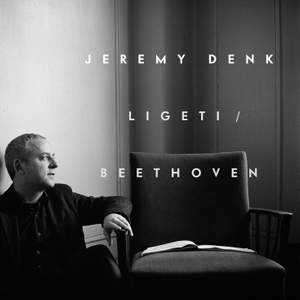
Nonesuch releases the label debut from acclaimed pianist Jeremy Denk, Ligeti/Beethoven, on May 14, 2012. The solo recording features Ligeti's Piano Études, Books One and Two, which Denk memorably performed in a series of recitals in 2011. The New York Times said his reading of the works left "audience members grasping for superlatives at intermission." The sets of études, six from Book One and seven from Book Two, bookend Denk's recording of Beethoven's Sonata No. 32 in C Minor, Op. 111, on the album. The Times said of Denk's 2010 Mostly Mozart Festival performance of the work: "This account, alive to every suggestion and nuance in the score, was an absolute joy to witness. Mr. Denk, clearly, is a pianist you want to hear no matter what he performs, in whatever combination-both for his penetrating intellectual engagement with the music and for the generosity of his playing." In his Ligeti/Beethoven liner note, Denk explains his reasons for recording these works together: "One curious connection...is the way both Ligeti and Beethoven relate themselves to jazz (and to syncopation, rhythmic dislocation generally). Many people get disturbed, or confused, by Beethoven's anachronistic boogie-woogie; but I can't help thinking that however unlikely, this is an outgrowth, too, of ecstasies latent in the holy theme. There is a sense of ecstasy, too, in the discombobulations of Ligeti... "But the most significant connection for me is between Beethoven's vast timeless canvas and Ligeti's bite-sized bits of infinity. Almost every étude visits the infinite; Ligeti uses it almost as a kind of cadence, a reference point. From simplicity, he ranges into unimaginable complexity; he wanders to the quietest and loudest extremes; he veers off the top and bottom of the keyboard. Always the infinite is lurking around, reminding you that it's not impossible, that it exists. I think of the way, among other things, Beethoven drifts off at the end of the Arietta, the way he indicates ending without ending, implies an infinite space of silence surrounding the work." Jeremy Denk has steadily built a reputation as one of today's most compelling and persuasive pianists with an unusually broad repertoire. He has appeared as soloist with many major orchestras, including the Atlanta, Dallas, Houston, New World, St. Louis, and San Francisco symphonies, The Philadelphia Orchestra, Orchestra of St. Luke's, Orpheus Chamber Orchestra, and Philharmonia Orchestra in London. He appears often in recital in New York, Washington, Boston, and Philadelphia. Denk maintains working relationships with a number of living composers and has participated in many premieres. Denk's recording of music by Charles Ives, released on his own Think Denk Media label, made many Best of 2010 lists, including those of the New York Times, Boston Globe, Washington Post, and New York magazine. He also is an avid chamber musician and a respected writer, both on his blog and in such publications as the New Yorker. “The Ligeti is crisp, nuanced and technically flawless, the Beethoven beautifully shaped and flexible. As Denk writes in the CD notes, he is fascinated by "Beethoven's vast timeless canvas and Ligeti's bite-sized bits of infinity". That fascination is illuminated in every bar he plays.” The Observer, 13th May 2012 “Ligeti's Piano Études are famously quixotic in pushing the player beyond their usual limits...But amongst the more extreme strategies are moments of great beauty...notable here for the way Jeremy Denk continues playing virtually beyond the point of audibility...He's ingeniously programmed amidst Ligeti's Études a reading of Beethoven's final Piano Sonata, in which order and chaos are as precipitously balanced as in Ligeti.” The Independent, 12th May 2012 “Denk boasts impressive rhythmic vitality throughout 'Touches bloques'...Jaded listeners who've sat through umpteen Beethoven Op. 111 recordings will (hopefully) convinced how Denk will not linger over freer passages yet, within them, strategically and specifically lean on a specific note.” Gramophone Magazine, August 2012 “Honesty and a rounded humanity define these performances, rather than a strenuous striving for the infinite. Denk makes Ligeti's En suspens, an exercise in jazzy rubato, more tender and touching than any other performances I've heard. And the opening of Beethoven's great Sonata has a noble understatement which is more affecting than grandiloquent...In all, it's a marvel.” BBC Music Magazine, August 2012 ***** BBC Music Magazine
Instrumental Choice - August 2012 |
| | | Usually despatched in 4 - 5 working days. |
|
|
| |  | Ligeti - Complete Piano Music
“Ullén is dazzlingly virtuosic in the Etudes, risking some hair-raisingly fast tempos…” BBC Music Magazine, November 2006 **** | |
|
| |  | Ligeti: Études
“Expressive immediacy… the recorded sound is well suited to the emotional directness of these performances” The Gramophone | | | (also available to download from $6.00) | This item is currently out of stock at the UK distributor. You may order it now but please be aware that it may be six weeks or more before it can be despatched. (Available now to download.) |
|
|
| |  | Ligeti - The Complete Piano Music, Volume 1
“To hear Ullén fly through Die Zauberlehrling is to understand the meaning of a great over competent performance. Small wonder Ligeti trusts the man!” Fanfare | | | (also available to download from $10.50) | Usually despatched in 2 - 3 working days. (Available now to download.) |
|
|
| |  | Ligeti & Liszt: Etudes
| | | Usually despatched in 4 - 5 working days. |
|
|
| |  |
In the wake of the success of her Ligeti and Scriabin recordings (Dynamic CDS 358 and CDS 416), both of which won the prestigious ”10” of Repertoire, the young Canadian pianist Lucille Chung now completes, with this second volume, all of Ligeti’s piano output, including the works written for two pianos and piano four hands, for which she has sought the collaboration of Alessio Bax. The instrumental virtuosity of these pieces is pushed to the limit, and the manual - but also psychological and nervous - control required of the interpreter is quite extraordinary. Exemplary in this respect is the Etude No. 1, by the significant title of Désordre (Disorder), dedicated to Pierre Boulez, in which the uninterrupted rhythmic and metric asymmetry between right and left hand creates a strong sense of instability and anxiety. | | | (also available to download from $10.50) | Usually despatched in 2 - 3 working days. (Available now to download.) |
|
|
| |  | Études Pour Piano Volume 1
| | | Usually despatched in 2 - 3 working days. |
|
|
| |
|