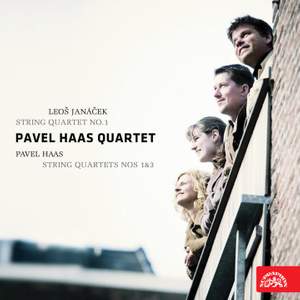
In stock - usually despatched within 1 working day.
Janácek: String Quartet No. 1 'The Kreutzer Sonata'
I. Adagio: Con moto
II. Con moto
III. Con moto · Vivo · Anadnate
IV. Con moto · Adagio · Maestoso
Haas, P: String Quartet No. 1 in C sharp minor, Op. 3 (1920)
in one movement
Haas, P: String Quartet No. 3, Op. 15 (1940–41)
I. Allegro moderato
II. Lento ma non troppo e poco rubato
III. Thema con variazioni e Fuga · Con moto
“the PHQ’s streamlined but full-blooded playing is more than welcome, and if they are lining up the first Janácek and the first and third Haas for a follow-up CD,I will be at the front of the queue to hear it”
April 2008
“Haas was destined for Auschwitz (where he was killed in 1944) and although it would be fanciful to read prophecy into the pages of this marvellous and varied work, [the 3rd String Quartet] the candour and emotional unrest that it expresses have inevitable associations. In the hands of the Pavel Haas Quartet Janácek's own powerfully emotive First Quartet positively glows... This is a superb release...”
January 2008
*****
“…totally compelling and warmly recorded performances…”
2010
“This disc's Gramophone Award-winning predecessor coupled the second string quartets of Haas and Janácek (see below), superbly played and including optional percussion in Haas's finale. Haas's Second (subtitled From the Monkey Mountains) is an amazing piece, but the Third is surely his masterpiece. It is both more concise and more tautly argued than the Second, less a journey into fantastical realms than an urgent, astringent drama, rhythmically driven and intensely heartfelt. And no wonder, given that the Quartet was composed in 1938 when Haas and his family were already marked for tragedy as part of a racially mixed community where an active Nazi faction was ready to pounce. Haas was destined for Auschwitz (where he was killed in 1944) and although it would be fanciful to read prophecy into the pages of this marvellous and varied work, the candour and emotional unrest that it expresses have inevitable associations. The longest movement is the last, a theme with variations which closes with a brief but pungent fugue and at times seems prophetic of Prokofiev's folk-derived Second Quartet of 1941. The First Quartet (1921) plays for a continuous, action-packed 14 minutes and so impressed Haas's mentor Janácek that he had it performed. Although less striking than the Third, the First inhabits a similar climate, where temperature and colour shift with a degree of rapidity that suggests Janácek's influence, though Haas's musical language has a softer edge. In the hands of the Pavel Haas Quartet Janácek's own powerfully emotive First Quartet positively glows; one cannot but help ponder what Haas himself might have achieved had he too lived to compose at the ripe old age of 69! The Haas Quartet negotiate Janácek's fervid narrative without over-playing the drama, and they obviously relish its novel and occasionally abrasive sound world. This is a superb release that deserves not merely to bask in the reflected glory of its predecessor, but to share in it. The sound is first-rate.”
Click on any of the works listed above for alternative recordings.