All recordingsPrices shown exclude VAT. (UK tax is not payable for deliveries to United States.) See Terms & Conditions for p&p rates. | |  | Mozart: Dissonances
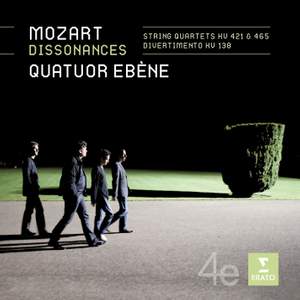
The Ebène Quartet’s fourth Virgin Classics release brings works that lie close to the origins of string-quartet writing – Mozart’s so-called ‘Haydn Quartets’. “It’s such amazing music, so rich and filled with such subtlety; completely unpretentious, yet of such genius,” says the Ebène’s first violin, Pierre Colombet. After their multi-award-winning Virgin Classics debut with a CD of Debussy, Ravel and Fauré, a programme of Brahms, and the pop-jazz collection ‘Fictions’, the members of the Ebène Quartet turn to works that lie close to the very origins of string-quartet writing – Mozart’s so-called ‘Haydn Quartets’. Composed in 1785, the set of six quartets was dedicated by Mozart to his friend and mentor Haydn, the acknowledged ‘father’ of the string quartet. The most famous of the set is the quartet in C major, KV 465, the ‘Dissonance’. It opens with a mysterious introduction, with layered harmonies creating the dissonance that gives the quartet its distinctive nickname. It is coupled with the quartet in D minor, KV 421 (another of the ‘Haydn Quartets) and the Divertimento in F major KV 138, written when Mozart was a teenager. Pierre Colombet, first violin of the Quatuor Ebène explains the ensemble’s approach to Mozart: “We felt that, after Fictions, it would be a good idea to choose something really very classical, essential quartet music which went back to the roots of the quartet. We made a Haydn disc for another label some time ago, and we felt we just had to do some Mozart now. Yes, we’ve been playing Mozart for a very long time, but over the past year or two, we’ve felt more and more of a need to do it – it’s such amazing music, so rich and filled with such subtlety; completely unpretentious, yet of such genius. And as Mathieu Herzog, the quartet’ viola vividly confesses: “It’s hardly news that classical musicians consider Mozart one of the most difficult composers to interpret, to play, to realise … you have to invest yourself constantly in his music and it’s very powerful, very tough on your emotions. And you have a weight on you – more like a layer of concrete on your head – because you want to succeed in delivering a new vision of the composer … We’re following in the footsteps of people who have played his music so very, very well and we want to respect Mozart for what he is. The whole thing is as hard as dancing Swan Lake in Caterpillar boots, but it’s worth the effort. Pierre Colombet explains the title of their new release : “It might seem a bit of a paradox to call a Mozart disc ‘Dissonances’, even though he did write a quartet which is known as the ‘Dissonance’, but beyond that it’s true that Mozart’s music has loads and loads of very complex harmonies, sounds which create friction with each other. Ebène’s cello Raphaël Merlin on the quartet’s interaction “When we’re playing Beethoven, Bartók or our jazz or pop repertoire, we use our instruments in a way that’s more percussive, that is more about the pressure we apply. But with Mozart it’s a matter of finding a natural resonance in our instruments, of letting them express themselves … almost of letting them communicate with each other in order to find the right resonance for this music. There is a phenomenon of sympathy – when the wood of an instrument’s soundbox vibrates and causes a vibration in the wood of an instrument close by. It’s that harmony that must link our instruments and that we ourselves must feel. It’s a very, very sensitive matter.” “Is there a more characterful foursome than the Quatuor Ebène? Their wonderfully vivid playing here suggests not. Without being mannered or sensationalist, they disclose worlds of feeling. Just listen to the infinite variety of their phrasing in the finale of the stern D Minor Quartet, K421, as they leave the enigmatic ending hovering with a question mark.” The Times, 24th September 2011 **** “At times brutally robust, at others so fragile you can hear the texture of the bow across the strings, this is a performance [of the D minor] that makes the hairs stand up on the back of your neck.” The Telegraph, 7th October 2011 **** “The Ebènes dig deep beneath the exquisite surface of this music to reveal its dark undercurrents. Taking their cue from the “Dissonance” nickname...they reveal similar drama and emotional conflict in the great D minor quartet and even the superficially innocent Divertimento, written when Mozart was a mere 15. Powerful, immaculately played performances.” Sunday Times, 30th October 2011 “The Quatuor Ébène trust Mozart's directive...These musicians bend and straighten, relax and tighten with micro-dynamic changes. All are intuitively sensed and go beyond literal obedience to the written markings. Yet pulse is steady and nothing is piecemeal or dislocated. Individual character comes first though...Interpretation is always carefully thought through and heartfelt” Gramophone Magazine, November 2011 “the Ebène players point the way forward to the enhanced emotional intensity of the Romantic era. For readings that combine the best of the 'old' and the 'new' it is difficult to imagine these remarkable performances ever being surpassed. Exemplary engineering provides the icing on the cake.” Classic FM Magazine, December 2011 ***** “[the divertmenti are] normally done with full orchestral forces, but they work perfectly well as string quartets - especially when performed as immaculately as here, with everything honed to perfection. The Ebene Quartet produce playing of great refinement and warmth in the mature works, too, with the famous dissonant introduction to K465 admirably mysterious...the playing itself throughout this well-recorded disc remains something to marvel at.” BBC Music Magazine, December 2011 **** | | | In stock - usually despatched within 1 working day. |
|
|
| |  | Mozart: Serenades & Divertimenti
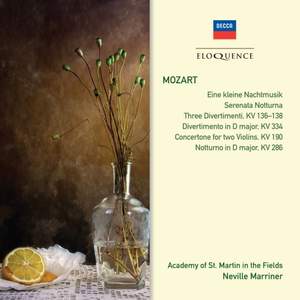
During the 18th century it was common for noblemen to employ numbers of musicians to entertain themselves and their guests, and to add dignity and colour to occasions of Church and State. Music was frequently written to form a pleasant background to dinners and parties. Serious or complex music would clearly have been inappropriate for gatherings of this kind; it was the task of the composer to amuse the guests without overstepping his function and distracting them from the more important business of eating, drinking and making merry. In these circumstances much music was produced which deserved no more than to be talked through; but composers of the ability of Mozart and Haydn responded with light music of a higher quality. The titles Divertimento, Cassation, Serenade and Notturno all refer to pieces of this kind. Elements of the old dances – allemande, courante, sarabande and so on – had fallen from favour, but the minuet was used a good deal and the style gallant was much in evidence. Neville Marriner and the Academy of St. Martin in the Fields’ recording of Mozart’s most popular serenade – the ubiquitous Eine kleine Nachtmusik – made for Argo in 1970 has never been out of the catalogue, but the other works on this compilation, equally compelling, magically performed, have not, as often, seen the light of day on CD. Such is the case with the brief issue in Decca’s ‘World Of…’ series of the extended Divertimento KV 334 and the haunting Notturno for four orchestras, deploying extraordinary echo effects. These are complemented on this anthology with the Serenata Notturna, the three early Divertimenti KV 136–138, and the little-known but breezy Concertone opening the collection. “Everywhere the orchestra offers the neatest and most stylish of playing; and this, coupled with good recording” Gramophone Magazine (Divertimento KV 334, Notturno) “this is the most enormously enjoyable Mozart playing, obviously prepared with great care and carried out with the utmost artistry” Gramophone Magazine (Divertimenti KV 136–138, Serenata Notturna) “The warm acoustic of St John’s … provides an aptly glowing atmosphere. A delightful disc” Gramophone Magazine (Concertone) “This reissue … tends to sweep the board. The playing is marvellous, and Marriner’s choice of tempi is equally apt. The Argo recording, rich in texture and detail, sounds admirably fresh here. […] The sparkle of this music-making is irresistible.” Penguin Guide | | | In stock - usually despatched within 1 working day. |
|
|
| |  | Mozart: Divertimenti, K136, K137, K138
Consort of London, Robert Clark | |
|
| |  | Mozart: Serenades and Divertimenti
Franz Liszt Chamber Orchestra, Sandor Frigyes | |
|
| |  | "Elemente" Trigonale 2007Festival of Early Music
anon.: | Qui d’amours veult avoir Pour haut et liement chanter Qui n’a le cuer rainpli de vraie joie Je la remire, la belle | Bach, W F: | Sinfonia in F major, F. 67 'Dissonant' | Cazzati: | Factus est proelium | Falconieri: | Battaglia de Barabasso yerno de Satanas | Haydn: | Piano Sonata No. 47 in B minor, Hob.XVI:32 Christine Schornsheim | Machaut: | Puisque la douce rousee/De Bon Espoir/Speravi, M4 Fins cuers doulz/Dame, je sui cilz/Fins cuers doulz, M11 Noster cetus (St. Martial) Inviolata genitrix/Felix virgo/Ad te suspiramus gementes et flentes, M23 Romeo and Juliet | Mancini, F: | Quanto dolce è quell’ardore | Merula: | Ciaccona | Mozart: | Divertimento in F major, K138 | Platti: | Concerto in G minor for Oboe, Strings and Continuo | Rognoni: | Sfogava con le stelle | Telemann: | Overture (Suite) TWV 55:G4 in G major 'Les nations anciens et modernes' |
Since 2003, world-class musicians have met annually in Kärnten, Austria, at the “TRIGONALE – Festival of Early Music.” This 2 CD set brings together the highlights of last year’s festival. Recorded live, the performances range from music of the Middle Ages, including motets by Machaut, through the Renaissance and Baroque eras to interpretations of the music of Mozart and Haydn. The line up of artistes is first class and included the Hilliard Ensemble, La Fenice/Jean Tubéry, and il Giardino Armonico, all offering an impression of the festival’s lively atmosphere. | | | Usually despatched in 2 - 3 working days. |
|
|
| |  | Mozart: Salzburg Symphonies
Salzburg Chamber Soloists, Lavard Skou Larsen | | | (also available to download from $10.50) | Usually despatched in 4 - 5 working days. (Available now to download.) |
|
|
| |  | The Tube Only Night Music
Tube only - recorded without the use of transistors | | | Usually despatched in 2 - 3 working days. |
|
|
| |  | Mozart: Divertimenti
| | | (Sorry, download not available in your country) | Usually despatched in 8 - 10 working days. |
|
|
| |  | Mozart: Eine Kleine Nachtmusik
| |
|
| | | |
|