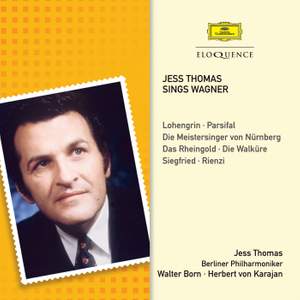
Prices shown exclude VAT. (UK tax is not payable for deliveries to United States.) See Terms & Conditions for p&p rates. | |  | Jess Thomas sings Wagner
Among the many Heldentenors are spoken of in glowing terms, perhaps none has been so unfairly neglected as Jess Thomas. Full-throated and resplendent, not a hint of strain, an amazing array of colours in the voice (from sotto voce to overpowering), he possessed an artistry that was not only a thrill in the theatre but that was beautifully caught in the recording studio – except, his studio recordings are few and far between. The only recital record of note was a showcase of Wagner arias he made with the Berlin Philharmonic (no less) and Walter Born in 1963. This recital appears in its entirety, for the first time internationally on CD, topped and tailed by scenes from Siegfried with Herbert von Karajan and the closing scene from Lohengrin, recorded ‘live’ in Bayreuth with Wolfgang Sawallisch. Born in 1927 in Hot Springs, South Dakota in the US, Thomas studied psychology at the University of Nebraska, worked for four years as a psychological adviser at a high school, and then embarked on postgraduate studies at Stanford University, California. The professor of singing there, Otto Schulmann, had worked before the war as a répétiteur for Karajan in Ulm; he heard Thomas and encouraged him to pursue a singing career. After studying intensively with Schulmann for three years and making his début in 1957 at San Francisco in the baritone role of Faninal in Der Rosenkavalier, Thomas, like most gifted American singing graduates at the time, gravitated to Germany, the home of his preferred repertoire and a country with many opera houses. He spent three years at the Karlsruhe Opera, where his first role was Lohengrin. His breakthrough in larger houses came when the opera producer Wieland Wagner, the composer’s grandson, cast him both in Parsifal at Bayreuth under Hans Knappertsbusch – with whom Thomas would enjoy some of his most memorable musical experiences – and as Radames in Berlin, under Karl Böhm. Thomas was both linguistically and musically more attracted to the greater depth, as he saw it, of Wagner’s works: ‘Wagner revolutionised the entire world of opera and not only with respect to the music, but above all in the fusion of music and drama’. He began to learn heavier Wagnerian roles such as Tannhäuser, Tristan and Siegfried. Karajan chose him as his Siegfried in his studio recording of the Ring, he recorded Lohengrin with Kempe and Hans Sachs with Keilberth. With insightful notes by Alan Newcombe, this release is a fascinating portrait of one of the greatest Wagner voices of any era. “I heard Jess Thomas the American tenor at Bayreuth last year singing Lohengrin like an angel. My simile is as yet relative, as I have not yet reached that stage, but relative also in the sense that so many of the native-born Wagnerian tenors one encounters emit sounds which to my ear do not qualify as ‘singing’ at all, being rather related to the noise newsboys make when calling a paper; i.e., a strong, carrying shout […] Mr. Thomas sings, and sings most sensitively, producing a steady flow of pleasing tone. He sings with intelligence and musicianship, too.” Gramophone Magazine | 
| | | Scheduled for release on 15 July 2013. Order it now and we will deliver it as soon as it is available. |
|
|
| |  | The Bayreuth Festival 1936 Original Recordings, CD 1
recorded in Bayreuth, July-August 1936 | 
| |
|
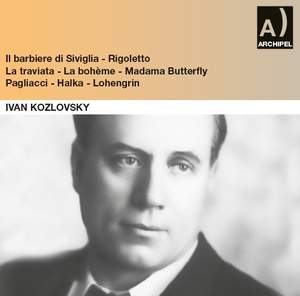
| |  | Ivan Kozlovsky – Recital No. 1
Ivan Kozlovsky (tenor) Samuil Samosud, Aleksandr Orlov, Onissim Bron Ivan Kozlovsky was a Soviet lyric tenor who became one of the greatest stars of Russian opera. He taught at the Moscow Conservatory for many years. This CD includes excerpts from Il barbiere si Siviglia, Rigoletto, La traviata, La bohème, Madame Butterfly, Pagliacci, Halka and Lohengrin. | | | Usually despatched in 2 - 3 working days. |
|
|
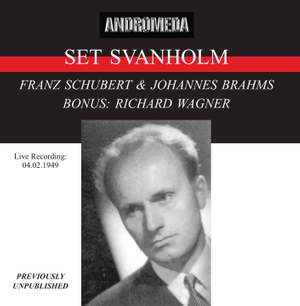
| |  | Set Svanholm: Recital
Brahms: | Wie bist du, meine Königin Op. 32 No. 9 Unbewegte laue Luft (No. 8 from Acht Lieder und Gesänge, Op. 57) In der Gasse, Op. 58 No. 6 Vorüber, Op. 58 No. 7 Dein blaues Auge, (No. 8 from Acht Lieder und Gesänge, Op. 59) Meine Liebe ist grün, Op. 63 No. 5 | Schubert: | An die Leier, D737 (Bruchmann) Liebesbotschaft, D957 No.1 Der Atlas, D957 No. 8 An Sylvia, D891 Einsamkeit, D620 Die Forelle, D550 An die Musik D547 Erlkönig, D328 | Wagner: | Höchstes Vertrau´n (Lohengrin) In fernem Land (from Lohengrin) Inbrunst im Herzen (from Tannhäuser) Am stillen Herd (from Die Meistersinger) Morgenlich leuchtend im rosigen Schein 'Prize Song' (from Die Meistersinger von Nürnberg) |
Live recording from 4th February 1949 | | | Usually despatched in 2 - 3 working days. |
|
|
| |  | Hans Hopf - Historical Recital
These recordings are from the Philips sessions of 1956 and German radio recordings of 1952 – 53. | | | Usually despatched in 2 - 3 working days. |
|
|
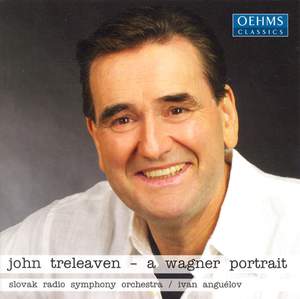
| |  | John Treleaven: A Wagner Portrait
The Independent wrote of his Siegfried at Covent Garden in October 2005; “Treleaven is splendid. His singing is unusually varied and he has remarkable staying power. If there is one thing that most Siegfrieds cannot convey, it is a feeling of lightness. Treleaven does it!” | | | (also available to download from $10.50) | Usually despatched in 2 - 3 working days. (Available now to download.) |
|
|
| |  | Set Svanholm
| | | Usually despatched in 2 - 3 working days. |
|
|
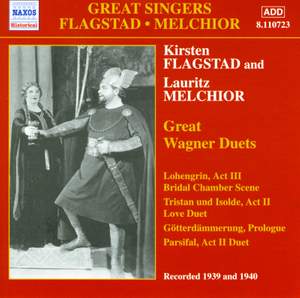
| |  | Great Wagner Duets (1939-1940)Selected arias from Lohengrin, Tristan und Isolde and more
| | | (also available to download from $8.75) | Usually despatched in 2 - 3 working days. (Available now to download.) |
|
|
| |  | Semperoper Edition, Vol. 3 (1948-1956)
Dora Zschille (soprano), Brunnhild Friedland (soprano), Helmut Eyle (bass), Kurt Rehm (baritone), Hans Kramer (bass), Ernst Gruber (tenor), Bernd Aldenhoff (tenor), Margarete Baumer (soprano), Karl Paul (baritone), Hans Hopf (tenor), Emilie Walter-Sachs (soprano), Josef Herrmann (baritone), Christel Goltz (soprano), Kurt Bohme (bass), Arno Schellenberg (baritone), Joachim Sattler (tenor) Dresden Staatskapelle, Leipzig Radio Symphony Orchestra, Leipzig Radio Chorus, Dresden State Opera Chorus, Grosses Rundfunkorchester Dresden, Dresden Philharmonic Orchestra, Joseph Keilberth, Gerhard Pfluger, Rolf Kleinert, Rudolf Kempe, Kurt Striegler, Hans-Hendrik Wehding, Gerhard Wiesenhutter, Walter Stoschek | |
|
| |  | Richard Wagner On Record
Wagner: | Du bist der Lenz (from Die Walküre) Lilli Lehmann Weilten die Sterne (from Die Meistersinger von Nürnberg) Hermann Winkelmann Noch bleibe denn unausgesprochen (from Tannhäuser) Wilhelm Hesch O du, mein holder Abendstern (from Tannhäuser) Leopold Demuth Weiche, Wotan, weiche! (from Das Rheingold) Ernestine Schumann-Heink Wohin nun Tristan scheidet (from Tristan und Isolde) Ernst Kraus Mögst du, mein Kind (from Der fliegende Holländer) Paul Knüpfer Jetzt fand ich's, was euch fehlt (from Das Rheingold) Otto Briesemeister Erstehe, hohe Roma, neu (from Rienzi) Jacques Urlus In fernem Land (from Lohengrin) Erik Schmedes Abendlich strahlt der Sonne Auge (from Das Rheingold) Theodor Bertram Als du in kuhnem Sange uns bestrittest (from Tannhäuser) Fritz Feinhals Fanget an! (Die Meistersinger von Nürnberg) Carl Burrian Entweihte Götter (from Lohengrin) Edyth Walker Hoho! Hoho! Hohei! Schmiede, mein Hammer, ein hartes Schwert! (from Siegfried) Heinrich Knote Mein Herr und Gott (from Lohengrin) Leon Rains Mein Vater, hochgesegneter der Helden (from Parsifal) Clarence Whitehill Dein Werk, o tör'ge Magd (from Tristan und Isolde) Johanna Gadski Des Königs Wort und Will tu ich euch kund (from Lohengrin) Nicola Geisse-Winkel Am stillen Herd (from Die Meistersinger) Leo Slezak Auf Ewigkeit wärst du verdammt mit mir (from Parsifal) Rudolf Berger Tatest du's wirklich? (from Tristan and Isolde) Paul Bender Nur eine Waffe taugt (from Parsifal) Heinrich Hensel O du, mein holder Abendstern (from Tannhäuser) Friedrich Plaschke Wohin nun Tristan scheidet (from Tristan und Isolde) Modest Menzinsky Was duftet doch der Flieder (from Die Meistersinger von Nürnberg) Hermann Weil Mein lieber Schwan (from Lohengrin) Hermann Jadlowker Hoiho! Hoihohoho! (from Götterdämmerung) Allen Hinckley Mögst du, mein Kind (from Der fliegende Holländer) Richard Mayr Der Unglücksel'ge, den gefangen (from Tannhäuser) Emmy Destinn Du Ärmste kannst wohl nie ermessen (from Lohengrin) Berta Morena Athmest du nicht mit mir die sussen Dufte? (from Lohengrin) Robert Hutt Über Stock und Stein (from Das Rheingold) Walther Kirchhoff Zauberfest bezähmt ein Schlaf (from Die Walküre) Fritz Soot Nothung! Nothung! Neidliches Schwert! (from Siegfried) Rudolf Ritter Ewig war ich (from Siegfried) Lucy Weidt An der Weltesche wob ich einst (from Götterdämmerung) Hermine Kittel Ich sah das Kind an seiner Mutter Brust (from Parsifal) Melanie Kurt Euch Lüften, die mein Klagen (from Lohengrin) Eva von der Osten Winterstürme wichen dem Wonnemond (from Die Walküre) Johannes Sembach Johohoe! Traft ihr das Schiff im Meere an 'Senta's Ballad' (from Der fliegende Holländer) Barbara Kemp Der Augen leuchtendes Paar (from Die Walküre) Karl Armster Mild und leise 'Isolde's Liebestod' (from Tristan und Isolde) Helene Wildbrunn Verachtet mir die Meister nicht (from Die Meistersinger von Nürnberg) Emil Schipper Seit Ewigkeiten harre ich deiner (from Parsifal) Lilly Hafgren Hojotoho, hojotoho, heiaha, heiaha! (from Die Walküre) Gertrude Kappel So ist’s denn aus...Deiner ew’gen Gattin (from Die Walküre) Margarete Arndt-Ober Siegmund heiß ich und Siegmund bin ich! (from Die Walküre) Richard Schubert Einsam wachend...Habet acht! (from Tristan und Isolde) Emmi Leisner Mime hiess ein mürrischer Zwerg (from Götterdammerung) Curt Taucher Ein Kind ward hier geboren (from Die Meistersinger von Nürnberg) Wilhelm Rode Du bist der Lenz (from Die Walküre) Maria Jeritza Oh, wunden wundervoller heiliger Speer (from Parsifal) Michael Bohnen Johohoe! Traft ihr das Schiff im Meere an 'Senta's Ballad' (from Der fliegende Holländer) Frida Leider Als du in kuhnem Sange uns bestrittest (from Tannhäuser) Harry De Garmo O Sachs, mein Freund (from Die Meistersinger) Lotte Lehmann Wie aus der Ferne längst (from Der Fliegende Holländer) Friedrich Schorr Weiche, Wotan, weiche! (from Das Rheingold) Sigrid Onegin Was duftet doch der Flieder (from Die Meistersinger von Nürnberg) Josef von Manowarda Gut'n Abend, Meister (from Die Meistersinger von Nürnberg) Emmy Bettendorf Schmerzen (No. 4 from Wesendonck-Lieder) Sabine Kalter Seit er von dir geschieden (from Götterdämmerung) Maria Olszewska Amfortas! Die Wunde! (from Parsifal) Nelly Larsen-Todsen Helle Wehr, heilige Waffe (from Götterdämmerung) Erik Enderlein Dich, teure Halle (from Tannhauser) Maria Müller Höchstes Vertrau´n (Lohengrin) Lauritz Melchior Weiche, Wotan, weiche! (from Das Rheingold) Karin Branzell Mein Herr und Gott (from Lohengrin) Alexander Kipnis Jerum! Jerum! (from Die Meistersinger) Rudolf Bockelmann Einsam in trüben Tagen (from Lohengrin) Elisabeth Rethberg Athmest du nicht mit mir die sussen Dufte? (from Lohengrin) Fritz Wolff Mild und leise 'Isolde's Liebestod' (from Tristan und Isolde) Gertrud Bindernagel O Himmel, lass dich jetzt erflehen (from Tannhäuser) Heinrich Schlusnus Hojotoho, hojotoho, heiaha, heiaha! (from Die Walküre) Kirsten Flagstad Auf wolkigen Hö'n wohnen die Götter (from Siegfried) Hans Hermann Nissen Fort, denn eile (from Die Walküre) Helen Traubel Winterstürme wichen dem Wonnemond (from Die Walküre) Franz Völker Am stillen Herd (from Die Meistersinger) Max Lorenz Fanget an! (Die Meistersinger von Nürnberg) Torsten Ralf Dein Werk, o tör'ge Magd (from Tristan und Isolde) Anny Konetzni Blick ich umher in diesem edlen Kreise (from Tannhäuser) Joel Berglund Euch Lüften, die mein Klagen (from Lohengrin) Maria Reining In fernem Land (from Lohengrin) Set Svanholm Allmächt’ge Jungfrau! (from Tannhäuser) Hilde Konetzni |
| | | Usually despatched in 2 - 3 working days. |
|
|
| |
|