Prices shown exclude VAT. (UK tax is not payable for deliveries to United States.) See Terms & Conditions for p&p rates. | |  | Mundus et MusicaInstrumental Music in Spain and Flanders c.1500
Qualia Trio: Lambert Colson (cornetto & recorders), Anna Danilevskaia (viella) & Christophe Deslignes (organetto) On their first CD, Qualia presents a collection of polyphonic music from late medieval sources, especially from manuscripts around the year 1500. In a very short period of time around the turn of the 15th century, the European music culture changed from the ancient phytagoreic to meantone temperament and created some astounding, highly complex and intellectually as well as musically challenging works, taking inspiration from both old and modern musical influences. Qualia lets the listener immerse into an almost alien musical world, into the deep roots and sources of being of European music history, which in today’s perception is almost lost completely. “It must be agreed that this is a somewhat specialist CD. It’s possible that, at fifty-three minutes, you might feel somewhat short-changed by this disc but the playing is so fine and the repertoire so rare and pleasing that you could almost play the disc right through again without feeling all that bleary-eyed.” MusicWeb International, April 2013 | | | (also available to download from $10.50) | Usually despatched in 2 - 3 working days. (Available now to download.) |
|
|
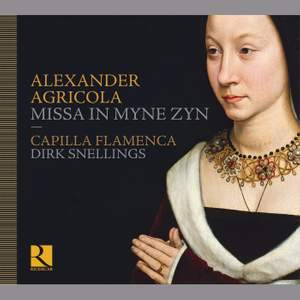
| |  | Agricola: Missa In myne Zyn
Alexander Ackermann, know as Agricola, was born in Ghent and was not only a contemporary of Josquin Desprez but also one of the most exciting composers of his period. Of the eight Masses by Agricola that have survived, the Missa in myne zyn is possibly the last, most demanding to perform and the most elaborate, making use of every possible technique, to include the thematic material of Agricola’s own 3-part song In myne zyn. The secular pieces recorded here lend themselves particularly well to the techniques of ornamentation and improvisation that the composer himself suggests. The recording opens with a number of other settings of In myne Zyn, including Agricola’s three-voice setting on which he went on to base the Mass; and near the end is his short setting of a famous Marian antiphon, the Regina coeli, whose well known plainchant is heard in the top voice. The Mass itself is interspersed with shorter three-voice settings of other well-known tunes of the day by some of the most famous names of preceding generations: Comme femme desconfortée is by Binchois (d. 1460), D’ung aultre amer by Johannes Ockeghem, and Tout a par moy by the Englishman Walter Frye. These short settings, which may have been intended for instrumental performance, nicely illustrate Agricola’s habit of building free counterpoint on short, pithy motives that are passed from voice to voice, even on different parts of the beat. Another piece is completely freely invented, with no borrowed material at all. This, again, is rather unusual, and so it’s perhaps not surprising that its title puns on a biblical quotation and the name of our composer: ‘My father is a farmer’ – Latin ‘Agricola’ for farmer. The Capilla Flamenca has long advocated the use of a group of soloists for the performance of polyphonic music; Agricola’s compositions suit the ensemble to perfection. “The Mass is enormous, even lacking a Kyrie, but the superb Capilla Flamenca, no strangers to this repertoire or to this composer, separate the sections with a series of motets and songs in exuberant, driven performances, employing violas da gamba.” Gramophone Magazine, May 2011 | | | Usually despatched in 4 - 5 working days. |
|
|
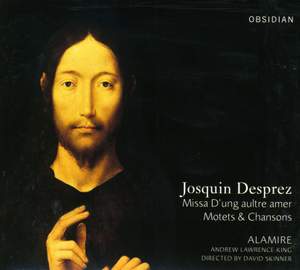
| |  | Josquin Desprez - Missa D'ung aultre amer
“Alamire's singing is glorious. Confident, precise and with an almost urgent concision which suits the compactness of the Gloria and Credo.” BBC Music Magazine, September 2008 ***** “This is the first recording by Alamire, a new ensemble boasting familiar English singers under the guidance of David Skinner. Their approach is direct and unaffected…” Gramophone Magazine, Janurary 2008 “This is a most ingeniously devised Josquin recitals. Laying emphasis on works of his early maturity, it records the composer's apparent obsession with Ockeghem's rondeau D'ung aultreamer. Josquin reworked it several times, including a Mass that generated several minor 'spinoffs', which are also presented here. The Mass is reckoned to be one of his earliest. It is certainly his shortest, and arguably the least well-known (and some scholars in fact dispute Josquin's authorship). But it has an immediate appeal that links it (in attitude, at least) to the songs that make up the rest of the disc. These are engagingly sung by Claire Wilkinson, accompanied on the harp by Andrew Lawrence-King, who gets a few solo spots of his own. The combination of harp and voice works very well and offers a new way of hearing some old favourites: that said, the sound recording seems to make the harp a touch louder than it might be. The recital is ingenious because alongside this relatively neglected Mass it seamlessly works in a few sacred works that count among Josquin's most popular: the ubiquitous Ave Maria, virgoserena, and above all Planxit autem David, which receives a particularly moving account. This is the first recording by Alamire, a new ensemble boasting familiar English singers under the guidance of David Skinner. Their approach is direct and unaffected, and to judge by the results they appear to have enjoyed these recording sessions.” Gramophone Classical Music Guide, 2010 | | | (also available to download from $10.50) | Usually despatched in 2 - 3 working days. (Available now to download.) |
|
|
| |  | Oh Flanders FreeMusic of the Flemish Renaissance
| | | (also available to download from $6.00) | Usually despatched in 2 - 3 working days. (Available now to download.) |
|
|
| |
|