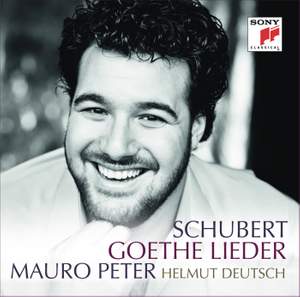
All recordingsPrices shown exclude VAT. (UK tax is not payable for deliveries to United States.) See Terms & Conditions for p&p rates. | |  | Schubert: Goethe Songs
Schubert: | Am Flusse D160 (Goethe) Schäfers Klagelied, D121 (Goethe) Meeres Stille, D216, Op. 3 No. 2 (Goethe) Heidenröslein, D257 Jägers Abendlied, Second Setting, D368 Sehnsucht, D123 Die Liebe (Klarchens Lied), D210 Trost in Tränen, D120 Rastlose Liebe, D138 Nähe des Geliebten, D162 Der Fischer, D225 (Goethe) Erster Verlust, D226 (Goethe) Der König in Thule, D367 Harfenspieler I 'Wer sich der Einsamkeit ergibt', D478 Harfenspieler II 'An die Türen will ich schleichen, D479 Harfenspieler III 'Wer nie sein Brot mit Tränen ass', D480 An Schwager Kronos, D369 An Mignon D161 Ganymed, D544 (Goethe) An die Entfernte, D765 (Goethe) Versunken D715 (Goethe) An den Mond, D259 (Goethe) Der Musensohn, D764 (Goethe) Auf dem See, D543 (Goethe) Geistes-Gruss, D142 |
| | | In stock - usually despatched within 1 working day. |
|
|
| |  | Schubert Lieder Volume 2: An Mein Herz
Schubert: | Der Jungling und der Tod, D545 (Spaun) Das Lied im Grünen, D917 Die Herbstnacht (Wehmut) D404 (Salis-Seewis) Ins stille Land, D403 Abschied von der Harfe D406 (Salis-Seewis) Drang in die Ferne, D770 An Mein Herz D860 Der Wanderer, D649 (Friedrich von Schlegel) Über Wildemann D884 (Ernst Schulze) Klage D371 Am Bach im Fruhling, D361 An die Laute D905 Des Fräuleins Liebeslauschen, D698 Augenlied, D297 (Mayrhofer) Du bist die Ruh D776 (Rückert) An die Musik D547 An eine Quelle D530 (Claudius) Der Sänger am Felsen, D482 Abschied von der Harfe D406 (Salis-Seewis) Liedesend, D473 (Mayrhofer) Das Heimweh, D456 (Winkler) Auf der Donau, D553 (Mayrhofer) Wie Ulfru fischt, D525 (Mayrhofer) Die Sternennacht D670 (Mayrhofer) Ruckweg, D476 (Mayrhofer) Geheimnis, D491 (Mayrhofer) Gondelfahrer, D808 Abendstern, D806 Der Sieg D805 (Mayrhofer) Nachtstück, D672 (Mayrhofer) Auflösung, D807 Heiss mich nicht reden, D877/2 Nur wer die Sehnsucht kennt, D877/4 An Mignon D161 Harfenspieler I 'Wer sich der Einsamkeit ergibt', D478 Am Flusse D160 (Goethe) Nähe des Geliebten, D162 Der Fischer, D225 (Goethe) Auf dem See, D543 (Goethe) Wonne der Wehmut D260 (Goethe) Willkommen und Abschied, D767 |
Matthias Goerne has received worldwide praise for his warm, fluid baritone and his profound interpretations. Highly respected as a Lieder singer, he is a frequent guest at renowned festivals and prestigious venues like the Carnegie and Wigmore Halls. From 2008 to 2011, Matthias Goerne will perform and record Schubert on 11 CDs for harmonia mundi and important venues all over the world will present the complete series of Schubert recitals with Matthias Goerne in their coming seasons. This second volume speaks of death, of the 'Wanderer', and of the relationship between Schubert and his poets . . . For this occasion the singer has called on two travelling companions who have left a lasting artistic impression on the world of lieder: Eric Schneider and Helmut Deutsch. Helmut Deutsch's career as a song accompanist began with Irmgard Seefried; he spent twelve years in an intensive collaboration with Hermann Prey, and has been the partner of many other celebrated singers. Eric Schneider has appeared notably with Christine Schäfer, Matthias Goerne, Christiane Oelze and Stephan Genz. He is a regular guest with these partners at the Schwarzenberg Schubertiade, Salzburg Festival and the Tanglewood Summer Music Festival. “Goerne… and Schneider offer grave and solemn performances of Goethe's Mignon and Harper songs, before ending on a higher note, celebrating the eternal joy of love in 'Willkommen and Abschied'.” BBC Music Magazine, February 2009 **** “Battered by Bryn Terfel dramatics, the ears cried out for a pure dose of lieder from a master of the craft. Matthias Goerne… seems to own a different shade of baritonal colour for every syllable Schubert wrote. The voice is sweet and serene, even at fff, and
the shifts that Goerne applies to the changing of seasons and the fickleness of love are done with enviable delicacy. More reticent than Fischer-Dieskau or Thomas Quasthoff to bend a line for expressive
emphasis, when Goerne takes a liberty the effect is breath stopping… T his is not an album to gorge at one go. Take it two songs a night before bedtime, and it might see you through to the end of recession.” Norman Lebrecht, Evening Standard CD of the Week “Goerne used to record for Decca, but it apparently had no interest in his 12-volume Schubert compendium, so the less ruthlessly commercial Harmonia Mundi comes to the rescue, for which the France-based company deserves the highest praise. From a vocal point of view, few male singers,
even Fischer-Dieskau, command such a rich palette of colours as Goerne does here…he goes where Dieskau never ventured: he includes two of Mignon's songs, Heiss' mich nicht reden and Nur wer die Sehnsucht kennt, as well as the Harper trilogy… In the middle Harper song, Mayrhofer's
Nachtstück and Nähe des Geliebten (Nearness of the Beloved), Goerne approaches the sublime and captures perfectly the wry wit of Goethe's sly dig at water-nymphery, Der Fischer, in which the surprise encounter of an angler with a "moist woman" is wryly underlined by Schubert. Luxury
support from Deutsch and Schneider sets the seal on an outstanding issue.” Sunday Times Classical CD of the Week “This promises to be a landmark series, up there with Hans Hotter and Fischer-Dieskau.” The Observer “Here elegy, fatalism and death-longing predominate and in such repertoire Goerne's mellow, darkly rounded timbre, expressive diction and care – rare in Lieder singers today – for a true, 'bound' line are well nigh ideal. Even at the most anguished fortissimo, his tone never grows harsh or hectoring. Perfectionism like Goerne's has inevitably provoked charges of over-calculation. Some might protest at the ultra-slow tempo for Du bist die Ruh. Yet Goerne's beauty of tone and phrasing (founded on seemingly superhuman reserves of breath), and a rapt intensity that rises to spiritual radiance in the final verse are mesmerising. At a more conventional tempo, he sings An die Musik as a simple, sincere confession of faith, with affectionate touches of rubato (and how eloquently Helmut Deutsch's left hand duets with the voice). Elsewhere Goerne's unsentimental tenderness can illuminate little-known songs that seem ordinary on the printed page – Abschied von der Harfe, say, or the quasi-operatic lament Der Sänger amFelsen. He even appropriates, successfully, two of Mignon's songs, giving one of the most desolate and – in the central section – disturbed performances of Nur wer die Sehnsucht kennt you will hear. True to form, Goerne makes an uncommonly melancholy serenader in An die Laute and DesMädchens Liebeslauschen, which never smiles. Yet he can lighten up, as in the story-telling of DerFischer and Wie Ulfru fischt. Like Deutsch on the first disc, Eric Schneider fully matches Goerne in acumen and command of colour, not least in a performance of Nachtstück of mingled grandeur, mystery and compassionate gentleness.” Gramophone Classical Music Guide, 2010 “Goerne's virtuoso vocal sculpting draws you into the inner landscape of each song, his warm, expressive baritone shaping detail often understated by lesser artists. This promises to be a landmark series, up there with Hans Hotter and Fischer-Dieskau.” The Guardian, 12th October 2008 | | | In stock - usually despatched within 1 working day. |
|
|
| |  | Schubert - The WandererLieder and Fragments
Schubert: | Viola, D786 (Schober) Pilgerweise D789 (Schober) An die Musik D547 New Track Auf der Bruck, D853 Tiefes Lied D876 Der liebliche Stern, D861 (Schulze) Der Wanderer, D649 (Friedrich von Schlegel) Fülle der Liebe D854 (F von Schlegel) Wiedersehn D855 (A W von Schlegel) Vom Mitleiden Maria D632 (Schlegel) Im Walde D708 Der Schmetterling D633 Harfenspieler I 'Wer sich der Einsamkeit ergibt', D478 Harfenspieler II 'An die Türen will ich schleichen, D479 Harfenspieler III 'Wer nie sein Brot mit Tränen ass', D480 Die Sterne, D939 (Leitner) Der Winterabend (Es ist so still), D938 Der Unglückliche, D713 Totengräbers Heimwehe D842 (Craigher) Auf dem Strom, D943, Op. post. 119 with Timothy Brown (horn) Ständchen 'Horch! Horch! die Lerch!', D889 New Track Lachen und Weinen, D777 New Track An die Laute D905 New Track Der Tod und das Mädchen, D531 New Track Pflicht und Liebe D467 (Gotter) Allegretto, D900 in C minor Piano Fragments (From Schubert: Piano Sonata D958 – 094638432128) Lebensmuth, D937 Piano Fragments (From Schubert: Piano Sonata D958 – 094638432128) Allegretto, D346 in C major Piano Fragments (From Schubert: Piano Sonata D958 – 094638432128) Johanna Sebus (Fragment), D728 Andantino, D348 in C Major Piano Fragments (From Schubert: Piano Sonata D958 – 094638432128) Abschied von der Erde, D829 |
Two musical titans in the classical world, British tenor Ian Bostridge and Norwegian pianist Leif Ove Andsnes, both major EMI Classics artists, are brought together once again in a 2CD compilation celebrating their great contribution and commitment to Schubert for the label. As well as featuring specially selected lieder and piano fragments from their critically acclaimed Bostridge / Andsnes Schubert Sonata and Lieder series, the album also includes five newly recorded lieder never previously released by Bostridge. Their partnership was described by The Times as "one of the most inspired of record-company matchmakings: the two musicians really do test and try each other at every turn, as well as being mutually supportive…” Firmly established in the opera house, concert hall and recital room, and much sought after internationally as one of the finest of his generation of tenors, Ian Bostridge is today one of the leading Schubert lieder interpreters, repertoire that he openly states as his first love. Ian’s passion for lieder dates back to early studies at his school in England. Ian explains: ‘I had a wonderful German teacher at my school who got me into German lieder and that has been the thing that has really made me a musician – the lieder.’ “An attractive compilation from EMI's 2001-02 series of Schubert Lieder and piano music. Here, it's predominantly Lieder, with just three piano fragments; but with both artists at their relaxed and creatively focused best.” BBC Music Magazine, December 2008 **** “...from Bostridge you have intelligent word painting, effortless sense of line, langorous phrasing, and a vocal quality that is as sonorous in the upper register as it is mellow in the lower. Andsnes more than accompanies, he pushes the beauty and depth of the piano writing to the fore, whilst never unbecomingly stealing the show.” Charlotte Gardner, bbc.co.uk, 11th July 2008 “Ian Bostridge is one of the most effective Schubert voices in Europe today” The Times | | | In stock - usually despatched within 1 working day. |
|
|
| |  | Arte Nova Voices: Schubert, Brahms & Martin
| | | In stock - usually despatched within 1 working day. |
|
|
| |  | An Die MusikFamous songs by Franz Schubert
Schubert: | Der Musensohn, D764 (Goethe) Litanei auf das Fest Allerseelen, D343 Auf dem Wasser zu singen, D774 Das Rosenband, D280 (Klopstock) Harfenspieler I 'Wer sich der Einsamkeit ergibt', D478 Harfenspieler III 'Wer nie sein Brot mit Tränen ass', D480 Harfenspieler II 'An die Türen will ich schleichen, D479 Erlkönig, D328 An die Musik D547 An die Laute D905 Prometheus, D674 (Goethe) Heidenröslein, D257 Frühlingsglaube, D686 Die Forelle, D550 Du bist die Ruh D776 (Rückert) Der Tod und das Mädchen, D531 Schäfers Klagelied, D121 (Goethe) Lachen und Weinen, D777 Memnon, D541 (Mayrhofer) Rastlose Liebe, D138 Ständchen 'Leise flehen meine Lieder', D957 No. 4 |
Klaus Mertens (bass/baritone) & Tini Mathot (fortepiano) This recording of Schubert lieder features many of his most popular works in the genre including Die Forelle (The Trout), Erlkönig (The Earl King), Der Tod und das Mädchen (Death and the Maiden), and the title track An Die Musik (To Music). The bass-baritone soloist is the noted Bach specialist Klaus Mertens, and the fortepiano is played by Ton Koopman’s wife and regular musical partner Tini Mathot. The German bass-baritone Klaus Mertens has made a name for himself as one of the most prominent and sought-after interpreters of the Baroque oratorio, and has recorded the great vocal works of Johann Sebastian Bach with numerous conductors. A soloist on more than 140 CDs and DVDs, he was a regular collaborator on the critically-acclaimed complete recording of Bach Cantatas by Ton Koopman and the Amsterdam Baroque Orchestra & Choir. He has also recorded Schubert’s great song-cycle Wintereisse for Challenge. The keyboard player Tini Mathot enjoys a close collaboration with her husband and former teacher, Ton Koopman. Together they give recitals and perform in chamber music projects in the major concert halls of Europe, the United States and Japan. Tini Mathot regularly appears as a soloist together with Ton Koopman in concertos for two (or more) harpsichords and orchestra, and alongside him has recorded double concertos by J.S. Bach, C.P.E. Bach, J.F. Reichardt and C. Schaffrath with the Amsterdam Baroque Orchestra. | | | Usually despatched in 4 - 5 working days. |
|
|
| |  | Songs of Hugo Wolfand songs by Schubert and Schumann
Daniel Lichti (baritone), Arlene Shrut (piano) | | | (also available to download from $10.50) | Usually despatched in 2 - 3 working days. (Available now to download.) |
|
|
| |  | Peter Schreier & András Schiff
Schubert: | Schwanengesang, D957 Rastlose Liebe, D138 Schäfers Klagelied, D121 (Goethe) Geheimes, D719 (Goethe) Ganymed, D544 (Goethe) Wandrers Nachtlied II 'Über allen Gipfeln ist Ruh', D768 Der Musensohn, D764 (Goethe) Harfenspieler I 'Wer sich der Einsamkeit ergibt', D478 Harfenspieler II 'An die Türen will ich schleichen, D479 Harfenspieler III 'Wer nie sein Brot mit Tränen ass', D480 |
This programme of Schubert Songs, many of them from the song cycle Schwanengesang, is
a wonderful recording from a BBC broadcast concert
back in 1991. This was the final concert in the Hall’s
90th anniversary season and includes stunning
performances, as expected, by both Schreier and
Schiff. ‘They brought their audience’s attention to more
details in the Schubert Songs than any artists have
before’ The Independent “…this is one of the darkest, slowest Schwanengesangs on disc: there is a unique menace in the final 'Gute Nacht' of 'Kriegers Ahnung'; and 'In der Ferne' gives full, long weight to those six slow pulses within the last word of each line. Schreier's recital also offers consummate performances of Schubert's Goethe settings...” BBC Music Magazine, May 2006 ***** “The 1991 recital by Peter Schreier and András Schiff is highly desirable, though the sound is not quite on the same level. Schreier was never the most honeyed of tenors; but in the lighter songs of Schwanengesang he compensates for a touch of reediness and a tendency to harden on high notes with the supple grace of his phrasing and his ultra-keen response to the text. Liebesbotschaft is eager and volatile, enhanced by Schiff's wonderfully limpid touch and his care to make the piano's singing left hand match the voice in eloquence (Schubert's original, high, key an advantage, here and elsewhere). On the downside, Aufenthalt is surely too slow and life-weary, weighed down by recurrent submissive rallentandos. But Das Fischermädchen has a lilting tenderness, Schiff again singing in dulcet partnership with the voice, while in the remaining Heine songs singer and pianist unflinchingly probe the extremes of anguish and bitterness. Die Stadt (the swirling, impressionistic arpeggios eerily insubstantial from Schiff) and Der Doppelgänger are as desolate and disturbing as any performances on disc, the suggestion of a whine, even a sneer, in Schreier's timbre extraordinarily apt here. After this we get a sharply characterised Goethe group that encompasses the bleakness of the three Harper's Songs (done with characteristic intense immediacy) and ends with an impulsive, dancing Der Musensohn that rightly brings the house down.” Gramophone Classical Music Guide, 2010 “Schreier was never the most honeyed of tenors; but in the lighter songs of Schwanengesang he compensates for a touch of reediness and a tendency to harden on high notes with the supple grace of his phrasing and his ultra-keen response to the text. Liebesbotschaft is eager and volatile, enhanced by Schiff's wonderfully limpid touch and his care to make the piano's singing left hand match the voice in eloquence... Das Fischermädchen has a lilting tenderness, Schiff again singing in dulcet partnership with the voice... Die Stadt (the swirling, impressionistic arpeggios eerily insubstantial from Schiff) and Der Doppelgänger are as desolate and disturbing as any performances on disc...” Gramophone Magazine, July 2006 | | | Usually despatched in 3 - 4 working days. |
|
|
| |  | Fauré & Schubert: Songs
Fauré: | Tristesse, Op. 6 No. 2 Au bord de l'eau, Op. 8 No. 1 (Prudhomme) Après un rêve, Op. 7 No. 1 Clair de Lune, Op. 46 No. 2 Arpège, Op. 76 No. 2 (Samain) En sourdine, Op. 58 No. 2 (Verlaine) L'horizon chimérique, Op. 118 | Schubert: | Harfenspieler I 'Wer sich der Einsamkeit ergibt', D478 Fischerweise, D881 (Schlechta) Der Wanderer, D489 Der Doppelgänger D957 No. 13 Heidenröslein, D257 Erlkönig, D328 |
recorded London, 22-24 May 1950 | |
|
| |  | Schubert - Goethe-Lieder
Schubert: | Wandrers Nachtlied I 'Der du von dem Himmel bist', D224 Wandrers Nachtlied II 'Über allen Gipfeln ist Ruh', D768 Ganymed, D544 (Goethe) Jägers Abendlied, Second Setting, D368 An Schwager Kronos, D369 Meeres Stille, D216, Op. 3 No. 2 (Goethe) Prometheus, D674 (Goethe) An den Mond, D296 Auf dem See, D543 (Goethe) Erster Verlust, D226 (Goethe) Der Musensohn, D764 (Goethe) Rastlose Liebe, D138 Nähe des Geliebten, D162 Heidenröslein, D257 Wonne der Wehmut D260 (Goethe) Erlkönig, D328 Der König in Thule, D367 Geheimes, D719 (Goethe) Grenzen der Menschheit, D716 Am Flusse, D766 Willkommen und Abschied, D767 Harfenspieler I 'Wer sich der Einsamkeit ergibt', D478 Harfenspieler II 'An die Türen will ich schleichen, D479 Harfenspieler III 'Wer nie sein Brot mit Tränen ass', D480 |
“Fischer-Dieskau is on top of his form...the spectrum of emotion takes on a new glow as each song begins...A treasurable disc” Penguin Guide, 2010 edition *** | | | Usually despatched in 8 - 10 working days. |
|
|
| |  | Schubert Orchestral SongsOrchestrated by Reger
Schubert: | Erlkönig, D328 Memnon, D541 (Mayrhofer) An die Musik D547 An den Mond, D296 Du bist die Ruh D776 (Rückert) Im Abendrot, D799 Litanei auf das Fest Allerseelen, D343 Gretchen am Spinnrade, D118 Nacht und Träume, D827 Greisengesang, D778 Gruppe aus dem Tartarus, second version, D583 (Schiller) Prometheus, D674 (Goethe) Harfenspieler I 'Wer sich der Einsamkeit ergibt', D478 Harfenspieler II 'An die Türen will ich schleichen, D479 Harfenspieler III 'Wer nie sein Brot mit Tränen ass', D480 |
| | | (also available to download from $10.50) | Usually despatched in 2 - 3 working days. (Available now to download.) |
|
|
| |
|