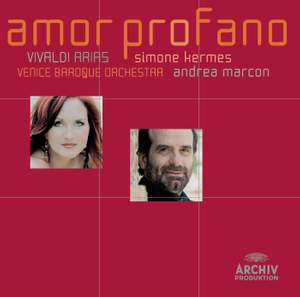
“Amor profano is a role model of how a Baroque opera arias recital disc should be put together - with proper research, affection for the composer, and top-notch artistry.” Gramophone Magazine, May 2008
“Kermes is on top form, singing with vocal clarity, tonal precision and inflective subtlety.” BBC Music Magazine, April 2008 *****
“Simone Kermes has once again teamed up with Andrea Marcon and his Venice Baroque Orchestra for a superbly balanced exploration of opera arias. The level of effort and intelligence in choosing the right repertoire is clearly manifest in this varied and stimulating anthology.
There is a tangible variety of dramatic sentiments and instrumental colours: the introduction of solo cello, recorders, trumpets, solo trumpet and horns in occasional arias is perfectly timed to avoid too much textural monotony, and they make the experience livelier and entertaining. Each aria seems to have been meticulously placed in a sequence that pulls the listener through the contrasts in Vivaldi's operatic writing, which also means that the disc tells a story about the repertoire as well as giving Kermes and the Venetian players plenty of opportunities to show how well they can perform it.
Some of Kermes's dizzying cadenzas are perhaps excessive, but such extravagances are never dull. Her delivery of tempestuous coloratura arias is often exhilarating (the opening aria 'Siam navi all'onde algenti'). The Venice Baroque Orchestra's playing is also dazzling, sensitive and lyrical.
Five of the arias here are first recordings, including a robust heroic aria from OrlandoFurioso – not Vivaldi's famous opera of that title but an earlier setting of the story that also featured music by Ristori – in which Kermes's rapid repeated notes are astonishing. The finest of the rare items is 'Quegl'occhi luminosi' (from Semiramide), which reminds us that, notwithstanding the flashy fast stuff, both singer and composer are often at their dramatic finest in ravishing slow music. 'Se in campo armato' (Catone in Utica) is tastefully played, with its vivacious trumpet-laden accompaniment excellently juxtaposed with a tender B section (although Kermes perhaps over-eggs the ornaments in the da capo repeat). The concluding aria 'Or che cinto ho il crin d'alloro' (Giustino) shows the musicians' infectious joy in the music, with an extrovert vocal line, exuberant horns, and snappy strings and continuo.
'Amor profano' is a role model of how a Baroque opera arias recital disc should be put together – with proper research, affection for the composer, and top-notch artistry.” Gramophone Classical Music Guide, 2010