Prices shown exclude VAT. (UK tax is not payable for deliveries to United States.) See Terms & Conditions for p&p rates. | |  | Salsa BaroqueMusic of Latin America and Spain of the 17th and 18th Century
Ensemble Caprice, Matthias Maute Under the artistic direction of Matthias Maute, Ensemble Caprice is renowned for its innovative interpretations of baroque music. Their previous CDs Vivaldi & Baroque Gypsies (AN 29912) and Telemann & Baroque Gypsies (AN 29919) have been extremely successful. Here they turn their attention to the fiery and passionate music of South America, music with a unique character. | | | In stock - usually despatched within 1 working day. |
|
|
| |  | Fire Burning in Snow
‘For fire burning in snow is the effect of love’. The final line of Juan de Araujo’s Dime, amor gives this recording its title and conjures up the passion and dramatic contrasts which make this disc such a delight. Araujo has been described by many commentators as the greatest Latin American composer of the age, although much of his music is still rarely performed. Little is known about the man (he was a disruptive student in Lima and involved in litigation in La Plata), and there is almost certainly more material to uncover. He was born in Spain in 1648 and emigrated at a young age to South America with his parents. After a period as organist at Lima Cathedral he lived in Panama and Cuzco, where a few of his manuscripts are found, and from 1680 he spent the last thirty-two years of his life as organist at the cathedral of La Plata, now known as the Bolivian judicial capital of Sucre. This disc includes one of his largest pieces, the triple-choir setting in eleven parts of the first great Vesper Psalm Dixit Dominus. This substantial setting is through-composed and vividly captures the dramatic elements in the text with a dazzling display of polychoral techniques. Silencio is a ravishing, double-choir lullaby which makes a complete contrast with the dramatic exchanges in the triplechoir ¡A, del tiempo! and ¡A, de la región de luces!. The fiery ¡Fuego de amor! is written for four choirs. The extraordinary imagination of Araujo in his choice of texts, his sensitivity to word-setting, his melodic, harmonic and textural inventiveness are remarkable, if not breathtaking. “In addition to the singers at his disposal, it seems that Araujo probably made use of cornetts, sackbuts, shawms, flutes, harps, guitars and percussion. Jeffrey Skidmore incorporates all these exotic ingredients into Ex Cathedra's performances but the most impressive element is the precision, blend and sonority of his singers in a splendid setting of Dixit Dominus. ” Gramophone Magazine, June 2008 “The performances throughout can hardly be faulted. A lovely and varied sonority is created by soloists emerging and returning from the 14-strong choir.” BBC Music Magazine, March 2008 ***** “Followers of Jeffrey Skidmore's earlier excursions into the Latin American Baroque with his Ex Cathedra group should need no prompting to buy volume three … Nothing stifles the infectious spark of these mostly secular effusions by the 17th-century Juan de Araujo, cathedral organist in Bolivia. Uplifting, and foot-tapping” The Times “Captures the essence of music informed by the assured grandeur of 16th-century Spanish music, tinged with the colour of native 'Indian' culture and often marked by vibrant echoes of the regions' African slave communities … An unmissable release” Classic FM Magazine “A hugely appealing, atmospheric disc … The reason we should bother with such an obscure composer is clear from the first note - the vivid contrasts and thrilling rhetoric found in Gabrieli and Monteverdi are developed and combined with a magical, dramatic, dark-hued Iberian sensibility” Sunday Times “Araujo is rightly considered to be perhaps the finest composer of his age working in Latin America … This is a captivating, colourful recording which may breathe the stiller London air but audibly relishes the genius of the too-long-neglected Juan de Araujo” International Record Review “The performances are glorious. Soloists and choir sing lustily but stylishly, and the instrumental backing is aptly contrived. Even more than in past volumes, I found this release just plain enchanting. Fine notes, full texts and translations. In all, one of those releases that is truly perfect! What an absolute treasure Hyperion has in Skidmore and his confederates!” American Record Guide “The standard of performance is unfailingly excellent. Ensemble work, both vocal and instrumental, is tight and the many vocal solos are all taken extremely well. The performances display flair and finesse on the part of all concerned Jeffrey Skidmore’s direction is perceptive, lively and, above all, persuasive...This is a CD that commands attention.” MusicWeb International “Araujo was equally at home in sacred and secular pieces: the Dixit Dominus for three choirs is particularly attractive, and his secular music has an irresistible foot-tapping quality. We remain indebted to Skidmore and the fine vocal and instrumental forces of his Ex Cathedra ensembles for resurrecting this material. An important release” Choir & Organ “Araujo's music is very different: sophisticated and marvellously expressive, and Ex Cathedra makes the most of it. The poetry too is worthy of attention: Very enjoyable” Early Music Today “Another hit which you can't keep out of your mind” Daily Mail “The instrumental ensemble is exciting, vital, rhythmically alert … The music of Juan de Araujo … is unquestionably a good find” Fanfare | | | In stock - usually despatched within 1 working day. |
|
|
| |  | Fire Burning in Snow
‘For fire burning in snow is the effect of love’. The final line of Juan de Araujo’s Dime, amor gives this recording its title and conjures up the passion and dramatic contrasts which make this disc such a delight. Araujo has been described by many commentators as the greatest Latin American composer of the age, although much of his music is still rarely performed. Little is known about the man (he was a disruptive student in Lima and involved in litigation in La Plata), and there is almost certainly more material to uncover. He was born in Spain in 1648 and emigrated at a young age to South America with his parents. After a period as organist at Lima Cathedral he lived in Panama and Cuzco, where a few of his manuscripts are found, and from 1680 he spent the last thirty-two years of his life as organist at the cathedral of La Plata, now known as the Bolivian judicial capital of Sucre. This disc includes one of his largest pieces, the triple-choir setting in eleven parts of the first great Vesper Psalm Dixit Dominus. This substantial setting is through-composed and vividly captures the dramatic elements in the text with a dazzling display of polychoral techniques. Silencio is a ravishing, double-choir lullaby which makes a complete contrast with the dramatic exchanges in the triplechoir ¡A, del tiempo! and ¡A, de la región de luces!. The fiery ¡Fuego de amor! is written for four choirs. The extraordinary imagination of Araujo in his choice of texts, his sensitivity to word-setting, his melodic, harmonic and textural inventiveness are remarkable, if not breathtaking. “In addition to the singers at his disposal, it seems that Araujo probably made use of cornetts, sackbuts, shawms, flutes, harps, guitars and percussion. Jeffrey Skidmore incorporates all these exotic ingredients into Ex Cathedra's performances but the most impressive element is the precision, blend and sonority of his singers in a splendid setting of Dixit Dominus.” Gramophone Magazine, June 2008 “The performances throughout can hardly be faulted. A lovely and varied sonority is created by soloists emerging and returning from the 14-strong choir.” BBC Music Magazine, March 2008 ***** “Followers of Jeffrey Skidmore's earlier excursions into the Latin American Baroque with his Ex Cathedra group should need no prompting to buy volume three … Nothing stifles the infectious spark of these mostly secular effusions by the 17th-century Juan de Araujo, cathedral organist in Bolivia. Uplifting, and foot-tapping” The Times “Captures the essence of music informed by the assured grandeur of 16th-century Spanish music, tinged with the colour of native 'Indian' culture and often marked by vibrant echoes of the regions' African slave communities … An unmissable release”” Classic FM Magazine “A hugely appealing, atmospheric disc … The reason we should bother with such an obscure composer is clear from the first note - the vivid contrasts and thrilling rhetoric found in Gabrieli and Monteverdi are developed and combined with a magical, dramatic, dark-hued Iberian sensibility” Sunday Times “Araujo is rightly considered to be perhaps the finest composer of his age working in Latin America … This is a captivating, colourful recording which may breathe the stiller London air but audibly relishes the genius of the too-long-neglected Juan de Araujo” International Record Review “The performances are glorious. Soloists and choir sing lustily but stylishly, and the instrumental backing is aptly contrived. Even more than in past volumes, I found this release just plain enchanting. Fine notes, full texts and translations. In all, one of those releases that is truly perfect! What an absolute treasure Hyperion has in Skidmore and his confederates!” American Record Guide “The standard of performance is unfailingly excellent. Ensemble work, both vocal and instrumental, is tight and the many vocal solos are all taken extremely well. The performances display flair and finesse on the part of all concerned Jeffrey Skidmore’s direction is perceptive, lively and, above all, persuasive...This is a CD that commands attention.” MusicWeb International “Araujo was equally at home in sacred and secular pieces: the Dixit Dominus for three choirs is particularly attractive, and his secular music has an irresistible foot-tapping quality. We remain indebted to Skidmore and the fine vocal and instrumental forces of his Ex Cathedra ensembles for resurrecting this material. An important release”” Choir & Organ “Araujo's music is very different: sophisticated and marvellously expressive, and Ex Cathedra makes the most of it. The poetry too is worthy of attention: Very enjoyable”” Early Music Today “Another hit which you can't keep out of your mind” Daily Mail “The instrumental ensemble is exciting, vital, rhythmically alert … The music of Juan de Araujo … is unquestionably a good find” Fanfare | | | In stock - usually despatched within 1 working day. |
|
|
| |  | Carmina Latina
Cappella Mediterranea, Choeur De Chambre De Namur & Clematis, Leonardo García Alarcon After the conquest of the Americas, Spanish and Portuguese clergymen and musicians brought their entire polyphonic tradition to these new lands. Some of these musicians settled in Latin America, with Juan de Araujo in Peru and Tomas de Torrejon y Velasco in Argentina. Others were born in the New World: Gaspar Fernandez was born in Mexico and remained there during his entire career. The extensive libraries of music of the great churches of Latin America also preserved a large number of manuscripts that often contained pieces that had completely disappeared from European collections. Although the above musicians introduced their polyphonic skills to the New World, they were also seduced by local popular traditions, going so far as to adapt texts used in Roman Catholic liturgy to the local native languages. Hanacpachap, recorded here, was the first sacred work in a native language to be published in Latin America. This developmental shift in the Iberian polyphonic tradition is demonstrated by the works on this CD, one of them being Cererols’ Missa de batalla: this was composed for three choirs and is one of the most important Spanish Masses from the beginning of the 17th century. This recording, an exploration of sacred and secular music in the New World during the first years of the Baroque period, was made at the conclusion of a successful concert tour that formed part of the Festival de Wallonie 2012. “The style is mainly European, a touch of Monteverdi mixed with a folk-tinged idiom. There's some wavery singing and a thudding bass, but lively pacing and buoyant rhythms under Leonardo García Alarcón.” The Observer, 19th May 2013 | 
| | | Usually despatched in 4 - 5 working days. |
|
|
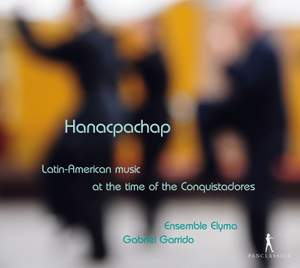
| |  | HanacpachapLatin-American music at the time of the Conquistadores
anon.: | Hanacpachap cussicuinin Un juguetico de fuego | Araujo, J de: | Si el Amor se quedare dormido Dime, amor Los coflades de la estleya | Avila, J: | Entrada | Fernandes, G: | Tleycantimo choquiliya Si nos emprestara oy Dios Xicochi conetzintle Pois con tanta graca | Fernández, D: | Danse | Franco, H: | St. Maria in Ilhuicac Dios itlazonantziné | Garcia, J: | Hermoso amor | González, G: | Serenissima una noche | Hidalgo, J: | Al dichoso nacer de mi nino | Padilla, J G: | A siolo flasiquiyo, negrilla Xácara: A la xácara xacarilla | Penalosa: | Danse | Salazar, D: | ¡Salga el torillo hosquillo! | Torrejon y Velasco: | Rorro : Desvelado Dueno Mio |
| | | (also available to download from $10.75) | Usually despatched in 3 - 4 working days. (Available now to download.) |
|
|
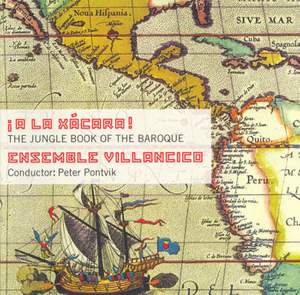
| |  | A la xácara! - The Jungle Book of the Baroque
anon.: | Hanacpachap cussicuinin Vachonloj ibankinal Turulu neglo | Araujo, J de: | Los coflades de la estleya Salga el torillo Si el Amor se quedare dormido | Fernandes, G: | Tleycantimo choquiliya Xicochi conetzintle | Franco, H: | St. Maria in Ilhuicac | González, G: | Serenissima una noche | Herrera, T de: | Hijos d'Eva, tributarios | Hidalgo, G: | Gloria Patri | Hidalgo, J: | Al dichoso nacer de mi nino | Padilla, J: | A la xacara xacarilla Deus in adiutorium meum intende | Padilla, J G: | Las estreyas se rien | Pascual, T: | ¡Oy es dia de placer y de cantar! | Penalosa: | Instrumental piece | Ruiz de Ribayaz: | Tarantela por primer tono |
Stockholm Ensemble Villancico, Peter Pontvik | | | (also available to download from $10.75) | Usually despatched in 4 - 5 working days. (Available now to download.) |
|
|
| |  | Carmina Sacra Vol. 2
| | | Usually despatched in 2 - 3 working days. |
|
|
| |
|