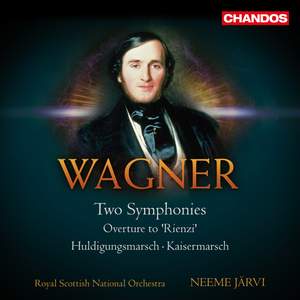
Our series of works by Richard Wagner, performed by the Royal Scottish National Orchestra and Neeme Järvi, continues with a disc of early symphonies, later marches, and an overture.
Early on in his career, Wagner composed two symphonies, both of which are included on this disc. The Symphony in C, which he wrote when he was just nineteen years old, is heavily influenced by Beethoven in its character, mood, and instrumentation. Written two years later, in 1834, the Symphony in E was left unfinished, Wagner completing only the first movement and thirty bars of the second. The completed version recorded here was prepared by the conductor Felix Mottl more than fifty years later at the request of Wagner’s widow, Cosima.
The two marches on this disc are the composer’s most obvious contributions to the genre of pomp and circumstance. The Huldigungsmarsch was written in 1864 for King Ludwig II of Bavaria. The march-like rhythms and brassy colours complement sections in which the strings provide a continuously flowing movement, all leading to a jubilant conclusion. The Kaisermarsch (1871) was a commission from the publishing firm Peters, who requested from Wagner a heroic morale booster at a time when the German countries were at war with France. Having initially composed it for military band, Wagner soon rewrote it for symphony orchestra, the version recorded on this disc.
The Overture to Rienzi, Wagner’s third completed opera (1838 – 40), incorporates the melody of Rienzi’s prayer at the start of Act V, which became the opera’s best-known aria, and ends with a dazzling military march. The Prelude to Act III of Lohengrin (1845 – 47) has the energy, fervour, and brassy sounds of the Overture to Der fliegende Holländer, and displays Wagner’s lasting fascination with creating drama by symphonic means.
“If he had written nothing more, Wagner's Symphony in C would still have prefigured his extraordinary genius - but not its direction...It's still a pleasure, though, fresh and vigorous; Neeme Jarvi's fairly brisk reading, beautifully played by the Royal Scottish National Orchestra, amply explains why Clara Schumann warned Robert he had a new rival.” BBC Music Magazine, May 2012 *****
“Jarvi and the RNSO don't skimp on the music's surging bombast and the Chandos sound has abundant character character: great depth of perspective and no loss of clarity.” Gramophone Magazine, June 2012
“Jarvi gives a spirited if undemonstrative account of this veritable warhorse [the Rienzi overture], elsewhere securing an animated response from the Royal Scottish National Orchestra that serves the music admirably...Pleasureable and thought-provoking listening guaranteed.” International Record Review, May 2012