All recordingsPrices shown exclude VAT. (UK tax is not payable for deliveries to United States.) See Terms & Conditions for p&p rates. | |  | JS Bach: Organ Trio Sonatas (arranged for multiple instruments)
The wealth of secular and sacred music Bach produced in his lifetime belies the fact that very few bona fide works for chamber ensemble exist (or survive). This prompted us, with a great sense of humility and deference towards the master, to increase our chamber repertoire with these beguiling gems. Our task of adapting these pieces for varying combinations of instruments can also be seen as harking back to Bach’s own interest in transferring styles and idioms from other works to a solo or group of instruments, and vice-versa, something which he explored particularly during his years of employment at the ducal court in Weimar (1708-1717). Regular performances in some of the world’s most prestigious venues have confirmed Florilegium’s status as one of Britain’s most outstanding period instrument ensemble. Since their formation in 1991 they have established a reputation for stylish and exciting interpretations, from intimate chamber works to large-scale orchestral and choral repertoire. “The trio sonatas that Bach wrote, probably for his son Wilhelm Friedemann to master his skills at the organ, are so perfect that you can understand why others have plundered them for different instruments...The most successful are BWV 525 and 526, nicely done with flute and violin duetting equally over continuo.” The Observer, 29th July 2012 “it is a measure of Florilegium’s success that anyone who does not know the organ originals would hardly guess that these trios were not conceived for flute, strings and lute or harpsichord continuo. To purists, the combinations might seem un-Bachian, but the instrumentation is inspired. This entrancing disc is a team effort, unreservedly recommended.” Sunday Times, 5th August 2012 “if the spirit of the originals is hard to reproduce, the attempt yields a rich crop of repertoire-enhancing chamber music. The playing sparkles with an intoxicating freshness that continually invites the lively outer movements onto the dance floor.” BBC Music Magazine, November 2012 **** “Especially imaginative scorings inform Florilegium's critiquing of the sonatas' contrapuntal clarity and spaciousness, ones which exploit the multi-genre references which so fascinated Bach...the main Florilegium protagonists offer some wonderfully responsive and vital Bach-playing, esepcially in the framing works.” Gramophone Magazine, November 2012 | | | In stock - usually despatched within 1 working day. |
|
|
| |  |
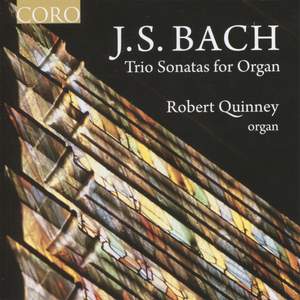
Continuing its work with the rising stars of the early music world, CORO is delighted to be releasing a brand new recording by one of The Sixteen Orchestra’s principal members - organist Robert Quinney. Recorded at The Queen’s College, Oxford, on the beautiful Frobenius Organ (one of the most notable instruments of its kind in the country), the Trio Sonatas are among Bach's most popular and appealing organ works. Complied in the composer’s later years, perhaps as studies for his eldest son Wilhelm Friedemann, the Trio Sonatas are a unique set of works in the organ repertory. Bach transferred to the organ the Italian trio sonata with its two treble voices and bass continuo; for the organ works, Bach uses right hand, left hand, and pedal. Robert Quinney is Sub-Organist of Westminster Abbey and played at the Royal Wedding of Prince William and Catherine Middleton in April. In addition to his daily work at the Abbey, he maintains a busy freelance schedule as a soloist and ensemble player, and is also Director of Oundle for Organists, whose residential courses offer inspiring tuition for young organists. His double compact disc The Grand Organ of Westminster Cathedral, recorded in 2004, was Instrumental Disc of the Month in BBC Music, earned a 5-star review in the French journal Diapason, and was an Editor’s Choice in Gramophone. “Alongside his impeccable performances, Quinney’s greatest achievement is to produce music-making which really communicates itself to the listener’.” GRAMOPHONE “The sound is fluting, crystalline, limpid, yet not without power and profundity. Adapting the Italian chamber-music genre, the trio sonatas are each in three movements, yet with an individual cast. Perfect they may be, but intimate, too, the disc a pure unfolding of pleasure.” Sunday Times, 25th September 2011 “Quinney embraces the transparency of Bach's trios with an ear for their variety, sparkle and cogency. The Frobenius organ at Queen's College, Oxford, provides him with an enticing palette of sounds, while its mechanical security allows Quinney's lucid and carefully articulation to emerge without compromise.” BBC Music Magazine, December 2011 **** “Needless to say, Quinney delivers finger- and foot-perfect performances...[He] projects the first movements with a light touch, allowing their intricate, tuneful beauty to shine brightly...With all the repeats observed, this makes for a very full disc but one which is highly satisfying.” Gramophone Magazine, January 2012 | | | In stock - usually despatched within 1 working day. |
|
|
| |  |
Benjamin Righetti (organ) The six trio sonatas stand out as an almost unique exception in Bach’s output for the organ, essentially composed for the Lutheran liturgy in a style that is frequently much more severe and sometimes positively out of step with the tastes of his time. To serve them K617 give us three organs from the Felsberg factory contributing their rich palette of timbres, played by the fingers and feet of young Swiss virtuoso Benjamin Righetti, 1st prize G. Silbermann of Freiberg (2005) and the International Organ Competition of the City of Paris (2007). 3 instruments: Orgelbau FELSBERG R. • Freytag Tricoteaux J.-M. St. Paul, Lausanne (1986) Triosonaten I & II; The Chiésaz St. Légier (1997) Triosonaten III & IV; Temple, Boudry (1994) Triosonaten V & VI | | | In stock - usually despatched within 1 working day. |
|
|
| |  |
| | | In stock - usually despatched within 1 working day. |
|
|
| |  |
Reine-Marie Verhagen (alto recorder / voice flute) & Tini Mathot (chamber organ / harpsichord) Within J. S. Bach’s wonderfully rich organ repertoire, the six organ trio sonatas are unique in their degree of difficulty and musical splendour. The version represented on this CD features the instrumental combination of recorder and harpsichord or organ. Occasional alterations had to be made to accommodate the recorder. Some keys have been altered to suit the range of the recorder, something Bach also did regularly with his own arrangements. Over the past centuries, the organ trio sonatas have inspired many musicians to make arrangements. In this particular instrumental version the six sonatas form a welcome and invaluable addition to the 18th-century recorder repertoire. Reine-Marie Verhagen studied the recorder with Pieter van Veen and Walter van Hauwe and graduated in 1976. She is a regular member of the Amsterdam Baroque Orchestra, conducted by Ton Koopman, and has performed in several 17th century operas with the ensemble La Sfera Armoniosa and its musical director Mike Fentross. Tini Mathot first studied piano, then harpsichord, at the Sweelinck Conservatory of Music in her home town of Amsterdam. She works closely together with her husband and former teacher Ton Koopman, a duo which performs numerous well- and less-known works for harpsichord, fortepiano and organ. Tini Mathot is recording producer for Ton Koopman, the Amsterdam Baroque Orchestra & Choir. Tini Mathot is mainly active as a performing musician in the field of chamber music. She is a member of the Corelli Ensemble, along with Reine Marie Verhagen. She was awarded the Diapason d’Or in France for the interpretation of the Haydn Trios on CD, released by Erato (with Andrew Manze, violin, and Jaap ter Linden, violoncello). | | | In stock - usually despatched within 1 working day. |
|
|
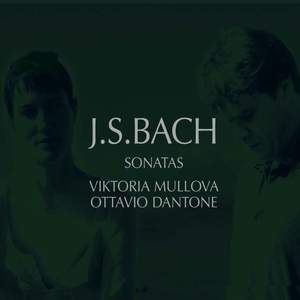
| |  | Bach - Violin Sonatas
“Mullova's warm tone and lightly articulated playing - the Allegro of the A major Sonata affords a particularly rewarding instance - are substantial rewards in themselves, but over and above these she and her keyboard partner prove a stylish and sympathetically matched duo.” BBC Music Magazine, Proms 2007 ***** “To hear Mullova play Bach is, simply, one of the greatest things you can experience” The Guardian BBC Music Magazine
Disc of the month |
| | | In stock - usually despatched within 1 working day. |
|
|
| |  | J S Bach - Works for Trumpet
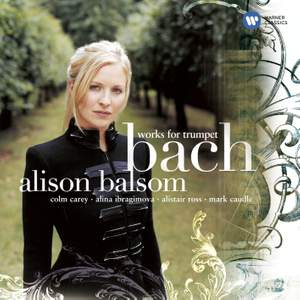
Gramophone described her Bach album as “splendid stuff” and the pieces “showcase Balsom’s phenomenal technique and gleaming expressiveness” “…as a showcase for this young artist's mesmerising virtuosity the disc does its job admirably, and presents some familiar and less familiar Bach in new guises at the same time. The supporting instrumentalists, especially organist Colm Carey, make a sterling contribution...” BBC Music Magazine, February 2006 ***** “A disc of arrangements which is impressive on every level. Beautifully mellow playing contrasting with virtuosic moments.” Classic FM Magazine, March 2006 ***** “Two transposed movements from BWV1008 and a mischievous solo take on the Badinerie (from BWV1067) showcase Balsom's phenomenal technique and gleaming expressiveness. Period-instrument practitioners Alina Ibragimova, Mark Caudle and Alastair Ross provide superb accompaniment in a charismatic version of the Trio Sonata. A surprisingly diverse range of textures and moods makes this disc a beguiling experience.” Gramophone Magazine, May 2006 | | | In stock - usually despatched within 1 working day. |
|
|
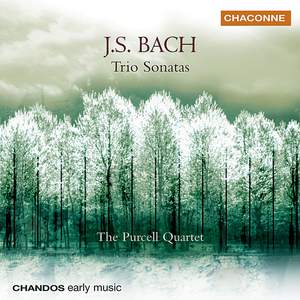
| |  | Bach - Trio Sonatasarranged by Richard Boothby
“'Too good to be left only to organists' is how Richard Boothby cheekily describes Bach's six delightful 'organ trios', in which the organist's two hands play one of the upper lines each, while the bass is played on the pedals. Such is the integrity of this texture in Bach's writing that transferral of this music to a 'true' trio sonata line-up of two melody instruments and continuo is a relatively simple and satisfactory task, and there seems to have been no shortage in recent years of musicians who would agree with Boothby to the point of making their own arrangements for various small ensembles. On disc, these have often served as filler items. Recordings of all six are rarer. Boothby's arrangements for the Purcell Quartet differ from the others currently available in involving no wind instruments. He shows considerable imagination, however, in convincingly varying the scoring between just two violins, viola da gamba and harpsichord, transferring the melodic line to his own viola da gamba whenever the tessitura demands in some movements, making it a full-blown partner in the dialogue in others, and also awarding the harpsichord a melodic role in BWV530. Typically for the Purcell Quartet, the performances offer a sweet sound and a clarity of texture which is all to the good in such intricately and ingeniously contrapuntal music. Generally speaking, however, these performances are enjoyable for their lightness and tenderness (try the slow movement of BWV529). If you want something livelier, and do not necessarily require all six sonatas, you may just favour the Palladian Ensemble's characteristically alert recording of four of them on Linn (see below).” Gramophone Classical Music Guide, 2010 | | | (also available to download from $10.75) | In stock - usually despatched within 1 working day. |
|
|
| |  | JS Bach: Trio Sonatas
Alessio Corti plays the Eilert-Köhler Organ (1738) of the Kreuzkirche at Suhl, Germany. Total playing time: 134 mins. Bonus: Prof. Alessio Corti interview System: PAL 16:9 DVD format: DVD-9 Region 0 (worldwide) Booklet and subtitles in English, French, German, Italian | | | Usually despatched in 8 - 10 working days. |
|
|
| |  | Bach and the South German Tradition II
Martin Neu (Blasius Bernauer Organ, Laufenburg (CH), Metzler Organ, Stuttgart-Obertürkheim) & Wilfried Rombach (tenor organ) The South German Organ Tradition was a considerable influence on Bach’s oeuvre. This recording portrays representative works of the South German composers Johann Jakob Froberger, Johann Caspar Kerll, Georg Muffat and Johann Pachelbel alongside compositions of Bach, thus outlining these interrelations. In addition, this SACD realises the historical performance practice of the Magnificat: works by Pachelbel and Bach are newly combined in a traditional performance of the Magnificat including sung and played verses, forming one musical unity. Two different instruments with different tunings have been used for this recording: the two early works by Froberger and Kerll are performed on the historic choir organ by Blasius Bernauer (1776) in Laufenburg, Switzerland, and the remaining works are played on the new Metzler organ (2005) in Stuttgart- Obertürkheim. “This is a fascinating, well-executed release that is recommended to anyone with an interest in music of this period.” International Record Review, February 2012 | | | (also available to download from $10.75) | Usually despatched in 3 - 4 working days. (Available now to download.) |
|
|
| |
|