All recordingsPrices shown exclude VAT. (UK tax is not payable for deliveries to United States.) See Terms & Conditions for p&p rates. | |  | Schumann: Songs
Schumann: | Lieder und Gesänge aus Goethes Wilhelm Meister, Op. 98a Gedichte der Königin Maria Stuart, Op. 135 Requiem, Op. 90 No. 7 Frauenliebe und -leben, Op. 42 Der Nussbaum, Op. 25 No. 3 Die Lotosblume, Op. 25 No. 7 Widmung, Op. 25 No. 1 Lied der Suleika, Op. 25 No. 9 Liebeslied, Op. 51 No. 5 Die Soldatenbraut Op. 64 No. 1 Erstes Grün, Op. 35 No. 4 Das verlassene Mägdlein, Op. 64 No. 2 Tragödie Op. 64 No. 3 Der Einsiedler, Op. 83 No. 3 |
| | | In stock - usually despatched within 1 working day. |
|
|
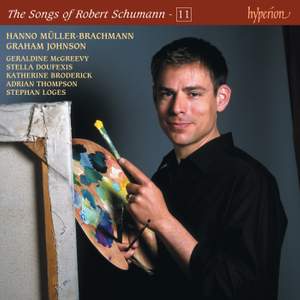
| |  | The Songs of Robert Schumann - Volume 11
Schumann: | Es stürmet am Abendhimmel, Op. 89 No. 1 Heimliches Verschwinden, Op. 89 No. 2 Herbstlied, Op. 89 No. 3 Abschied vom Walde, Op. 89 No. 4 Ins Freie, Op. 89 No. 5 Resignation, Op. 83 No. 1 Der Einsiedler, Op. 83 No. 3 Mein altes Roß, Op. 127 No. 4 Drei Gesänge, Op. 95 Sologesänge aus Friedrich Rückerts Minnespiel, Op. 101 Sechs Gedichte aus dem Liederbuch eines Malers, Op. 36 Provencalisches Lied, Op. 139 No. 4 Ballade, Op. 139 No. 7 Der Handschuh, Op. 87 |
Graham Johnson’s monumental and triumphant complete Schumann Songs edition comes to an end with an eleventh disc of rarities and delights. The first issue in the Hyperion edition of Schuman’s songs, with the soprano Christine Schäfer, included a number of the composer’s later lieder, and with this last issue we come full circle in returning to some of the least known songs—music seldom heard on the concert platform. Hanno-Müller Brachmann appears in his debut recording for Hyperion. As well as a devoted lieder singer who has performed with some of the greatest living pianists, he is also a considerable presence on the world’s opera stages and an acclaimed interpreter of Bach’s Passions. He brings all these qualities to this fascinating disc. Various duets and ensemble pieces are included on this disc and feature familiar and well-loved singers from elsewhere in this series, as well as the winner of the 2008 Kathleen Ferrier Prize: Katherine Broderick. The release is complemented by Graham Johnson’s renowned booklet notes, which make these discs things of such inestimable value. “A real disc of discovery: this is Schumann as he is seldom heard. In this final volume of his revelatory Songs of Robert Schumann series, Graham Johnson perceptively writes about, accompanies and presents still more rarities, in the voices of both loyal colleagues and of younger singers whom he keenly champions.” BBC Music Magazine, February 2009 **** “Hyperion's Schumann Song Edition ends, as it began 12 years ago, with a recital devoted largely to the problematic late songs of 1849-52. With the odd exception, these have often been castigated, not least by Eric Sams in The Songs ofRobert Schumann, as the products of a torpid and increasingly sick mind. But though most of the songs on this disc tend to be more understated, less romantically subjective than those of Schumann's great song year, 1840, the best of them are not necessarily inferior to their predecessors, just different. There are undeniable duds, usually when Schumann is in hearty or heroic vein, alongside touching lyrics like the fragile 'Heimliches Verschwinden', the rapturous 'Liebster, deine Worte stehlen', or 'Provenzalisches Lied', a piquant celebration of courtly love. The lion's share of the programme, including the six Reinick Songs falls to baritone Hanno Müller-Brachmann, whose singing is more notable for robust directness than subtlety. He exploits his deep bass resonances to good effect in 'Sonntags am Rhein', that quintessential song of pious Biedermeier contentment. In 'Liebesbotschaft, Müller-Brachmann sounds lugubrious, despite the flowing tempo, rather than tenderly devoted. He is at his best in declamatory, dramatic mode, recounting a minstrel's bloody revenge in 'Ballade', or in a powerful and atmospheric performance of another chivalrous ballad, 'Der Handschuh'. Elsewhere there are welcome cameo appearances from Adrian Thompson (graceful and smiling in 'Provenzalisches Lied'), Geraldine McGreevy and Stella Doufexis, who combine with baritone Stefan Loges in two attractive quartets from the Rückert Minnespiel. Katherine Broderick, a Wagnerian soprano of the future, impresses with her vibrant intensity in the three Op 95 songs, though even she and Johnson cannot disguise the bombastic tawdriness of 'Dem Helden'. Whatever the provisos, this disc goes far to vindicating some of Schumann's leastfavoured late songs, not least due to Graham Johnson's eloquent advocacy, in print and in performance.” Gramophone Classical Music Guide, 2010 | | | In stock - usually despatched within 1 working day. |
|
|
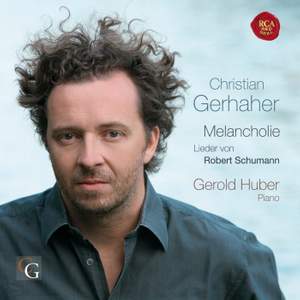
| |  | Melancholie
“The German baritone’s approach to Schumann’s lieder is eminently sensible, sensitive to every word, the curve of each phrase, carefully weighting emotions and colours, strongly supported throughout by Gerold Huber’s poetic piano accompaniments. The Liederkreis cycle is the prime offering, but watch out too for the Hans Christian Andersen settings (Op 40) – in these musicians’ hands, masterpieces of foreboding, death stalking sunshine.” The Times, 25th April 2008 **** “With his bright, burnished high baritone, expressive diction and alert, unexaggerated response to mood and nuance, Gerhaher confirms his credentials as one of the most probing Lieder singers of the younger generation.” Gramophone Magazine, July 2008 “Gerhaher twins the Eichendorff Liederkreis with Schumann's four settings of poems by Hans Christian Andersen - and reveals, in minutely sensitive, sometimes harrowing performances their emotional and musical kinship. And the Op. 39 Liederkreis itself? Well, Gerhaher's fusion of deeply pondered insight and unselfconscious enunciation, together with Gerold Huber's sentient piano allow this exceptional performance to become a benchmark in its own right.” BBC Music Magazine, July 2008 ***** “Though the catch-all title 'Melancholie' is slightly misleading, Christian Gerhaher's enterprisingly planned programme provides a conspectus of Schumann's art as a Lieder composer. With his bright, burnished high baritone, expressive diction and alert, unexaggerated response to mood and nuance, Gerhaher confirms his credentials as one of the most probing Lieder singers of the younger generation. While it is virtually impossible for a single voice to do equal justice to all 12 songs of the Liederkreis, he succeeds better than most. He beautifully suggests the melancholy and mystery of the opening 'In der Fremde', singing with fine legato and a subtly judged use of rubato, and brings an impetuous urgency and a chilling final frisson to the Lorelei scene 'Waldesgespräch'. 'Die Stille', a difficult song for a man to bring off, is delicate and wondering without archness; the bardic 'Auf einer Burg' is hypnotically sustained in a numb, blanched tone, devoid of all nuances, while the final 'Frühlingsnacht', which can easily sound flustered, here has an ecstatic sense of finality. Perhaps Gerhaher and the discerning if sometimes over-discreet Gerold Huber slightly miss the tremulous expectation of 'Intermezzo'; and there have been more magical performances of 'Mondnacht', here taken dangerously slowly. But for imaginative depth in the Liederkreis Gerhaher can certainly stand alongside the best. Gerhaher and Huber choose unusually slow tempi for one or two of the other songs, most questionably in the Andersen song 'Der Spielmann', where the village wedding music should surely suggest more feverish wildness than here. Far more often, though, Gerhaher impresses with his unselfconscious eloquence, whether in the anguished life-weariness of the Harpers' songs, a chillingly timed and coloured 'Der Soldat' or in the potentially mawkish 'Liebesbotschaft', sung with a rapt, echt Schumannesque inwardness. Not for the only time in these Reinick songs, Gerhaher makes you 'upgrade' music that can look distinctly homely, even bland, on the printed page. The baritone provides his own thoughtful note, though frustratingly you'll have to go to his website for English translations of the song texts.” Gramophone Classical Music Guide, 2010 | | | In stock - usually despatched within 1 working day. |
|
|
| |  | Eichendorff Lieder
Mendelssohn: | Das Waldschloss Nachtlied, Op. 71 No. 6 Pagenlied | Pfitzner: | Im Herbst Op. 9 No. 3 Lockung Op. 7 No. 4 In Danzig, Op. 22 No. 1 Der verspätete Wanderer, Op. 41 No. 2 Nachts Op. 26 No. 2 Zum Abschied meiner Tochter, Op. 10 No. 3 | Schumann: | In der Fremde (No. 1 from Liederkreis, Op. 39) Schöne Fremde (No. 6 from Liederkreis, Op. 39) Zwielicht (No. 10 from Liederkreis, Op. 39) Im Walde (No. 11 from Liederkreis, Op. 39) Der Einsiedler, Op. 83 No. 3 Intermezzo (No. 2 from Liederkreis, Op. 39) | Schwarz-Schilling: | Kurze Fahrt Marienlied Bist du manchmal auch verstimmt | Walter, B: | Der Soldat Der junge Ehemann | Wolf, H: | In der Fremde I 'Da fahr ich still im Wagen' Nachtzauber (No. 8 from Eichendorff-Lieder) Der Musikant (No. 2 from Eichendorff-Lieder) Nachruf Seemans Abschied (No. 17 from Eichendorff-Lieder) Der verzweifelte Liebhaber (No. 14 from Eichendorff-Lieder) Verschwiegene Liebe (No. 3 from Eichendorff-Lieder) |
| | | Usually despatched in 3 - 4 working days. |
|
|
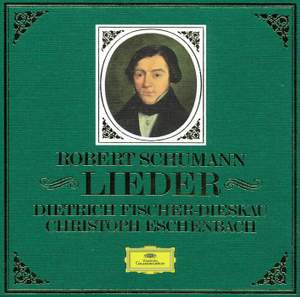
| |  | Robert Schumann: Lieder
Schumann: | Widmung, Op. 25 No. 1 Freisinn, Op. 25 No. 2 Der Nussbaum, Op. 25 No. 3 Aus dem Schenkenbuch im Divan I, Op. 25 No. 5 Aus dem Schenkenbuch im Divan II, Op. 25 No. 6 Die Lotosblume, Op. 25 No. 7 Talismane, Op. 25 No. 8 Hochländers Abschied, Op. 25 No. 13 Mein Herz ist schwer, Op. 25 No. 15 Rätsel, Op. 25 No. 16 Zwei Venetianische Lieder, Op. 25 Nos. 17 & 18 Hauptmanns Weib, Op. 25 No. 19 Was will die einsame Träne, Op. 25 No. 21 Niemand, Op. 25 No. 22 Du bist wie eine Blume, Op. 25 No. 24 Aus den östlichen Rosen, Op. 25 No. 25 Zum Schluß, Op. 25 No. 26 Lieder und Gesänge I, Op. 27 Drei Gedichte von Emanuel Geibel, Op. 30 Die Löwenbraut, Op. 31 No. 1 Die rote Hanne, Op. 31 No. 3 Sechs Gedichte aus dem Liederbuch eines Malers, Op. 36 Der Himmel hat eine Träne geweint, Op. 37 No. 1 Ich hab' in mich gesogen, Op. 37 No. 5 Flügel! Flügel! um zu fliegen, Op. 37 No. 8 Rose, Meer und Sonne , Op. 37 No. 9 Liederkreis, Op. 39 Lieder (5), Op. 40 Der Schatzgräber, Op. 45 No. 1 Frühlingsfahrt, Op. 45 No. 2 Der frohe Wandersmann, Op. 77 No. 1 Liederkreis, Op. 24 Gedichte (12) von Justinus Kerner Op. 35 Abends am Strand, Op. 45 No. 3 Dichterliebe, Op. 48 Die beiden Grenadiere, Op. 49 No. 1 Die feindlichen Brüder, Op. 49 No. 2 Auf dem Rhein, Op. 51 No. 4 Romanzen und Balladen III, Op. 53 Belsazar, Op. 57 Tragödie Op. 64 No. 3 Melancholie Op. 74 No. 6 (Francisco Saa de Miranda / Emanuel Geibel) Geständnis, Op. 74 No. 7 Der Kontrabandiste, Op. 74 No. 10 Aufträge, Op. 77 No. 5 Liederalbum für die Jugend, Op. 79 (extracts) Resignation, Op. 83 No. 1 Der Einsiedler, Op. 83 No. 3 Der Handschuh, Op. 87 Es stürmet am Abendhimmel, Op. 89 No. 1 Heimliches Verschwinden, Op. 89 No. 2 Herbstlied, Op. 89 No. 3 Abschied vom Walde, Op. 89 No. 4 Ins Freie, Op. 89 No. 5 Gedichte (6) und Requiem, Op. 90 An den Mond, Op. 95 Nachtlied, Op. 96 No. 1 Schneeglöckchen Op. 96 No. 2 (anonymous) Ihre Stimme Op. 96 No. 3 (August von Platen) Ballade des Harfners, Op. 98a No. 2 Wer nie sein Brot mit Tränen ass, Op. 98a No. 4 Wer sich der Einsamkeit ergibt, Op. 98a No. 6 An die Türen will ich schleichen, Op. 98a No. 8 Mein Schöner Stern! Op. 101 No. 4 Der Gärtner, Op. 107 No. 3 Abendlied, Op. 107 No. 6 Vier Husarenlieder Op. 117 Warnung Op. 119 No. 2 (Gustav Pfarrius) Die Meerfee Op. 125 No. 1 Jung Volkers Lied, Op. 125 No. 3 Husarenabzug, Op. 125 No. 2 Dein Angesicht, Op. 127 No. 2 Es leuchtet meine Liebe, Op. 127 No. 3 Spanische Liebeslieder Op. 138 (selection) Provencalisches Lied, Op. 139 No. 4 Trost im Gesang, Op. 142 No. 1 Lehn deine Wang' Op. 142 No. 2 Mein Wagen rollet langsam, Op. 142 No. 4 Schön Hedwig Op. 106 Vom Heideknaben Op. 122 Nos. 1 & 2 Sechs frühe Lieder, Op. post. (WoO 21) |
Dietrich Fischer-Dieskau & Christoph Eschenbach | | (Sorry, download not available in your country) | |
|
|
| |
|