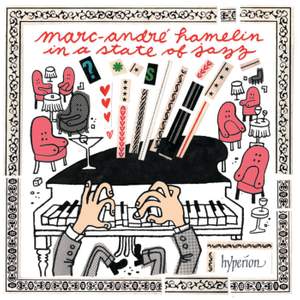
Marc-André Hamelin’s technical and interpretative brilliance over an extraordinarily wide range of repertoire has placed him firmly in the top rank of living pianists. His recent recordings of Alkan and Haydn were universally
acclaimed in the highest terms. In this latest recording, Hyperion presents Marc-André Hamelin ‘in a state of jazz’, as he turns his attention to the music of Kapustin, Antheil, Gulda and Weissenberg—all composers who felt keenly that there was a fundamental desire on the part of the concert-going public to hear something different. This wonderful disc is full of surprises—as Hamelin writes in his entertaining yet scholarly liner notes, ‘There is no jazz in this recording. At least not in the traditional sense … There is much to be enjoyed here, and much to be amazed by’.
May 2008
****
“Hamelin's amazing technique and clarity of sound means that the music sounds as spontaneous as it can, though there's still a lingering doubt that it's all just a bit too knowing and clever.”
“The Canadian pianist Marc-André Hamelin possesses one of those musical brains that spark with maddening brilliance in whatever direction takes his fancy … it’s hard to believe Hamelin didn’t grow up within earshot of some dubious jazz haunt
in New Orleans or Harlem … as Hamelin explains in his enjoyably lucid booklet notes, Gulda’s astonishing pianistic pedigree deserves to be seen in a far wider context … Hamelin’s evocations of these are wonderfully whimsical yet as crisp as celery. The syncopations ‘sit’ so comfortably under his
fingers—exactly the right balance between ambition and restraint, warmth and edge—a pretty rare commodity in the performance of classical repertoire, let alone jazz-inspired music … this is a lovely, lovely disc; I highly recommend it”
June 2008
“It is played with such agility and aplomb that you end up mesmerised by every bar. ”
2010
“'In a State of Jazz' presents a form of fusion music where the influence of jazz is grafted onto classical forms. So although Gulda, Kapustin and Weissenberg whirl us into heady jazz idioms, their work is notated rather than improvised. As Marc-André Hamelin tells us in the opening sentence of his brilliant accompanying essay, 'there is no jazz on this recording'. Again, all three composers, temporarily stifled by classical norms and mores, sought a liberation that would send them soaring into what would once be considered alien territory. Weissenberg, for example, claims his Sonata in a Stateof Jazz is fuelled by 'intoxication, contamination and madness' while 'written in a state of indisputable sobriety'. Gulda, too, loved to escape from the confines of Carnegie Hall to the Birdland club in New York, jamming away into the small hours and claiming that he had left the past to join the vibrant living present and future. All this and much more makes for music that is arguably more brittle and sophisticated than uplifting, but it is played with such astounding agility and aplomb that you end up mesmerised by virtually every bar. Indeed, it is no exaggeration to say that no other pianist could approach Hamelin in such music. Notes pour and cascade like diamonds from his fingers and he has an inborn flair for the music's wild, free-wheeling melodies and rhythms, for its glittering whimsy and caprice. Doubting Thomases should try the first movement of Kapustin's Second Sonata for crazed virtuoso exuberance and Trenet's 'Coin de rue' (cunningly arranged by Weissenberg) for teasing nostalgia. Superbly presented and recorded, this is a special addition to Hamelin's towering and unique discography.”
June 2008
****
“Hamelin plays with such dextrous panache that he puts back much of the heat that formalisation of jazz as 'composition' removes”
Click on any of the works listed above for alternative recordings.