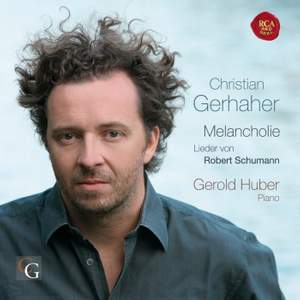
“The German baritone’s approach to Schumann’s lieder is eminently sensible, sensitive to every word, the curve of each phrase, carefully weighting emotions and colours, strongly supported throughout by Gerold Huber’s poetic piano accompaniments. The Liederkreis cycle is the prime offering, but watch out too for the Hans Christian Andersen settings (Op 40) – in these musicians’ hands, masterpieces of foreboding, death stalking sunshine.” The Times, 25th April 2008 ****
“With his bright, burnished high baritone, expressive diction and alert, unexaggerated response to mood and nuance, Gerhaher confirms his credentials as one of the most probing Lieder singers of the younger generation.” Gramophone Magazine, July 2008
“Gerhaher twins the Eichendorff Liederkreis with Schumann's four settings of poems by Hans Christian Andersen - and reveals, in minutely sensitive, sometimes harrowing performances their emotional and musical kinship. And the Op. 39 Liederkreis itself? Well, Gerhaher's fusion of deeply pondered insight and unselfconscious enunciation, together with Gerold Huber's sentient piano allow this exceptional performance to become a benchmark in its own right.” BBC Music Magazine, July 2008 *****
“Though the catch-all title 'Melancholie' is slightly misleading, Christian Gerhaher's enterprisingly planned programme provides a conspectus of Schumann's art as a Lieder composer.
With his bright, burnished high baritone, expressive diction and alert, unexaggerated response to mood and nuance, Gerhaher confirms his credentials as one of the most probing Lieder singers of the younger generation. While it is virtually impossible for a single voice to do equal justice to all 12 songs of the Liederkreis, he succeeds better than most. He beautifully suggests the melancholy and mystery of the opening 'In der Fremde', singing with fine legato and a subtly judged use of rubato, and brings an impetuous urgency and a chilling final frisson to the Lorelei scene 'Waldesgespräch'. 'Die Stille', a difficult song for a man to bring off, is delicate and wondering without archness; the bardic 'Auf einer Burg' is hypnotically sustained in a numb, blanched tone, devoid of all nuances, while the final 'Frühlingsnacht', which can easily sound flustered, here has an ecstatic sense of finality.
Perhaps Gerhaher and the discerning if sometimes over-discreet Gerold Huber slightly miss the tremulous expectation of 'Intermezzo'; and there have been more magical performances of 'Mondnacht', here taken dangerously slowly.
But for imaginative depth in the Liederkreis Gerhaher can certainly stand alongside the best.
Gerhaher and Huber choose unusually slow tempi for one or two of the other songs, most questionably in the Andersen song 'Der Spielmann', where the village wedding music should surely suggest more feverish wildness than here.
Far more often, though, Gerhaher impresses with his unselfconscious eloquence, whether in the anguished life-weariness of the Harpers' songs, a chillingly timed and coloured 'Der Soldat' or in the potentially mawkish 'Liebesbotschaft', sung with a rapt, echt Schumannesque inwardness. Not for the only time in these Reinick songs, Gerhaher makes you 'upgrade' music that can look distinctly homely, even bland, on the printed page. The baritone provides his own thoughtful note, though frustratingly you'll have to go to his website for English translations of the song texts.” Gramophone Classical Music Guide, 2010