Prices shown exclude VAT. (UK tax is not payable for deliveries to United States.) See Terms & Conditions for p&p rates. | |  | Enchanted Forest: Anna Prohaska
Anna Prohaska possesses a beautiful voice, perfect technique, interpretive originality, and genuine charisma and character. Singing Baroque arias by Cavalli, Handel, Monteverdi, Morley, Purcell, and Vivaldi – Anna Prohaska vividly brings life to all the fairy-like characters who inhabit this extraordinary music. Favoured by such maestri as Claudio Abbado, Daniel Barenboim, and Pierre Boulez – Anna Prohaska, with Enchanted Forest, demonstrates a mature mastery of coloratura and cantilena singing. “superlative backing from Jonathan Cohen’s instrumental group Arcangelo. In a programme ranging from Monteverdi to Handel the plus points are delicate tone, exuberant ornamentation and echo effects in a wonderful Cavalli aria. But her English consonants don’t have enough bite in Purcell and her mannered glissandi need ruthless suppression.” The Times, 16th March 2013 *** “Arcangelo's instrumental playing is reliably interesting, sometimes too interesting (Jonathan Cohen is not a 'less is more' director)...Prohaska's real talent is for the the earthy, wordy, rhythmically and emotionally multivalent declamations of Cavalli and Monteverdi...Lamento della ninfa is the standout performance, brilliantly characterised by Prohaska...this is more like an opera compressed into mere minutes.” BBC Music Magazine, May 2013 **** “She's wonderful in 17th-century music, spinning out the lines of a Purcell chaconne and negotiating Cavalli's recitatives-cum-ariosos with impeccable understanding and style. When she turns to Handel and Vivaldi, however, the sensitivity of her singing gives way to a heavyweight athleticism, and the results are altogether less appealing. Arcangelo under Jonathan Cohen are breathtaking throughout.” The Guardian, 11th April 2013 *** “Prohaska has a strong-centred voice with a slightly dark colouring which is striking in itself...the more outgoing and technically demanding Handel and Vivaldi arias certainly come off effectively, with Prohaska's sometimes unconventional ornamentation adding a characterful twist” Gramophone Magazine, May 2013 “All is cleanly articulated in rapid motion, whether long runs or intricate vocal curlicues...Arcangelo and Cohen augments one's pleasure.” International Record Review, June 2013 | 
| | | In stock - usually despatched within 1 working day. |
|
|
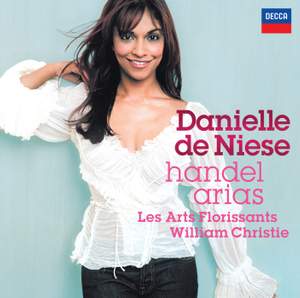
| |  | Danielle de Niese - Handel Arias
The debut solo recording from Danielle de Niese, who became a star overnight after her stunning 'all singing, all dancing' performance as Cleopatra in Handel's Giulio Cesare at Glyndebourne in 2005. Danielle signs a selection of Handel arias from both famous and lesser-known works which showcase perfectly her extraordinary dramatic range and vocal abilities. “De Niese demonstrates good technical skills and a keen sense of character, but above all there's a strong artistic personality at work that enables her to make each statement her own.” BBC Music Magazine, March 2008 **** “When it comes to sorceresses, de Niese is splendid. The two arias for Medea in Teseo are well contrasted. "Dolce riposo" is a duet for voice and oboe over a pulsating string accompaniment, sung with an affecting gentleness, while "O stringerò nel' sen" is a fiery expression of jealousy. ” Gramophone Magazine, June 2008 “Her singing is utterly delectable and completely assured.” The New York Times “De Niese can certainly "sell" a number. She makes each of these arias an emotional journey, heightening the expression when the first section is repeated. Semele's "Myself I Shall Adore" becomes increasingly, and delightfully, dizzy, with narcissistic flights of ornamentation, while at the opposite end of the spectrum she suggests a new intensity of grief towards the end of Ginevra's "Il mio crudel martoro" ( Ariodante ), with a "soured" colouring on the key word "moro" - dying.
What makes me faintly uneasy is the less than even quality of de Niese's voice and her reluctance to sing either a true legato or a true pianissimo, though the ultra-close miking must take some of the blame here. Her bright, slender soprano, with its distinctive quick vibrato, has an attractive hint of smokiness in the middle register. Higher up, it can become thin and squally - I noticed this especially in her no-holds-barred performances of Cleopatra's "Da tempeste" and Morgana's "Tornami a vagheggiar" ( Alcina ).
Yet for all her vocal imperfections, De Niese brings each of these characters to vivid life.” The Times, 10th May 2008 | | | In stock - usually despatched within 1 working day. |
|
|
| |
|