Prices shown exclude VAT. (UK tax is not payable for deliveries to United States.) See Terms & Conditions for p&p rates. | |  | A Tribute to Scriabin
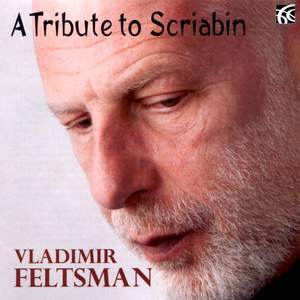
Scriabin: | Prelude, Op. 11 No. 11 in B major Prelude, Op. 11 No. 13 in G flat major Prelude, Op. 16 No. 1 in B major Prelude, Op. 16 No. 3 in G flat major Prelude, Op. 16 No. 4 in E flat minor Prelude, Op. 22 No. 1 in G sharp minor Prelude, Op. 22 No. 2 in C sharp minor Prelude, Op. 22 No. 3 in B minor Prelude, Op. 37 No. 2 Prelude, Op. 37 No. 3 Piano Sonata No. 4 in F sharp major, Op. 30 Deux poèmes, Op. 32 Étude Op. 42 No. 4 in F sharp major Étude Op. 42 No. 5 in C sharp minor Waltz in A flat major, Op. 38 Rêverie, Op. 49 No. 3 Poème Aile, Op. 51 No. 3 Danse languide, Op. 51 No. 4 Two Pieces, Op. 57 Etrangeté, Op. 63 No. 2 Deux Danses Op. 73 Preludes, Op. 74 (5) Vers la flamme, Op. 72 Valse Op. Posth |
This recording was conceived as a portrait of the artist through the mosaic of his works, proceeding in chronological order – from the age of innocence to the age of experience. “How he relishes Chopin's influence...His performance of the Fourth Sonata ('towards a blue flame') is a marvel of clarity and musicianship...More generally, everything is given with a warmth and sincerity that are the reverse of extravagance or self-conscious idiosyncrasy: as an introduction to Scriabin's compulsive genius this disc could hardly be bettered.” Gramophone Magazine, Awards Issue 2012 | | | Usually despatched in 4 - 5 working days. |
|
|
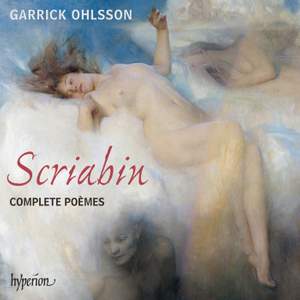
| |  | Scriabin: Intégrale des Poèmes
Scriabin: | Deux poèmes, Op. 32 Poeme for Piano, Op.41 Poème tragique Op. 34 Poème-Nocturne, Op. 61 Poème Aile, Op. 51 No. 3 Poème for piano, Op. 59 No. 1 Poeme satanique for Piano, Op.36 Poème in C major, Op. 52 No. 1 Quasi Valse, Op. 47 Waltz in A flat major, Op. 38 Poeme languide Op. 52 No. 3 Poème fantasque in C major, Op. 45 No. 2 2 Poems for Piano, Op. 44 Feuillet d'album, Op. 45 No. 1 Poèmes, Op. 69 Nos. 1 & 2 2 Poems for Piano, Op. 63 Deux poèmes Op. 71 Vers la flamme, Op. 72 |
These pieces with their ‘revolutionary’ harmony took the piano into the 20th century. They are a challenge to the interpreter, as they have to master both the spiritual and technical aspects of this composer’s art. Pascal Amoyel more than rises to the challenge. He studied at the Paris Conservatoire and is both a pianist and composer. “Amoyel's first-rate pianism puts clarity, proportion, and controlled freedom above all else and keeps the music's volatile undercurrents alive and active” Classics Today “Pascal Amoyel admits he was driven close to neurosis when preparing his Scriabin recording and found it difficult to re-emerge into the world of other composers. Aphoristic or endlessly protracted, seemingly lost in a harmonic limbo or fiercely to the point, such music is indeed challenging to both listener and performer. For Amoyel the tirelessly extended Poème-nocturne is 'phantasmagorical, ill-defined and confused' (terms he intends as the greatest compliment) and his playing on what he describes as a 'rather sombre-sounding Steinway' amply conveys his enthusiasm. He is acutely sensitive to the dark mystery at the heart of the Op 41 Poème, its final section a decadent memory of Chopin's Op 10 No 6 Etude, and responds with refinement as well as energy to the Poème tragique with its demands of festivamente, fastoso, irato and fiero. In the Poème satanique (music indelibly associated with Sofronitsky) light is stalked by darkness in a menacing game of tag, while the enchanting Op 38 Valse is an all- Russian extension of the world of Liszt's Valsesoubliées. The Op 69 No 2 Poème is a notably grotesque danse macabre and in the final Vers laflamme Amoyel takes us on a mesmeric journey from threatening shadows to searing brilliance. Yet even here he resists virtuoso temptations, making it odd that he should be described in France as one of Cziffra's 'spiritual heirs'. Confidentiality and insinuation are his hallmarks rather than wildness or flamboyance. Calliope's sound, like Amoyel's instrument, is subdued but it hardly detracts from an experience that is stifling or exhilarating, according to taste.” Gramophone Classical Music Guide, 2010 “Amoyel makes the 3 minutes of this first Poème blissful to listen to - a sweet polyphony of floating lines, a pure rubato. In the title of Poème languide, the manner is explicit, but there are also heavily insistent, iteratively
chordal items, such as Poème satanique. Vers la flamme memorably combines the approaches. Poème fantasque self-destructs in 29 seconds.” Sunday Times | | | Usually despatched in 2 - 3 working days. |
|
|
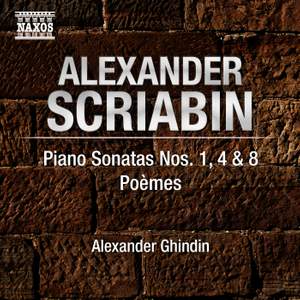
| |  | Piano Recital: Alexander GhindinWinner, 2007 Cleveland International Piano Competition
Scriabin: | Piano Sonata No. 1 in F minor, Op. 6 Piano Sonata No. 4 in F sharp major, Op. 30 Piano Sonata No. 8, Op. 66 Deux poèmes, Op. 32 2 Poems for Piano, Op. 44 Poème fantasque in C major, Op. 45 No. 2 Poème Aile, Op. 51 No. 3 Poème for piano, Op. 59 No. 1 2 Poems for Piano, Op. 63 Poèmes, Op. 69 Nos. 1 & 2 Deux poèmes Op. 71 |
Alexander Ghindin (piano) Scriabin’s cycle of Piano Sonatas is one of the most visionary and dramatic in the canon. The First dates from 1892, written at a time of crisis in his life, and is a passionate, emotionally unstable work, whilst No. 4, completed over a decade later, embodies the new developments in his stylistic armoury. The Eighth was the last of the ten to be completed, and it approaches the zenith of Scriabin’s art in its intricacy, poetry and complex tapestry of textures. The Poèmes and Morceaux represent, in even more concentrated form, the harmonic allure of Scriabin’s writing. The youngest ever laureate of the International Tchaikovsky Competition in Moscow in 1994, and winner of the 2007 Cleveland International Piano Competition, Alexander Ghindin has established himself as a major pianist of distinction. “The performances of both the later works have a terrific febrile intensity that is true to the spirit, if not always to the letter, of Scriabin's music.” The Guardian, 15th September 2011 *** | | | (also available to download from $6.00) | Usually despatched in 2 - 3 working days. (Available now to download.) |
|
|
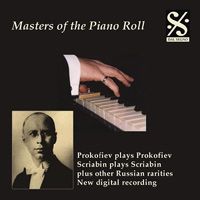
| |  | Prokofiev Plays Prokofiev, Scriabin Plays Scriabin
& Other Piano Rarities
Glazunov: | Prelude in G minor, Op.23 No.5 Sergei Prokofiev | Lyapunov: | Elegy on the Death of Liszt, Op. 11 Serge Liapounov | Miaskovsky: | Whims Op. 25 (excerpts) Sergei Prokofiev | Prokofiev: | Pieces (10), Op. 12: No. 2 - Gavotte Sergei Prokofiev Pieces (10), Op. 12: No. 1 - March Sergei Prokofiev Pieces (10), Op. 12: No. 3 - Rigadon Sergei Prokofiev Pieces (10), Op. 12: No. 10 - Scherzo Sergei Prokofiev Prelude in C major, Op. 12 No. 7 Sergei Prokofiev The Love for Three Oranges Suite - excerpts Sergei Prokofiev Sarcasm Op. 17 No. 1 Sergei Prokofiev Sarcasm Op. 17 No. 2 Sergei Prokofiev Conte de la vieille grand-mere, Op. 31, No. 3 Sergei Prokofiev Toccata in D minor, Op. 11 Sergei Prokofiev | Scriabin: | Gavotte, Op. 49 No.3 Sergei Prokofiev Prelude, Op. 45 No. 3 in E flat major Sergei Prokofiev Poème Aile, Op. 51 No. 3 Sergei Prokofiev Prelude, Op. 22 No. 1 in G sharp minor Alexander Scriabin Prelude, Op. 11 No. 1 in C major Alexander Scriabin Prelude, Op. 11 No. 2 in A minor Alexander Scriabin Prelude, Op. 11 No. 13 in G flat major Alexander Scriabin Prelude, Op. 11 No. 14 in E flat minor Alexander Scriabin Désir, Op. 57 No. 1 Alexander Scriabin Mazurka, Op. 40 No. 2 Alexander Scriabin |
| | | Usually despatched in 8 - 10 working days. |
|
|
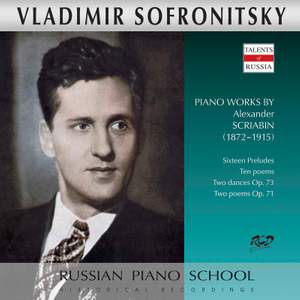
| |  | The Art of Sofronitsky: Scriabin
Scriabin: | 12 Preludes Op. 11 Prelude, Op. 9 No. 1 in C sharp minor for the left hand Prelude, Op. 22 No. 2 in C sharp minor Prelude, Op. 15 No. 1 in A major Prelude, Op. 13 No. 1 in C major Poème in C major, Op. 52 No. 1 Poème for piano, Op. 59 No. 1 Poème Aile, Op. 51 No. 3 Poeme languide Op. 52 No. 3 Masque, Op. 63, No. 1 Poeme satanique for Piano, Op.36 Poème, Op. 32 No. 2 Poème in F sharp major, Op. 32 No. 1 Poèmes, Op. 69 Nos. 1 & 2 Deux Danses Op. 73 Deux poèmes Op. 71 Fragilite, Op. 51, No. 1 Feuillet d'album, Op. 45 No. 1 Piano Sonata No. 4 in F sharp major, Op. 30 Poème tragique Op. 34 Waltz in A flat major, Op. 38 Étude Op. 8 No. 11 in B flat minor |
Vladimir Sofronitsky (piano) ADD | | | Usually despatched in 8 - 10 working days. |
|
|
| |  | Sofronitzky plays Russian Music
Scriabin: | Prelude, Op. 11 No. 1 in C major Piano Sonata No. 3 in F sharp minor, Op. 23 Piano Sonata No. 2 in G sharp minor, Op. 19 'Sonata Fantasy' Poème, Op. 32 No. 2 Poem for Piano, Op. 44, No. 1 Ironies Op. 56 No. 2 Désir, Op. 57 No. 1 Polonaise, Op. 21 Étude Op. 42 No. 4 in F sharp major Étude Op. 42 No. 6 in D flat major Waltz in A flat major, Op. 38 Prelude, Op. 11 No. 3 in G major Prelude, Op. 11 No. 6 in B minor Prelude, Op. 11 No. 7 in A major Prelude, Op. 11 No. 8 in F sharp minor Prelude, Op. 11 No. 11 in B major Prelude, Op. 11 No. 12 in G sharp minor Prelude, Op. 11 No. 13 in G flat major Prelude, Op. 11 No. 17 in A flat major Prelude, Op. 11 No. 20 in C minor Prelude, Op. 13 No. 1 in C major Prelude, Op. 11 No. 2 in A minor Prelude, Op. 13 No. 3 in G major Prelude, Op. 11 No. 4 in E minor Prelude, Op. 11 No. 5 in D major Prelude, Op. 13 No. 6 in B minor Prelude, Op. 15 No. 1 in A major Prelude, Op. 9 No. 1 in C sharp minor for the left hand Prelude, Op. 11 No. 9 in E major Prelude, Op. 11 No. 10 in C sharp minor Prelude, Op. 22 No. 2 in C sharp minor Prelude, Op. 16 No. 2 in G sharp minor Prelude, Op. 16 No. 5 in F sharp major Prelude, Op. 16 No. 4 in E flat minor Prelude, Op. 11 No. 15 in D flat major Prelude, Op. 11 No. 16 in B flat minor Prelude, Op. 11 No. 19 in E flat major Prelude, Op. 11 No. 21 in B flat major Prelude, Op. 11 No. 22 in G minor Prelude, Op. 11 No. 24 in D minor Poème in C major, Op. 52 No. 1 Poème for piano, Op. 59 No. 1 Poème Aile, Op. 51 No. 3 Masque, Op. 63, No. 1 Poeme satanique for Piano, Op.36 Piano Sonata No. 9, Op. 68 'Black Mass' Poèmes, Op. 69 Nos. 1 & 2 Flammes sombres, Op. 73 No. 2 Guirlandes, Op. 73 No. 1 Piano Sonata No. 10, Op. 70 Fragilite, Op. 51, No. 1 Feuillet d'album, Op. 45 No. 1 Étude Op. 42 No. 5 in C sharp minor Mazurka, Op. 40 No. 2 Étude Op. 8 No. 12 in D sharp minor |
Vladimir Sofronitzky (piano) ‘He played like a god – he looked like a god’ Heinrich Neuhaus Vladimir Sofronitsky was born in St Petersburg in 1901, the youngest of 6 children. He studied in Warsaw with Anna Lebedeva-Getsevich, a pupil of Anton Rubinstein, and, on the recommendation of Glazunov, further studies with Alexander Michalowski. Michalowski was a pupil of Moscheles, Reinecke and Tausig, so the Beethoven – Mendelssohn – Liszt line was seamless. Composition classes with Maximillian Steinberg (Rimsky’s son-in-law) followed as did a period of study with Leonid Nikolayev, who also taught Shostakovich. In 1917, Scriabin’s daughter Elena enrolled under Nikolayev, and she and Sofronitzky married in 1920 and moved to Paris, where their circle included members of the Scriabin family, Glazunov, Prokofiev (a good friend), Medtner and Cortot. In July 1945 he played for Stalin, Gromyko, President Truman and Churchill at the Potsdam Conference. His career revolved around concerts, recording and teaching, and his repertoire was broad – from Bach and Scarlatti, Clementi, Mozart, Beethoven and Schubert, to Chopin and Liszt, Schumann, a little late Brahms, a little Ravel and Debussy and Poulenc. Russian repertoire included Balakirev’s Islamey, and Tchikovsky’s Seasons and some Liadov. Scriabin reigns supreme (except the 7th Sonata ‘White Mass’ Sofronitzky was superstitious), Glazunov, Medtner, Prokofiev, Rachmaninov and Shostakovich also figure prominently. During the Cold War, he took a shine to Glenn Gould, and Van Cliburn, and Lazar Berman was a disciple. ‘I would proceed to the concert as if going on a blind date, anticipating something completely unknown, mysterious and wonderful, in other words, a miracle! He approached the piano and the magic began’ Stanislav Neuhaus, Recollections | | | In stock - usually despatched within 1 working day. |
|
|
| |
|