Frescobaldi: Canzona quinta

This page lists all recordings of Canzona quinta, by Girolamo Frescobaldi (1583-1643) on CD & download (MP3 & FLAC). Generally, more recent releases are listed first, but with priority given to those that are in stock.

Prices shown exclude VAT. (UK tax is not payable for deliveries to United States.)
See Terms & Conditions for p&p rates.

1600: Masterpieces of 17th-century Italian Instrumental Music

1600: Masterpieces of 17th-century Italian Instrumental Music


Abaco, E:

Concerto a quattro da chiesa, Op. 2 No. 1 in D minor

anon.:

Fantaisie

Luigi Rossi?

Bononcini, G B:

Sinfonia quarta

Castello:

Sonata decima sesta à 4 per stromenti d’arco

Frescobaldi:

Canzona quinta

Gabrieli, G:

Canzone a quattro detta la spiritata

Legrenzi:

Sonata Seconda à sopran solo

Macque:

Consonanze stravaganti

Marini, B:

Passacaglio a quattro e a tre

Merula:

Canzon Quinto

Capriccio cromatico a 4

Salvatore:

Canzone francese seconda

Torelli:

Concerto for strings, Op. 6 No. 1

Zanetti:

Il scolaro… per imparare a suonare di violino


Mauro Lopes Ferreira, Nicholas Robinson (violins), Ettore Belli (viola), Luca Peverini cello), Ugo di Giovanni (theorbo) & Rinaldo Alessandrini (harpsichord, organ & director)

Concerto Italiano

The programme chosen for this CD by the eminent early music specialist Rinaldo Alessandrini and performed by members of his hand-picked ensemble Concerto Italiano illustrate most of the forms that instrumental music adopted in the course of the seventeenth century. Amongst the composers featured are Giovanni Gabrieli, Frescobaldi, Zanetti, and Torelli, as well as lesser known figures of the period including Giovanni de Macque, Evaristo dall’Abaco, and Giovanni Bononcini.

In 1587 the publication in Venice of a Ricercar per sonar by Andrea Gabrieli was symptomatic of a new order in the history of music. The sole vocation of the art of Europe was no longer to accompany a text, and purely instrumental music was now established in its own right. The city of Venice played a special role in the gradual abandonment of Renaissance forms, where the freedom of thought permitted by the republic and its status as the publishing capital of the world facilitated an unprecedented development of secular music, and it was there in 1617 that Biagio Marini published the first sonata for violin and continuo. The selection of 17th century pieces performed on this CD was entirely recorded by a four-part group (two violins, viola, and continuo), a typically Italian formation that was to lead to the birth of the string quartet in the eighteenth century.

“This collection focuses largely on works by lesser-known composers such as Zanetti, Merula and Salvatore, but includes two standout works in the "Fantaisie" attributed to Luigi Rossi, and Frescobaldi's "Canzoni da Sonare", the composer's first significant break with strict counterpoint.” The Independent, 9th March 2012 ***

“The playing is never less than polished, though the bowing of the faster movements is routinely pithy. Concerto Italiano's personality is better expressed in the piercing suspensions of the slower pieces, such as the anonymous Fantasia on the tears of Orpheus.” The Independent on Sunday, 18th March 2012 ****

“Concerto Italiano's lean ensemble of a string quartet, harpsichord and archlute plays the descending chromatic figures in a lamentful Fantasie from Rossi's Orfeo with finesse and sensitivity...Alessandrini's programme has a seamless artistic flow that gently pulls the listener along an illuminating narrative...[He] ensures that later music by Legrenzi and Torelli possess astute dance rhythms and shapely harmonic details.” Gramophone Magazine, June 2012

“This is a superb release in every way. The music is engaging and entertaining as well as being excellently played and recorded. It is also historically informative and instructive and I recommend it wholeheartedly.” MusicWeb International, 12th June 2012

Naive - OP30531

(CD)

$17.00

(also available to download from $10.75)

In stock - usually despatched within 1 working day.

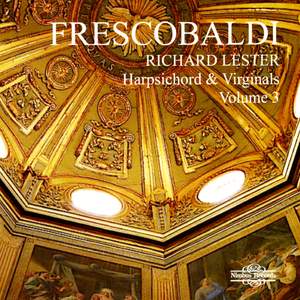
Richard Lester plays Frescobaldi - Volume 3

Richard Lester plays Frescobaldi - Volume 3


Frescobaldi:

Toccata Seconda (1627)

Capriccio fatto sopra il Cucchù

Toccata Quarta

Balletto Primo - Corrente del Balletto

Aria detto Balletto

Balletto Seconda - Corrente del Balletto

Toccata undecima (1627)

Canzona Prima

Toccata Decima (1627)

Canzona quinta

Capriccio di Durezze (1624)

Partite dodici sopra l'aria di Ruggiero

Ricercar No. 3 (Recercar franzese terza)

Capriccio Fra Jacopino sopra l’Aria du Ruggiero

Balletto Terzo - Corrente del Balletto – Passacagli

Capriccio sopra la Bassa Fiamenga

Correntes 1-4

Aria detta la Frescobalda (1627)


Richard Lester (harpsichord & virginals)

Richard Lester was described both by The Times and the Daily Telegraph as ‘one of our leading players’ and more recently acclaimed as ‘one of the greatest early music keyboard players of this or any other time.’ In 1981, Sir William Glock, former BBC controller of music invited him to perform a solo harpsichord recital at the Bath International Festival. Countless engagements at major international music festivals followed including the Bruges festival, Bath Bach festival and concerts at the Wigmore Hall, Royal Albert Hall, and in 2007 a sell out solo recital at London's South Bank Centre.

“[Lester's playing] is precise, fluent and poised. His dexterity is evident in his carefully polished and thoughtful performances. Tempos are generally unhurried by contrast with the virtuoso rapidity often favoured these days by younger harpsichordists in this repertory.” International Record Review, September 2011

“Performance of Frescobaldi demands a free, improvisatory style of performance, of which Richard Lester is obviously a master. He plays a perfectly chosen harpsichord with a particularly attractive, warm sonority, not in the least 'clattery'” Penguin Guide, 2011 edition

Nimbus - Lester plays Frescobaldi - NI5870

(CD)

$18.50

Usually despatched in 4 - 5 working days.

Baroque Voices 29 - Amour & Mascarade

Baroque Voices 29 - Amour & Mascarade

Purcell & Italy


anon.:

The furies masque

The Fairey Masque

Cupararee or Graysin

The Ladies Masque

The Goates masque

The second Witches dance

Frescobaldi:

Canzon terza

Canzona quinta

Canzon prima (1628)

Canzon sesta, from In partitura, il promo libro delle canzoni, 1628

Mancini, F:

Quanto dolce è quell’ardore

Largo

Recitatif

Allegro

Purcell:

Bid the virtues (from Come ye Sons of Art, Z323)

O dive custos Auriacae domus, Z504

Plainte - O, Let Me Weep (from The Fairy Queen, Z629)

Sound the trumpet, beat the drum, Z335


Patricia Petibon & Jean-François Novelli

Ensemble Amarillis

A new and fresh light on pieces by Henry Purcell, interspersed with music by Frescobaldi, Mancini, and several anonymous composers.

Naive Baroque Voices - AM187

(CD)

$11.75

(also available to download from $10.75)

Usually despatched in 3 - 4 working days. (Available now to download.)

Frescobaldi  - Works for Organ

Frescobaldi - Works for Organ


Frescobaldi:

Toccata sesta will sopra I pedali

Toccata ottava di durezze e legature (1627)

Canzona quarta, from Il secondo libro di toccate, canzoni..., 1627

Cappricio sopra la sol fa mi re ut

Toccata per Elevazione

Canzona quinta

Ricercar No. 3 (Recercar franzese terza)

Toccata Sesta (1615)

Capriccio di Durezze (1624)

Fantasia seconda

Canzon francese "La Pesenti"

Toccata quarta per l'Elevazione

Capriccio sopra Ut, Re, Mi, Fa, Sol, La

Canzon seconda

Toccata terza per l'Elevazione

Toccata quinta "sopra i pedali, e senza"


Liuwe Tamminga - Organs in the Basilica di San Petronio, Bologna "in cornu Epistolae" (Lorenzo da Prato, 1471-1475, G. Battista Facchetti, 1531)

"In cornu Evangeli (Baldassare Malamini, 1596 (Track 15)

This is a stirring programme of organ music given by Liuwe Tamminga on two superb instruments dating from 1471 and 1475. The original sound of the organs each adding genuine authenticity to the performances

“The organs of San Petronio, Bologna, dating from 1531 and 1596, are perfect for this music, together with a wonderful acoustic and a player who understands intimately how this music works. Liuwe Tamminga presents a varied selection of pieces, including several Elevation Toccatas, whose intense and improvisory style contrasts well with rhythmically dynamic works like the Canzona quinta.” Choir & Organ, November/December 2008 *****

Accent Plus - ACC10120

(CD)

$10.00

(also available to download from $10.75)

Usually despatched in 2 - 3 working days. (Available now to download.)

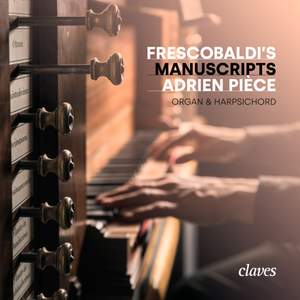
Frescobaldi: Keyboard Works

Frescobaldi: Keyboard Works


Frescobaldi:

Toccata Prima

Canzon seconda

Ricercar No. 1 (Recercar franzese primo)

Toccata nona

Canzona quinta

Toccata Quarta

Canzon terza

Capriccio sopra la Bassa Fiamenga

Toccata Settima

Ricercar No. 3 (Recercar franzese terza)

Canzona prima, from Il secondo libro di toccate, canzoni..., 1627

Partite sopra l'aria della romanesca from "Toccate e partite", Lib.I

Toccata Ottava

Ricercar No. 5 (Recercar franzese quinto)

Canzon a 4

Toccata Settima

Capriccio Sopra Il Cucho


Hank Knox (harpsichord)

It is tempting to see the history of music in Frescobaldi's time as a kind of Darwinian struggle between the conservative, rule-bound traditions of the sixteenth century and the freely expressive innovations of the early seventeenth century, or between the prima pratica of contrapuntal rigour and dry, intellectual structures, and the seconda pratica of the expressive madrigal, toccata and sonata with its emphasis on personal expression and freedom. For Frescobaldi, however, the two conflicting styles of composition amount to two facets of the same musical coin, which both shine brilliantly thanks to harpsichordist Hank Knox’s riveting performance on a magnificent 17th-century Italian instrument that is part of Kenneth Gilbert's collection of early harpsichords presently housed in the Musée des Beaux-Arts in Chartres.

Atma - ACD22184

(CD)

$17.50

(also available to download from $10.75)

Usually despatched in 2 - 3 working days. (Available now to download.)

Copyright © 2002-13 Presto Classical Limited, all rights reserved.