Prices shown exclude VAT. (UK tax is not payable for deliveries to United States.) See Terms & Conditions for p&p rates. | |  | Couperin - Piéces de Clavecin
French harpsichordist Olivier Baumont has distinguished himself as a performer and scholar, specializing in French Baroque repertoire. He took up the harpsichord without learning piano first, sharing his family's love for French history of the seventeenth and eighteenth centuries. He studied with Kenneth Gilbert and Huguette Dreyfus and worked with Gustav Leonhardt in his master classes in Cologne. He was awarded first prize in harpsichord (1981) and in chamber music (1982) at the Paris Conservatory and won the Concours de Solistes de Radio France in 1982. He frequently performs at music festivals in Europe, England, and the United States, and has toured widely. Since 1992, he has directed the Festival Couperin at Chaumes-en-Brie. In September, 2001, Baumont became professor of harpsichord at the Paris Conservatory. He is the author of a biography of François Couperin, has edited harpsichord works by Michel Corrette and Jacques Duphly, and has contributed scholarly articles to numerous musicological journals. “Selected harpsichord pieces from four collections played on no less than nine different harpsichords. Stylishly played, though sound is rather dry.” BBC Music Magazine, January 2010 **** | | | Usually despatched in 4 - 5 working days. |
|
|
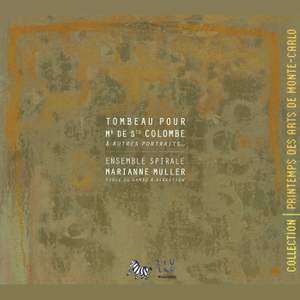
| |  | Tombeau pour Mr de Ste Colombe
Ensemble Spirale, Marianne Muller This disc presents a the music of a group of French musicians who throughout the seventeenth and eighteenth centuries painted each other’s portraits, or their self-portraits, generally with considerable wit. We know that they were familiar with each other, and many of them are described in works bearing their names, or in tributes such as tombeaux. Thus Rameau, in his Pièces de clavecin en concerts, made fun of himself, and then offered his personal vision of Marin Marais and Forqueray. Forqueray, for his part, depicts himself with a tone of authority that we recognise from his music. After this, in a lighter vein, he has fun imagining how to describe Leclair or Couperin. Marais, assuming an official air with son Tombeau pour Mr de Lulli, renders a magnificent homage to this dominant personality of his time; yet he also relates with intense inwardness how music was transmitted to him by his master Sainte-Colombe and what kind of man the latter was. These pieces do not form suites of dances, so typically French, but rather a sort of guided tour through a teeming variety of timbres, thanks to instruments as different as the guitar, the harpsichord and the theorbo, which with the second bass viol make up a rich continuo group, light when necessary, lively and colourful. “Composing a tombeau was a uniquely French way of honouring the life and musical legacy of a departed colleague. These are fascinating and eloquent performances.” Gramophone Magazine, September 2008 “This 350th birthday tribute to the French viol composer Marin Marais makes an excellent introduction to his music…. The E minor Suite, with its flowing, melancholy sarabande, energetic gigues (one of which involves stratospherically high double-stopping) and the grandly sorrowful Tombeau on a chromatic ground-bass, which makes a satisfying conclusion.” The Telegraph “The title only hints at the disc's riches: it is a veritable 'art gallery' in sound. Marianne Muller and her continuo colleagues in the Ensemble Spirale explore the ways in which 17th- and 18th-century French composers, inspired by the popularity of 'literary portraits', devised selfportraits and hommages in music to their teachers, family and friends. Composing a tombeau was a uniquely French way of honouring the life and musical legacy of a departed colleague. The lute-playing Gautier cousins (Ennemond and Denis) were early masters of this form; this recording may indeed have been inspired by those Marais composed for his teachers, Lully and Ste Colombe. There is more to ponder: we find Rameau's evocation of Forqueray and the reverse as well as self-portraits. However, as both Forqueray (father and son) and Rameau were married to musicians, it may be that some of these allude to the ladies. Further pièces de caractère by Forqueray complete the CD. That the music of most of these composers is reasonably well known to us helps us today to appreciate the allusions being made. But there is still more here to excite our interest. Muller has arranged two of Rameau's well known Pièces de clavecin en concerts, substituting a second bass viol in the part usually taken by a flute or violin. The result is a slightly lighter, more homogeneous texture that loses none of its sparkle in translation. These are fascinating and eloquent performances.” Gramophone Classical Music Guide, 2010 | | | Usually despatched in 4 - 5 working days. |
|
|
| |
|