Prices shown exclude VAT. (UK tax is not payable for deliveries to United States.) See Terms & Conditions for p&p rates. | |  | Christine Schäfer sings Mélodies
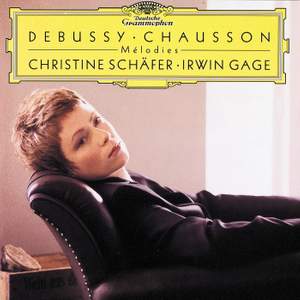
The brief but close friendship between Chausson and Debussy was based, it would seem, on the attraction of opposites. The bourgeois, god-fearing, happily married Chausson, living on inherited money in a spacious apartment on the fashionable Boulevard de Courcelles, was free to pursue high-minded, respectable projects like his Symphony in B flat, declaring his allegiance to his teacher, the pater seraphicus, César Franck, or his opera, Le Roi Arthus, an attempt to transplant Wagner onto French soil. Debussy on the other hand, a bohemian, an atheist, with a roving eye, especially for green-eyed blondes and a love-hatred for Wagner that would inspire many of his finest works, was to be beholden to no one – hence his famous reply when asked what rules he followed: ‘Mon plaisir’. But it was in the field of the mélodie that the two men came closest. Yet put the two composers side by side, as we witness in this creatively and intelligently conceived recital, and it takes your breath away. This was one of Christine Schäfer’s earliest recordings, during which time she was signed to Deutsche Grammophon, and Irwin Gage’s pianism is no mere ‘accompaniment’ – it is a vital ingredient and a partnership of equals. | | | (Sorry, download not available in your country) | In stock - usually despatched within 1 working day. |
|
|
| |  | Debussy Songs Volume 2
Two of Britain’s leading exponents of French song, the acclaimed sopranos Lorna Anderson and Lisa Milne, join Malcolm Martineau for the second volume of Hyperion’s overview of Debussy’s haunting, mercurial songs. The French composer’s output in this genre extended throughout his life and he was always inspired by poetry—from his first adolescent attempts to set Paul Verlaine’s Fêtes galantes (which he later revised) to the Trois Poèmes de Mallarmé, written five years before his death. All inhabit a universe of shifting colours and impressions, from the sensual, perfumed ‘flutes and flesh’ of the Chansons de Bilitis to the Proses lyriques, which foreshadow the dreamlike atmosphere of Pelléas et Mélisande. “Anderson and Milnes contrasting in approach. Anderson effortlessly glides through Debussy's limpid, lengthy phrases, while Milne's shivering sense of wonder is Melisande-like in its pent-up excitement. Milne's breathy approach to the sublime Ariettes oubliees has plenty of frisson about it” BBC Music Magazine, July 2012 **** “The first thing to say that the performances by sopranos Lorna Anderson and Lisa Milne are consistently beautiful, alert to the implications of Debussy's word-setting, whether ecstatic or subdued...Martineau matches them in the subtlety, characterisation and refined textures of his piano-playing” Gramophone Magazine, June 2012 | | | In stock - usually despatched within 1 working day. |
|
|
| |  | Albéniz: The French Connection
Marisa Martins (mezzo-soprano) & Mac McClure (piano) After the Spanish composer Albéniz settled in Paris, he became part of an inner circle of composers including Chausson, Dukas, Fauré, Debussy and Ravel. All of the works on this CD were written between 1895 and 1909, the year Albéniz died. They show a great variety of styles and colours and it is sublime music. | | | In stock - usually despatched within 1 working day. |
|
|
| |  | Marianne Fiset sings songs by Ravel, Debussy & Dvorak
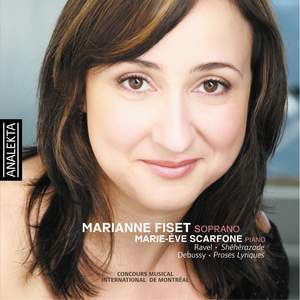
Marianne Fiset (soprano) & Marie-Eve Scarfone (piano) Soprano Marianne Fiset and pianist Marie-Eve Scarfone first worked together in 2005 when they were both members of the Montreal Opera. They perform regularly throughout Europe, Canada and the USA and their repertoire concentrates on the music of the French, German and Russian song composers. The Dvorak extract is played by the Orchestre de la Francophile Canadienne and conducted by Jean-Philippe Tremblay. | | | In stock - usually despatched within 1 working day. |
|
|
| |  | Mélodies
| | | (also available to download from $10.50) | Usually despatched in 3 - 4 working days. (Available now to download.) |
|
|
| |  | Debussy: Mélodies
Yumi Nara (soprano), Claude Lavoix (piano) | | | Usually despatched in 2 - 3 working days. |
|
|
| |  | Proses LyriquesFrench song recital
Janet Howd (soprano), Christopher Ross (piano) | | | Usually despatched in 8 - 10 working days. |
|
|
| |  | French Songs and Arias (1940-1947)Selected works by Thomas, Duparc and more
| |
|
| |  | The Art of Susan Graham
Berg: | Sieben frühe Lieder | Berlioz: | La Damnation de Faust, Op. 24: Chanson gothique 'Autrefois un roi de Thulé' Dieu! Que viens-je d'entendre?…Il m'en souvient ... Je l'aime donc? (from Béatrice et Bénédict) | Brahms: | He, Zigeuner, greife in die Saiten ein! (No. 1 from Zigeunerlieder, Op.103) Hochgetürmte Rimaflut, wie bist du trüb (No. 2 from Zigeunerlieder, Op.103) Wißt ihr, wann mein Kindchen am allerschönsten ist? (No. 3 from Zigeunerlieder, Op.103) Lieber Gott, du weißt, wie oft bereut ich hab' (No. 4 from Zigeunerlieder, Op.103) Brauner Bursche führt zum Tanze (No. 5 from Zigeunerlieder, Op.103) Röslein dreie in der Reihe blühn so rot (No. 6 from Zigeunerlieder, Op.103) Kommt dir manchmal in den Sinn (No. 7 from Zigeunerlieder, Op.103) Rote Abendwolken ziehn am Firmament (No. 8 from Zigeunerlieder, Op.103) | Chausson: | Poème de l'amour et de la mer, Op. 19 | Debussy: | Proses Lyriques Fantoches Songs from Le livre de Baudelaire | Gluck: | O del mio dolce ardor (from Paride ed Elena) Non, je n'espere plus... O toi qui prolongeas mes jours (from Iphigénie en Tauride) O malheureuse Iphigenie! (from Iphigénie en Tauride) Non, cet affreux devoir... Je t'implore et je tremble (from Iphigénie en Tauride) Qu'entends-je? Qu'a-t-il dit?... Amour, viens rendre a mon ame (from Orphée et Eurydice) J'ai perdu mon Eurydice (from Orphée et Eurydice) | Hahn, R: | A Chloris O mon bel inconnu: 'O mon bel inconnu' Brummell: 'Air de la Lettre' Mozart: 'Etre adore' O mon bel inconnu: 'C'est tres vilain d'etre infidele' Ciboulette: 'C'est pas Paris, c'est sa banlieue' | Handel: | Di te mi rido (from Alcina) Mi lusinga il dolce affetto (from Alcina) | Heggie: | Who will walk with me? (from Dead Man Walking) He will gather us around (from Dead Man Walking) | Honegger: | Les Aventures du roi Pausole: 'Si vous saviez' | Ives, C: | The Things our Fathers Loved The Housatonic at Stockbridge Swimmers Memories: (A) Very Pleasant; (B) Rather Sad Ann Street Serenity ‘1, 2, 3' Songs My Mother Taught Me The Circus Band The Cage The Indians Like a Sick Eagle September Soliloquy, or a Study in 7ths and Other Things Farewell to Land Thoreau | Mahler: | Liebst Du um Schönheit (Rückert-Lieder) | Messager: | L'Amour masque: 'J'ai deux amants' Fortunio: 'Je ne vois rien..Lorsque je n'etais qu'une enfant' Coups de roulis: 'Les hommes sont biens tous les memes' Passionnement: 'L'amour est un oiseau rebelle' Les P'tites Michu: 'Vois-tu, je m'en veux' La Petite Fonctionnaire: 'Je regrette mon Pressigny' Les Dragons de l"Imperatrice: 'Amour, amour, quel est donc ton pouvoir' L'Amour masque: 'Mon reve' | Moore, B: | Sexy Lady | Mozart: | Non so più cosa son, cosa faccio (from Le nozze di Figaro) Parto, parto, ma tu ben mio (from La Clemenza di Tito) Voi che sapete (from Le nozze di Figaro) Deh, per questo istante solo (from La Clemenza di Tito) Non ho colpa (from Idomeneo) Dunque Sperar Poss'io...Il Tenero Momento (from Lucio Silla) | Poulenc: | Quatre poemes de Guillaume Apollinaire | Ravel: | Shéhérazade | Rorem: | Sonnet (Santa Fe Songs) Clouds Early in the morning The Serpent Now Sleeps the Crimson Petal Opus 101 (Santa Fe Songs) I Strolled Across an Open Field To a Young Girl Jeanie with the Light Brown Hair Ode For Poulenc Little Elegy Alleluia Look down fair moon O you to whom I often and silently come I will always love you The Tulip Tree The Wintry Mind (Santa Fe Songs) I am Rose The Lordly Hudson O Do Not Love Too Long Far-Far-Away For Susan A Journey Sometimes with one I love Love Orchids Stopping by Woods on a Snowy Evening Do I love you more than a day? Ferry Me Across the Water The Sowers (Santa Fe Songs) That shadow, my likeness | Simons, Moises: | Toi c'est moi: 'C'est ca la vie, c'est ca l'amour' Toi c'est moi: 'Vagabonde' | Yvain: | Yes: 'Yes' |
| | | Usually despatched in 4 - 5 working days. |
|
|
| |  | Elly Ameling: The Dutch Nightingale
Bach, J S: | Cantata BWV202 'Weichet Nur, betrübte Schatten' (Wedding Cantata) Cantata BWV209 'Non sa che sia dolore' (Italian Cantata) Cantata BWV80 'Ein feste Burg ist unser Gott': Komm in mein Herzenshaus Cantata BWV147 'Herz und Mund und Tat und Leben': Bereite dir, Jesu, noch itzo die Bahn Cantata BWV149 'Man singet mit Freuden vom Sieg': Gottes Engel weichen nie St John Passion, BWV245: Ich folge dir gleichfalls St John Passion, BWV245: Zerfliesse, mein Herze Christmas Oratorio, BWV248: Nur ein Wink von seinen Händen Cantata BWV93 'Wer nur den lieben Gott läßt walten': Ich will auf den Herren schau'n Cantata BWV177 'Ich ruf zu dir, Herr Jesu Christ': Verleih', dass ich aus Herzens Grund Cantata BWV94 'Was frag ich nach der Welt': Es halt es mit der blinden Welt Cantata BWV202 'Weichet Nur, betrübte Schatten' (Wedding Cantata): Sich üben im Lieben Cantata BWV144 'Nimm, was dein ist, und gehe hin': Genügsamkeit Cantata BWV89 'Was soll ich aus dir machen, Ephraim?': Gerechter Gott, ach, rechnest du? Cantata BWV21 'Ich hatte viel Bekümmernis': Seufzer, tränen, kummer, not Flosst, mein Heiland, flosst dein Namen (from Christmas Oratorio) Cantata BWV187 'Es wartet alles auf dich': Gott versorget alles Leben Cantata BWV199 'Mein Herze schwimmt im Blut': Stumme Seufzer, stille Klagen Cantata BWV98 'Was Gott tut, das ist wohlgetan': Hört, ihr Augen, auf zu weinen Erfullet, ihr himmlischen, gottlichen Flammen (Wie schon leuchtet der Morgenstern BWV1) Cantata BWV75 'Die Elenden sollen essen': Erfüllet, ihr himmloschen göttlichen Flamen Cantata BWV74 'Wer mich liebet, der wird mein Wort halten': Komm, mein Herze steht dir offen Mass in F major, BWV233: Qui tollis peccata mundi | Beethoven: | Wonne der Wehmut, Op. 83 No. 1 Mass in C major, Op. 86: Kyrie | Beginiker: | Ecce nova guadia Nun wiegen wir das Kindlein | Brahms: | Da unten im Tale (No. 6 from Deutsche Volkslieder, WoO 33) Geistliches Wiegenlied, Op. 91 No. 2 | Chausson: | Les Papillons, Op. 2 No. 3 (Gautier) Le Colibri, Op. 2 No. 7 (de Lisle) | Debussy: | Nuit d'étoiles Fleur des blés (André Girod) Dans le jardin Fêtes galantes - Set 1 Proses Lyriques Trois Poèmes de Stéphane Mallarmé Noël des enfants qui n'ont plus de maison | Duparc: | Chanson triste | Fauré: | Le papillon et la fleur, Op. 1 No. 1 Rêve d'amour, Op. 5 No. 2 Dans les ruines d'une abbaye Op. 2 No. 1 Seule! Op. 3 No. 1 L'aurore Puisqu'ici-bas toute âme Op. 10 No. 1 Tarentelle Op. 10 No. 2 Au bord de l'eau, Op. 8 No. 1 (Prudhomme) Automne, Op. 18 No. 3 Le parfum impérissable Op. 76 No. 1 Arpège, Op. 76 No. 2 (Samain) Pleurs d'or Op. 72 Chanson de Melisande Soir Op. 83 No. 2 Chanson Op. 94 Vocalise-étude La chanson d'Ève, Op. 95 Le jardin clos Op. 106 C'est la paix Op. 114 Après un rêve, Op. 7 No. 1 | Grieg: | Ich liebe Dich, Op. 5 No. 3 | Hahn, R: | Si mes vers avaient des ailes | Haydn: | The Mermaid's Song, Hob. XXVIa:25 Ein Magd, ein' Dienerin, Hob. XXVIId:1 | Loewe, C: | Niemand hat's gesehn, Op. 9, H.X/4 | Mahler: | Symphony No. 4 in G major: Wir geniessen den himmlischen Leben | Marchesi: | La Folletta | Mendelssohn: | Auf Flügeln des Gesanges, Op. 34 No. 2 | Mozart: | Ridente la calma, K152 Oiseaux, si tous les ans, K307 Dans un bois solitaire, K308 Die Zufriedenheit, K473 Komm, liebe Zither, K351 Warnung 'Männer suchen stehts zu naschen', K433 Das Veilchen, K476 Sei du mein Trost, K391 Der Zauberer, K472 Das Lied der Trennung, K519 Als Luise die Briefe, K520 Das Traumbild, K.530 Un moto di gioia, K579 Die Verschweigung, K518 Die kleine Spinnerin, K531 Abendempfindung an Laura, K523 Die Alte K517 An Chloë, K524 Sehnsucht nach dem Frühlinge, K596 | Poulenc: | Airs chantés Trois Poèmes de Louise Lalanne Cinq Poèmes de Max Jacob La courte paille Fancy Colloque Trois poèmes de Louise de Vilmorin Ce doux petit visage Fiançailles pour rire | Satie: | La diva de l'empire Je te veux | Scarlatti, A: | Le violette | Schubert: | Auf dem Wasser zu singen, D774 Auf dem See, D543 (Goethe) Erlafsee D586 (Mayrhofer) Die Forelle, D550 Die gefangenen Sänger D712 (Schlegel) Verklarung D59 (Herder, after Pope) Der Jungling und der Tod, D545 (Spaun) Suleika I, D720 Suleika II, D717 Raste Krieger, Krieg ist aus (Ellens Gesang I), D837 Jäger, ruhe von der Jagd (Ellens Gesang II), D838 Ave Maria, D839 Gretchen am Spinnrade, D118 Trost im Liede, D546 (Schober) An die Musik D547 Ganymed, D544 (Goethe) Trost im Liede, D546 (Schober) An die Musik D547 Ganymed, D544 (Goethe) Frühlingsglaube, D686 Liebe schwarmt auf allen Wegen, D239 No. 6 (Goethe) Lachen und Weinen, D777 Ständchen 'Horch! Horch! die Lerch!', D889 Der Hirt auf dem Felsen, D965 (Von Chezy / Muller) Im Frühling, D882 Amalia, D195 (Schiller) Atys D585 Seligkeit D433 (Holty) | Stölzel: | Bist du bei mir | Stravinsky: | Pastorale | trad.: | As I sat on a sunny bank Sweet was the song In Dulci Jubilo Uff'm Berge O suver maecht van Israel Klein, klein Jezuken Canco de nadal Baile de Nadal Baile de Córdoba Baile Andaluz Entre le boeuf et l'ane gris L'appel des bergers Noël pour l'amour de Marie Noël des jouets |
Born Elisabeth Sara Ameling on 8 February 1933 in Rotterdam, the Dutch soprano known as Elly Ameling won first prize at the Vocal Concours in ’s- Hertogenbosch in Holland in 1956, and the Concours International de Musique in Geneva in 1958. She gave her first formal recital in Amsterdam in 1961 and went on to perform for more than thirty years in virtually every major cultural centre in the world as one of the greatest singers of our age, renowned for her warm, unaffected personality, purity of tone and effortless technique. She made her career mainly as a concert and lieder singer, with some appearances in opera (Mozart and Haydn), and became renowned for her recitals of French and German songs and for her superlative interpretative gifts. CD 1 begins with two solo cantatas for soprano by Johann Sebastian Bach – the famous Wedding Cantata (BWV202) and ‘Non sa che sia dolore’ (BWV209) – followed by further arias from Bach cantatas and oratorios. CD 2 presents more music by Bach, with a collection of beautiful soprano arias from cantatas, accompanied by oboe and bass continuo. The oboe soloist is the Dutch virtuoso Han de Vries, who plays three different types of instrument, namely the normal oboe, the ‘oboe da caccia’ and the ‘oboe d’amore’, as specified by the composer, to striking musical effect in the various arias. In CD 3 Ameling shows her skill as an unrivalled interpreter of the music of Schubert with a collection of the composer’s best-known and most popular Lieder including ‘Die Forelle’, ‘Ave Maria’, ‘Gretchen am Spinnrade’ and ‘An die Musik. The piano accompanists are Irwin Gage and Jörg Demus. CD 4 opens with Schubert’s great showpiece for soprano and clarinet: ‘Der Hirt auf dem Felsen’ (‘The Shepherd on the Rock’), in which the clarinet soloist is George Pietersen, plus three other Schubert songs. These are followed by a group of songs by Mozart, including ‘Ridente la calma’, ‘Dans un bois solitaire’ and ‘Un moto di gioia’. The soprano is accompanied by Irwin Gage in the Schubert and Jörg Demus in the Mozart. In CDs 5 and 6, Ameling moves into the field of French song, for which she was trained by the famous French baritone Pierre Bernac. Her repertoire here encompasses many well-known songs by Gabriel Fauré, Claude Debussy and Francis Poulenc. She is accompanied by the distinguished pianist Dalton Baldwin, with whom she frequently performed. In CD 7 we hear a collection of much loved popular songs, typical of the mixed programmes with which the artist always delighted her audiences at recitals. These include Mendelssohn’s ‘Auf Flügeln des Gesanges’ (‘On Wings of Song’) and Grieg’s ‘Ich liebe dich’ (‘I Love You’). The disc closes with a further group of French mélodies by Poulenc. The final CD begins with a collection of Christmas songs from many lands, to which Ms Ameling brings her own special charm. Then comes a typical example of Ameling as a participant in a large-scale liturgical work, in the Kyrie from Beethoven’s Mass in C, where her clearly focussed voice blends perfectly with those of her three fellow soloists. The programme ends with the finale from Mahler’s Fourth Symphony, in which Ameling is heard as the radiant soprano soloist extolling the joys of heaven in a child-like way, with the Pittsburgh Symphony Orchestra conducted by André Previn. | | | In stock - usually despatched within 1 working day. |
|
|
| |
|