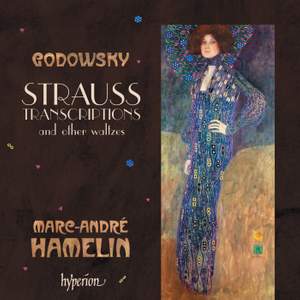
Marc-André Hamelin’s programme is mostly devoted to Godowsky’s works based on themes by—or directly inspired by—Johann Strauss II. It is not intended to be a comprehensive survey but is, nevertheless, fully representative of Godowsky’s finest reflections on the Waltz King. In the three great Strauss transcriptions, Godowsky elevated the art of the piano paraphrase to a higher musical and pianistic plane; however their extreme technical difficulty remains a striking feature and places them out of the reach of ordinary pianists. And Marc-André Hamelin is, of course, no ordinary pianist—in fact his playing on a recent disc (see below) was compared to that of Alkan and Liszt.
Triakontameron and Walzermasken are rarely performed examples of Godowsky’s original work, and continue the composer’s love-affair with the waltz—they are written entirely in 3/4 time. The last work on this dazzling disc is an oddity—indeed, a rarity. Sometime prior to 1925, Godowsky made a piano roll of his arrangement of The Last Waltz by Oscar Straus (1870–1954), the Vienna-born composer. The eponymous Waltz is heard throughout the 1920 operetta. The music of Godowsky’s transcription was never published for some unknown reason—it is a uniquely appealing arrangement. In the early 1970s, Gilles Hamelin, the pianophile father of Marc-André, notated, arranged and edited The Last Waltz from Godowsky’s piano roll, which was then published in 1975. Shortly afterwards, a copy of the negative of Godowsky’s manuscript was sent to Gilles Hamelin. It was all but illegible, so Hamelin Snr. Made a fair copy in his own hand: in almost every respect it tallied with the version he had transcribed from the piano roll.
August 2008
*****
“There's no need for analogies about a surfeit of Viennese cream-cakes with this excellent CD: the musical inventions is so brilliant and varied, and the performance so coruscating, that one's attention is firmly held.”
15th August 2008
****
“How many fingers does Hamelin have? Thirty would be a conservative estimate, though the magic of his piano playing lies in his subtlety and flow, never in any shallow brilliance. Manner matches matter perfectly in this lilting CD of three “symphonic metamorphoses” of Johann Strauss’s waltzes by the piano virtuoso Leopold Godowsky. They sound symphonic too, deftly worked, complex in structure and emotion. The succulent recording is the cherry on the cake.”
15th August 2008
***
“Whatever you think of the music, Hamelin's playing is infinitely seductive and flawlessly judged in its mixture of panache, grace and charm.”
September 2008
“Countless inner voices and contrapuntal rejoinders abound in these works, and Hamelin makes them audible and clear… All told, a stellar achievement…”
23rd August 2008
“[The symphonic metamorphoses] are more than just for show, and Hamelin brings out their poetic intent as much as their panache and vivid energy.”
2010
“Here's another release that testifies to Marc- André Hamelin's cultured musicianship, extraordinary keyboard proficiency and unflappable tonal control. His key assets include the most together, impeccably voiced chords in the business, plus octaves, trills and rapid leaps that remain effortlessly even and focused, regardless of tempo. All of this comes into delightful play over the course of the three big Strauss Symphonic Metamorphoses. Countless inner voices and contrapuntal rejoinders abound in these works, and Hamelin makes them audible and clear without resorting to the pianistic equivalent of red-ink underlining or pop-up windows. Furthermore, Hamelin is a seasoned and subtle orchestrator at the piano; notice how he achieves such eloquent shading of simultaneous legato and detached phrases with no more help from the sustain pedal than is necessary. One could argue that Godowsky's pinpoint tempo modifications throughout Wein, Weibund Gesang might benefit from stronger characterisation, in the manner of Shura Cherkassky's admittedly more capricious Decca recording, although Hamelin eschews the older pianist's cuts; in fact, Hamelin plays all three Metamorphoses complete, as written. As it happens, the less demanding shorter selections from Walzermasken, Triakontameron and The Last Waltz inspire some of Hamelin's most poetic, lyrically inspired playing on disc. All told, a stellar achievement, graced by Hyperion's close-up yet ample engineering, plus Godowsky biographer Jeremy Nicholas's thoroughly informative and penetrating annotations.”
Click on any of the works listed above for alternative recordings.