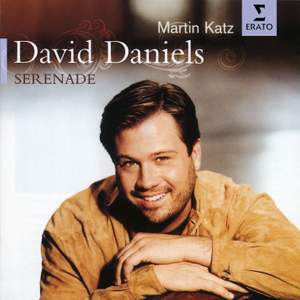
Cesti: Intorno all'idol mio

This page lists all recordings of Intorno all'idol mio, by Pietro Antonio Cesti (1623-69) on CD & download (MP3 & FLAC).

Prices shown exclude VAT. (UK tax is not payable for deliveries to United States.)
See Terms & Conditions for p&p rates.

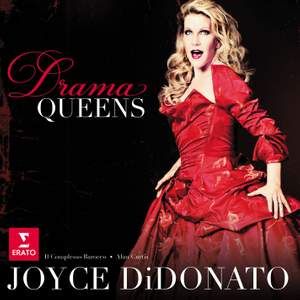
Joyce DiDonato: Drama Queens

Joyce DiDonato: Drama Queens

Royal Arias from the 17th and 18th Centuries


Cesti:

Intorno all'idol mio

Giacomelli:

Sposa, son disprezzata (from Merope)

Gluck:

Ah! Si la liberté me doit être ravie from Armide

Handel:

Piangerò la sorte mia (from Giulio Cesare)

Ma quando tornerai (from Alcina)

Brilla nell' alma un non inteso ancor (from Alessandro)

Hasse, J A:

Morte, col fiero aspetto (from Antonio e cleopatra)

Haydn:

Vedi, se t'amo (from Armida)

Keiser:

Lasciami piangere (from Fredegunda)

Geloso, sospetto (from Octavia)

Monteverdi:

Disprezzata regina (L'incoronazione di Poppea)

Orlandini:

Da torbida procella (from Berenice)

Col versar barbaro il sangue (from Berenice)

Porta, G:

Madre diletta (from Ifigenia in aulide)

Vinci, Leonardo:

Tradita, sprezzata (from Semiramide)


Crowned with a Grammy Award for her last album, Diva, Divo, Joyce DiDonato joins conductor Alan Curtis and Il complesso barocco for Drama Queens, an electrifying programme of royal arias from the 17th and 18th centuries, composed by figures as famous as Handel and Vivaldi and as little known as Orlandini and Porta. As DiDonato says: “High drama, profound emotion, fearless vocal writing, time-stopping passages, historical significance and real discovery ... What more could I ask for?”

The impact achieved by Joyce DiDonato with her last Virgin Classics album, Diva, Divo, was summed up by her triumph at the 2012 Grammy Awards in February: victor in the Classical Vocal Solo category, the ‘Yankee Diva’ also became the first classical singer to perform live at the Grammy ceremony, receiving a standing ovation for her spectacular rendition of the final rondo from Rossini’s La Cenerentola.

Enterprising as ever, DiDonato now presents a new themed recital, conceived in partnership with Alan Curtis, who also conducted her Virgin Classic recordings of Handel’s Ariodante and Radamisto and her duet recital Amore e Gelosia with Patrizia Ciofi. Drama Queens sees DiDonato portraying a parade of royal personages in a diversity of challenging situations and extreme states of mind.

“For me, this is my most exciting recording project to date,” says Joyce DiDonato,” because it is everything I deeply adore about the world of opera: high drama, profound emotion, fearless vocal writing, time-stopping passages, historical significance and real discovery. What more could I ask for?

“I wanted to return to this genre of music I love so deeply: the free, mysterious, profoundly moving world of Baroque opera, but to do it in the grandest fashion – from the throne of royalty! Each of the characters is a queen (or a sorceress, which equals queen in this fantastical world) ... Well, we have allowed one princess, because the aria is completely unknown and it is simply too beautiful to be left out: ‘Madre diletta, abbracciami’ by Giovanni Porta [c1675-1755].

“What more could a singer ask for than to indulge in the antics of rage and bliss, despair and jubilation, heartbreak and true love?” she continues. “It will be an extraordinary journey, thanks to these larger-than-life characters, and I fully expect to learn a lot about myself along the way.”

Conductor and musicologist Alan Curtis explains that: “Our Drama Queens are a motley group. Our idea was to cultivate extremes, to gather arias that show larger-than-life emotions. They range from noble, but sultry seductiveness, through the hysterically happy to vindictive despair and royal rage. The musical styles are also as varied as possible.”

The arias range in period from the dawn of opera, Monteverdi and Cesti, to lesser-known works by Gluck and Haydn. “We also include some little-known music by Reinhard Keiser [1674-1739], notably an aria with an amazing five-part accompaniment for solo bassoons, without strings,” adds Curtis. (Joyce DiDonato describes it as “an aria of jealousy, suspicion and torment with the bassoon and voice chasing each other.”)

Alan Curtis continues: “Two flashy arias by Giuseppe Orlandini [1676-1760] come from an opera about the great Jewish Queen Berenice, thought to be lost, but found in a California library ... But we have not totally excluded well-known works either. There is Joyce's beloved ‘Sposa son disprezzata’, a YouTube favourite, which most people know in the version for Princess Irene, the rejected bride in Vivaldi's Tamerlano. But it was actually taken by Vivaldi from an earlier opera by Geminiano Giacomelli [1692-1740], where it was sung by a male character and performed by the famous castrato Farinelli. Another Farinelli aria we include comes from an early serenata by Hasse; he sang in drag as one of the greatest drama queens of all time – Cleopatra! And, of course, we include everybody's favourite Cleopatra aria: Handel's ‘Piangerò la sorte mia’, from Giulio Cesare.”

“Coloratura runs are lightning fast, angry declamations hurled like thunderbolts — and limpid laments meltingly cooed. I don’t like DiDonato when she gets too shouty or adds “expressive” pitch-bends. But it’s all compellingly theatrical. Great choice, too, with familiar Handel mingled with rare jewels” The Times, 3rd November 2012 ****

“an anthology of suitably impassioned royal roles from Baroque operas, their emotional scope ranging from the giddy flush of love evoked by her tremulous coloratura and swooning fades as Berenice in Orlandini's "Da torbida procella", to the self-sacrifice of Porta's Ifigenia, rendered with such poised nobility” The Independent, 10th November 2012 ****

“DiDonato and Alan Curtis...have unearthed some Baroque rarities. Instead of Handel's Berenice, we have Orlandini's Berenice, whose 'Da torbida procella' is an ideal fit for DiDonato's spitfire fioritura.” BBC Music Magazine, Christmas 2012 ****

“DiDonato produces her most emotionally moving and sensitively embellished singing in 'Madre diletta'...Wonderfully sung, passionately played and programmed intelligently - an exemplary recital.” Gramophone Magazine, January 2013

“DiDonato caresses the plaintive lines of Piangero la sorte mia with the intensity of Bartoli, and brings a mordant, witchy edge to Ma quando tornerai...There’s sprightly support from Alan Curtis’s Italian period band. DiDonato’s fans won’t be disappointed.” Sunday Times, 13th January 2013

“In the slow-moving 'Lasciami pinagere' .DiDonato's timbre is at its most beautiful, her phrasing eloquent, the trills not distracting the smooth flow of the musical line...The virtuosity needed to triumph over the swift scalework is coruscatingly supplied by DiDonato...Alan Curtis's Complesso Barocco's partnership is invaluable...This is a treasure of a disc, for the music, the orchestra and Joyce DiDonato.” International Record Review, February 2013

Virgin - 6026542

(CD)

$16.50

In stock - usually despatched within 1 working day.

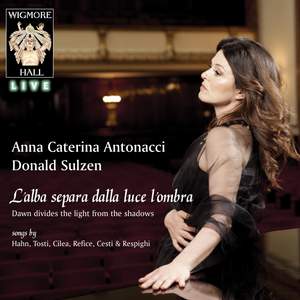
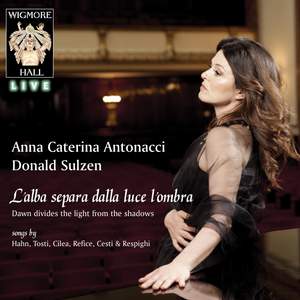
L’alba separa dalla luce l’ombra

L’alba separa dalla luce l’ombra

Dawn divides the light from the shadows


Cesti:

Intorno all'idol mio

Cilea:

Serenata

'Mormorante di tenero desio'

Nel ridestarmi

Non ti voglio amar

Hahn, R:

Venezia – Chansons en dialecte Venetien

Refice:

Ombra di Nube

Respighi:

Sopra un'aria antica

Tosti:

Quattro canzoni di Amaranta (Lasciami, lascia ch 'io respiri; L 'alba separa dalla luce l 'ombra; In van preghi; Che dici,o parola del saggio)

Marechiare

encore


Anna Caterina Antonacci (soprano) & Donald Suzen (piano)

Anna Caterina Antonacci’s enchanting recital entitled 'L’alba separa dalla luce l’ombra' delves into a colourful landscape of French and Italian art song. She explores the rich tonal and emotional contrasts of works spanning almost three centuries, with deeply engaging interpretations throughout.

Antonacci is famed for her profound and vivid appearances both on the opera stage [most recently in Covent Garden's The Trojans] and recital platform, and this recording manages to capture her spellbinding, dramatic performance and her ability to give clear voice to the varied, ever-shifting psychological states portrayed through this emotional programme, recorded live on 5th December, 2011.

“Even without her magnetic stage presence, Antonacci presents a vivid 'face' in all she sings here...Antonacci's tone - fierily intense rather than especially rich - can sound a touch strained at climaxes. But she responds with quicksilver intelligence and empathy to the shifting emotional states of these yearning and/or disenchanted lovers...so gripping is Antonacci in everything she sings that it seems churlish to carp.” Gramophone Magazine, December 2012

“If one wants to be pernickety one could possibly say that Antonacci’s vibrato is sometimes over-generous and that she occasionally sounds slightly worn. Under some circumstances this could be quite serious criticism but with so expressive and life-enhancing a singer it hardly matters. This is a delightful programme, delightfully executed and with delightful accompaniments. I wish I had been there!” MusicWeb International, December 2012

“Antonacci and her scrupulous accmpanist Donald Sulzen, provide alert and imaginative accounts of all their material...Antonacci brings individuality to everything she sings, her colouristic range reinforcing her careful definition of text.” BBC Music Magazine, March 2013 ****

Wigmore Hall Live - WHLIVE0054

(CD)

$11.50

In stock - usually despatched within 1 working day.

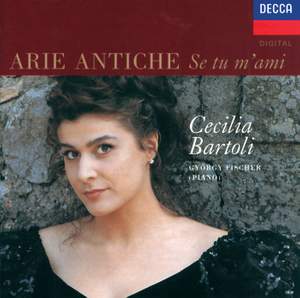
If You Love Me/Si tu m'ami

If You Love Me/Si tu m'ami

18th-Century Italian Art Songs


anon.:

Occhi Belli

Caccini, G:

Tu ch'hai le penne, amore

Amarilli mia bella

Caldara:

Selve amiche

Sebben crudele me fai languir

Carissimi:

Vittoria, mio core!

Cavalli:

Delizie contente

Cesti:

Intorno all'idol mio

Giordani, G:

Caro mio ben

Lotti:

Pur dicesti, o bocca bella

Marcello, B:

Quella fiamma che m'accende

Paisiello:

Nel cor più non mi sento

Il mio ben quando verrà (from Nina, o sia La pazza per amore)

Chi vuol la Zingarella

Parisotti:

Se tu m'ami

Scarlatti, A:

Gia il sole al Gange

Son tutta duolo

La Donna ancora è fedele - Se Florindo è fedele

O cessate di piagarmi (from Il Pompeo)

Spesso vibra per suo gioco

Vivaldi:

Sposa son disprezzata (from Bajazet)


Cecilia Bartoli (mezzo), György Fischer (piano)

Decca - 4362672

(CD)

$16.50

(Sorry, download not available in your country)

In stock - usually despatched within 1 working day.

Copyright © 2002-13 Presto Classical Limited, all rights reserved.