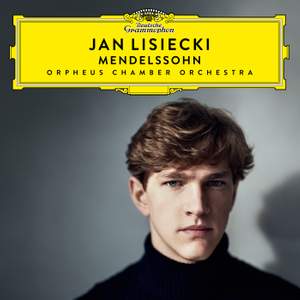
All recordingsPrices shown exclude VAT. (UK tax is not payable for deliveries to United States.) See Terms & Conditions for p&p rates. | |  | Mendelssohn: Piano Concerto No. 1 & Piano Solo Works
Mendelssohn: | Piano Concerto No. 1 in G minor, Op. 25 Mito Chamber Orchestra, Seiji Ozawa Song without Words, Op. 62 No. 1 in G major 'May Breezes' Song without Words, Op. 67 No. 4 in C major 'Spinning Song' or 'Bee's Wedding' Song without Words, Op. 62 No. 5 in A minor 'Venetianisches Gondellied No. 3' Song without Words, Op. 62 No. 6 in A major 'Spring Song' Song without Words, Op. 53 No. 3 in G minor Song without Words, Op. 38 No. 6 in A flat major 'Duetto' Rondo capriccioso in E major, Op. 14 Prelude & Fugue for piano in E minor, Op. 35 No. 1 |
| | | In stock - usually despatched within 1 working day. |
|
|
| |  | Piano Encores
Albéniz: | Tango (No. 2 from Espana, Op. 165) | Bizet: | Adagietto (arr. Godowsky) | Chopin: | Nocturne No. 5 in F sharp major, Op. 15 No. 2 Waltz No. 6 in D flat major, Op. 64 No. 1 'Minute Waltz' Waltz No. 14 in E minor, Op. post., KKIVa:15, B 56 Nocturne No. 2 in E flat major, Op. 9 No. 2 Étude Op. 25 No. 1 in A flat major 'Aeolian Harp' Étude Op. 25 No. 2 in F minor Étude Op. 25 No. 11 in A minor 'Winter Wind' | Debussy: | Préludes - Book 1: No. 8, La fille aux cheveux de lin | Godowsky: | Ballet Music from 'Rosamunde' Elegy for the left hand alone | Mendelssohn: | Rondo capriccioso in E major, Op. 14 Song without Words, Op. 19b No. 3 in A major 'Hunting Song' | Moszkowski: | En Automne, Op. 36 No. 4 La Jongleuse, Op. 52 No. 4 | Schlözer: | Etude in A flat major, Op. 1 No. 2 | Strauss, R: | Ständchen, Op. 17 No. 2 |
Jorge Bolet was an avowed Romantic, happy to relax once the serious business of his recital is over. Like Moiseiwitsch, he could be mischievously enterprising, challenging his audience to guess the composer of this or that rare poetic jewel or confection - or, like Rubinstein, he could affectionately confirm and recreate their favourites. With delightful old world charm, fleet of finger, yet ever conscious of the singing line, Bolet weaves pure magic in this collection of encores. After a long absence from the catalogue, this disc returns, now at budget price. “...the unfailing wizardry of Bolet. He is also splendidly recorded. It is difficult to see how an encore-fancier could greet this record with anything but the most delighted of, well encores.” Gramophone Magazine | | | In stock - usually despatched within 1 working day. |
|
|
| |  | Rudolf Serkin, Vol. 61951-1957
| |
|
| |  | Mendelssohn: Works For Piano
Cyril Huvé is a disciple of Claudio Arrau and pioneer in the rediscovery of nineteenth century keyboards and their expressive possibilities. He sees these instruments as a means to affirm the values of the Romantic tradition of piano performance which his mentors passed on to him. This recording, performed on a Broadwood 1840, is testament to his dedication and skill. | | | Usually despatched in 2 - 3 working days. |
|
|
| |  | Jorge Bolet: His earliest recordings
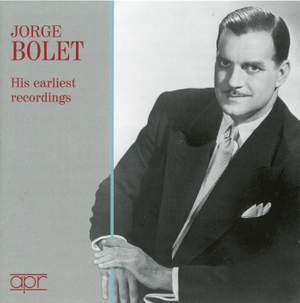
From the mid 1970’s until his death, Cuban born Jorge Bolet emerged as one of the world’s truly great pianists and one of the last representatives, along with the likes of Cherkassky, Horowitz and Earl Wild, of the great Romantic tradition of pianism. His pedigree was marvellous - a student of Godowsky-disciple David Saperton at the Curtis Institute, there he was also able to play for Godowsky himself and Josef Hofmann. He won the Naumburg competition in 1937 and looked set for a great career, but the war interrupted the flow of things and he struggled through the 1950s & 60s, mainly playing in the USA and not quite making the international ‘big-time’. His big break came with an RCA contract and the release on LP of a stunning live Carnegie Hall concert in 1974. Shortly after, he was signed to Decca and went on to make many award winning discs. But what of the early years? There’s not much, but here, for the first time on CD, we have the four LPs he made in the 1950s. His very first disc was of Latin-American repertoire that he was never to record again. Here also is the first ever recording of Prokofiev’s Second Piano Concerto in a performance that is still up there with the best. These almost unknown discs are sure to fascinate, and fill an important gap in the mystery of Bolet’s early career. “This invaluable reissue of discs dating from 1952-53 is a reminder of Jorge Bolet's early stature. The first-ever recording of Prokofiev's malignant, ferociously demanding Second Concerto is of so much more than documentary interest...nothing can dim one's sense of Bolet's massive and unswerving authority, a quality at once lyrical and magisterial...A true aristocrat of the keyboard, his warmth and humanity strike you at every turn.” Gramophone Magazine, December 2011 | | APR - APR6009 (CD - 2 discs) Normally: $19.25 Special: $15.40 |
| | Usually despatched in 2 - 3 working days. |
|
|
| |  | Annie Fischer, Volume 1
Beethoven: | Piano Concerto No. 1 in C Major, Op. 15 Hungarian Radio Symphony Orchestra, Peter Mura Piano Concerto No. 5 in E flat major, Op. 73 'Emperor' Hungarian Radio Symphony Orchestra, Peter Mura Piano Concerto No. 3 in C minor, Op. 37 Hungarian Radio Symphony Orchestra, Antal Dorati | Chopin: | Piano Concerto No. 1 in E minor, Op. 11 Hungarian Radio Symphony Orchestra, Peter Mura | Handel: | Chaconne in G major, HWV 430/Anh. | Liszt: | Piano Concerto No. 1 in E flat major, S124 Hungarian Radio Symphony Orchestra, Peter Mura | Mendelssohn: | Rondo capriccioso in E major, Op. 14 From Hungarian Television broadcasts of the 1960’s | Mozart: | Piano Concerto No. 22 in E flat major, K482 Hungarian Radio Symphony Orchestra, Peter Mura Piano Concerto No. 24 in C minor, K491 (CD) Live performance c1978 Swiss Italian Radio Orchestra, Marc Andreae | Schumann: | Piano Concerto in A minor, Op. 54 (CD) Live performance c1984 NDR Symphony Orchestra, Hamburg Woldemar Nelsson |
Annie Fischer’s (July 5, 1914 - April 10, 1995) main teacher was Ernst von Dohnányi at the Budapest Music Academy. In 1933 she won the first prize at the International Liszt Competition and soon established an illustrious solo concert career. She was regularly invited to perform throughout Europe by the likes of Otto Klemperer, Ferenc Fricsay, Igor Markevich, Antal Dorati, Walfganf Sawalisch, Adrian Boult. and considered one of the most admired pianists of the 20th century. Her great qualities were the poetic, passionate and magically beautiful performances that created a special communication with the audience. | | | Usually despatched in 4 - 5 working days. |
|
|
| |  | Mendelssohn - Piano Works
Wolfram Smitt-Leonardy (piano) Felix Mendelssohn (1809-47) was one of the most gifted of all composers. A child prodigy born to a wealthy banking family in Berlin, he matured musically at an incredible rate – and was composing music in his ‘mature’ style by the age of 15 – something not even Mozart achieved. Like Beethoven, Chopin and Liszt, he was a formidable pianist, and his style as a pianist was influenced by composers such as Hummel, Thalberg, Moscheles and Weber. His two mature piano concertos ( a third has just been discovered), are brilliant compositions for the instrument, and novel in structure, with the 3 movements linked. His music for solo piano contains some remarkable music, especially the Op. 54 Variations, his greatest work for solo piano – it is brilliantly conceived and executed, highly virtuosic, harmonically and thematically daring piece. The other works on this CD illustrate both the virtuosic and the more reflective facets of Mendelssohn’s writing for piano. The capriccios reflect the popular taste at the time for works with a slow romantic introduction followed by a dashing finale. Op.72 Kinderstücke are very different from Schumann’s Kinderszenen. These are idyllic, gentle pieces, and have a fairy-tale quality to them. | | | Usually despatched in 4 - 5 working days. |
|
|
| |  | Mendelssohn - Piano Workson period instruments
Mendelssohn: | Fantasia on "The Last Rose of Summer", Op. 15 3 Fantasies (or Caprices) Op. 16 Albumblatt in E minor, Op. 117 Rondo capriccioso in E major, Op. 14 Songs without Words, Book 2 (6), Op. 30 Songs without Words, Book 5 (6), Op. 62 Song without Words, Op. 62 No. 3 in E minor 'Trauermarsch' alternative Erste fassung 1843 Song without Words, Op. 62 No. 3 in E minor 'Trauermarsch' alternative Fassung des Widmungsautographs fur Clara Schumann Prelude in E minor Minnelied im Mai 'Holder klingt der Vogelsang', Op. 8 No. 1 Andante con expressione, Op. 8, No. 2 Lied (Lenau): Larghetto, Op. 8, No. 3 Erntelied (folksong) Op. 8 No. 4 |
Includes gems composed by Mendelssohn’s sister Fanny played by Tobias Koch on a 200 year old concert grand. | |
|
| |  | Pure Mendelssohn
Mendelssohn: | Song without Words, Op. 53 No. 3 in G minor Movement in G minor Song without Words, Op. 67 No. 3 in B flat major Song without Words, Op. 53 No. 2 in E flat major Song without Words, Op. 30 No. 6 in F sharp minor 'Venezianisches Gondellied No. 2' Lied in F sharp minor Song without Words, Op. 67 No. 5 in B minor Song without Words, Op. 85 No. 4 in D major Variations sérieuses in D minor Op. 54 Song without Words, Op. 19b No. 1 in E major 'Sweet Remembrance' Song without Words, Op. 19b No. 3 in A major 'Hunting Song' Gondellied (Barcarolle) in A Lied F-Dur Lied Es-Dur Song without Words, Op. 38 No. 2 in C minor Song without Words, Op. 102 No. 2 in D major Song without Words, Op. 67 No. 4 in C major 'Spinning Song' or 'Bee's Wedding' Rondo capriccioso in E major, Op. 14 Albumblatt in E minor, Op. 117 |
“Realistically captured, with strong, sweeping accounts of the Variations sérieuses as the programme's centrepiece and the Andante and Rondo capriccioso with which Knauer rounds off proceedings, this is a distinguished contribution to the 200th anniversary celebrations.” Gramophone Magazine, March 2009 “One of the main reasons for the success of this disc is that instead of doggedly ploughing his way through a chronologically ordered selection of Songs Without Words, Sebastian Knauer has chosen only those which appeal to him and about which he has something individual to say. At least, that is the impression one gets from his playing. For Mendelssohn specialists there are the added bonuses of four world premiere recordings: the Songs in F sharp minor and F major (sans opus numbers) are heard here in the first edition of the 2001 Viennese Urtext; the Song in E flat is a completion by Mendelssohn's biographer Larry Todd (who also contributes the booklet here); Op 102 No 2 in D major is a 'recording of the dedicated original score' (no further information is given). Realistically captured, with strong, sweeping accounts of the Variations sérieuses as the programme's centrepiece and the Andante andRondo capriccioso with which Knauer rounds off proceedings, this is a distinguished contribution to the 200th anniversary celebrations.” Gramophone Classical Music Guide, 2010 | | | Usually despatched in 4 - 5 working days. |
|
|
| |  | Mendelssohn - Piano Music
Pieter-Jelle de Boer (piano) 2009 is the 200th anniversary of Mendelssohn’s birth, and he will be the focus of many radio and TV programmes, plus concerts worldwide. New recording: one of a series of releases from Brilliant Classics featuring outstanding young artists who have won the principal prizes at the Young Pianist Foundation’s National Piano Competition. Pieter-Jelle de Boer was born in the Netherlands in 1978, and started playing the piano at the age of five. A student of Jan Wijn, Murray Perahia and Emanuel Ax, he took the second prize at the 2001 YPF National Piano Competition. At the Paris Conservatoire, he studied conducting with Peter Eötvös and John Carewe. He has a busy recital and concert schedule. For this Mendelssohn recital, de Boer has chosen some of the composer’s most brilliant and virtuosic works. The Variations sérieuses Op.54 are generally considered to be among his most successful works for solo piano. As a virtuoso pianist Mendelssohn composed manyhighly demanding works for his instrument. The early Sonata Op.6 shows the unmistakable influence of Beethoven and Mozart, but the Rondo capriccioso Op.14 is a wonderful example of the technical wizardry Mendelssohn was capable of. He was very friendly with the composer and pianist Ignaz Moscheles (a friend in turn of both Beethoven and Hummel), and the older man’s influence upon the young Mendelssohn’s keyboard-writing should not be underestimated. This disc offers a good opportunity to sample some of Mendelssohn’s piano-writing outside of the famous Songs without Words sets that tend to overshadow his works for piano. | | | Usually despatched in 4 - 5 working days. |
|
|
| |
|