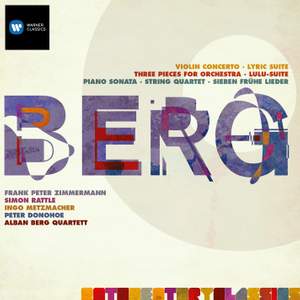
All recordingsPrices shown exclude VAT. (UK tax is not payable for deliveries to United States.) See Terms & Conditions for p&p rates. | |  | Berg: Violin Concerto & Lulu Suite
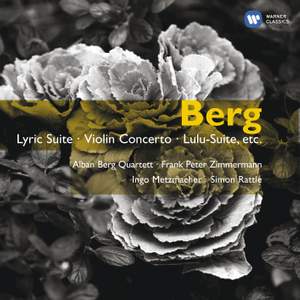
Alban Berg (1885-1935) is, arguably, the most approachable of the three great serialist composers who were working in Vienna at the turn of the century – Schoenberg and Webern being the other two. Of the three, it was Berg whose technique was less stringently atonal: his music has a romantic lyricism that is largely absent from the later music of his two friends. This is no better illustrated than in his last work, the gorgeously wistful Violin Concerto of 1935, a work that is dedicated 'To the Memory of an Angel' – the angel being the recently deceased 18-year-old, Manon Gropius, daughter of the Bauhaus architect Walter Gropius and Mahler's surviving widow Alma. The other works in this set help to make it the perfect introduction to Berg's music, from the Suite from his notorious opera Lulu to the beautiful Lyric Suite and the early lyricism of the Seven Early Songs. | | | In stock - usually despatched within 1 working day. |
|
|
| |  |
| | | In stock - usually despatched within 1 working day. |
|
|
| |  |
| | | In stock - usually despatched within 1 working day. |
|
|
| |  | Berg: Three Orchestral Pieces
| 
| | | Scheduled for release on 17 June 2013. Order it now and we will deliver it as soon as it is available. |
|
|
| |  | Berg: Violin Concerto & Three Orchestral Pieces
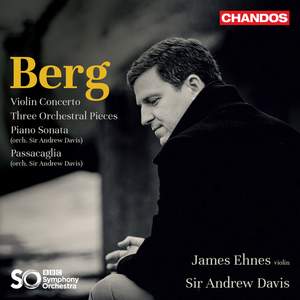
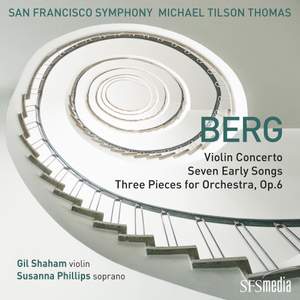
Berg’s Three Orchestral Pieces of 1913–15 rank along side Stravinsky’s Petrushka and The Rite of Spring as one of the most remarkable and explosive large-scale orchestral works of the early 20th century. The sound world, although Mahler-esque in places, is Berg’s unique voice: highly chromatic, dark, brooding, wistfully melancholic, often romantic. Schoenberg, his teacher, advised the young Berg not to try to emulate his fellow pupil Anton Webern in working in ultra-condensed forms. Schoenberg recognised Berg’s natural gift for melody and colour, and that these required a broad canvas and full orchestra to be effective. The Violin Concerto from 20 years later was composed when Berg was financially crippled as the Nazi party had condemned his opera Wozzeck as ‘degenerate’, and the royalty income had dried up. He was working on his second opera Lulu when news reached him that Manon, the teenage daughter of Mahler’s widow Alma and Walter Gropius, close friends of Berg, had died after a long and painful illness. The concerto is one of the most personal and emotional utterances by any composer. It has also come to light that Berg makes reference to Mizzi, a 17-year-old housemaid with whom he had a passionate affair and a daughter. The work was premiered in 1935, and in December of that year Berg died of septicaemia, leaving Lulu unfinished. Recording made in 1983/4 ‘Kremer gives a beautifully tender account of the first movement of the Concerto, aided by a markedly slower opening tempo than usual and by a really hushed pianissimo at the outset. The result is that the change of mood and tempo when the music moves from andante to allegretto are immediately perceptible: the allegretto has not been pre-empted by earlier accelerations, as can easily happen.’ Gramophone, July 1985 New booklet notes | | | Usually despatched in 2 - 3 working days. |
|
|
| |  | Christiane Iven sings Berg & Strauss
Christiane Iven (soprano) Orchestre Philharmonique de Strasbourg, Marc Albrecht Berg’s chamber music version of the Strauss waltz ‘Wine Women and Song’, Op.333 is considered one of the curiosa of his oeuvre, and even today is seldom performed. Coupled here with Berg’s more substantial orchestral works, Christaner Iven is a great singer and is equally talented as an actress. | | | (also available to download from $10.50) | Usually despatched in 2 - 3 working days. (Available now to download.) |
|
|
| |  | Berg - Lulu Suite & Drei OrchesterstückeRecorded Live Concertgebouw Amsterdam 19, 20, 23 October 2005 (Lulu Suite) 27, 28, 29, 30 September 2006 (Drei Orchesterstücke)
Since taking audiences by storm in his first appearance with the Royal Concertgebouw Orchestra in April 2004, conductor Daniele Gatti has been a regular and welcome guest with the orchestra. His concert performances are characterised by highly individual interpretations of traditional orchestral repertoire and a fondness for less common repertoire, with a particular preference for the Second Viennese School and related movements. On this CD, Gatti's first recording with the Royal Concertgebouw Orchestra, he conducts two key works by Alban Berg: the early Drei Orchesterstücke and the suite from the unfinished opera Lulu, Berg's swansong. Under his baton, both works, which Gatti conducted from memory in these concerts, are given highly ominous, atmospheric performances. “…conductors as well as listeners can be distracted by the high-gloss surfaces of Berg's orchestration, especially in the Lulu Suite, but Gatti always draws the ear inwards, past smoochy saxophone and celesta, deep inside those contrapuntal caverns of ecstasy where Berg is even more in his element that Mahler or Strauss.” Gramophone Magazine, February 2009 “Gatti's Berg is very much post-Romantic rather than proto-modernist, with the Mahlerian influences emphasised. In the Three Orchestral Pieces, however, he generates shocking intensity throughout...here you really do feel you've been witness to the wartime dissolution of a world.” The Guardian, 10th October 2008 **** | | | Usually despatched in 3 - 4 working days. |
|
|
| |  | Vladimir Jurowski - Live from the Royal Festival Hall
Recorded live at Southbank Centre’s Royal Festival Hall,
London, 19 September 2007 “The cogently-planned programme works magnificently in execution. Jurowski is thoughtful and unegotistical in the 50-minute accompanying interview, and you can watch him closely in the second DVD which places the 'conductor camera' in a box in the corner of the screen.” BBC Music Magazine, July 2008 ***** “Pulling off such a programme demands absolute conviction in the moment of performance, and this concert had it in spades. If this is a sign of things to come, the Jurowski/LPO partnership will set a standard by which all other London orchestras are judged.” Financial Times BBC Music Magazine
DVD Choice - July 2008 |
| | | Usually despatched in 2 - 3 working days. |
|
|
| |  |
| | | Usually despatched in 8 - 10 working days. |
|
|
| |  |
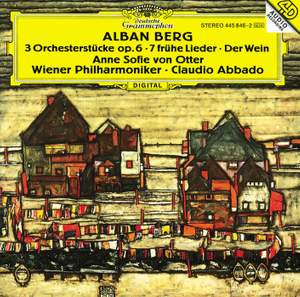
Wiener Philharmoniker, Claudio Abbado “Anne Sofie von Otter included the Seven EarlySongs on a recital disc (no longer available on CD). Singing with orchestra, von Otter naturally works on a larger scale. The words are more firmly bound into the vocal line; there isn't the detailed give-and-take that's possible with a pianist. But the outline of her interpretation remains that of a true Lieder singer, always lighting upon unexpected subtleties of colour and emphasis to inflect the poetry. In all this Abbado is an equal partner. Von Otter needs careful accompaniment in the concert hall if she's to dominate an orchestra and Abbado, in co-operation with DG's technical team, has produced a balance that never drowns her, but still sounds fairly natural. In Der Wein, Berg's late concert aria, von Otter and Abbado catch the lilt of the jazz rhythms. In the Seven EarlySongs are they a touch too cool? Perhaps, but in the final song, 'Sommertage', they throw caution to the winds and end the cycle on a passionate high. Abbado has recorded the Three OrchestralPieces before and his 1970s recording has long been one of the standard versions of this work. The opportunity to see how his thoughts have developed since then brings more surprises than might have been expected. In short, his outlook is progressing from the Italianate to the Germanic. No doubt the influence of the Vienna Philharmonic Orchestra has much to do with this and their marvellously eloquent playing is one of the prime attractions of the disc. In their company Abbado finds more depth and complexity in the music than before, although that does mean that the March loses the Bartókian attack and driving rhythms that made his first version so exciting.” Gramophone Classical Music Guide, 2010 | | (Sorry, download not available in your country) | |
|
|
| |
|