All recordingsPrices shown exclude VAT. (UK tax is not payable for deliveries to United States.) See Terms & Conditions for p&p rates. | |  | The Art of Magdalena Kozena
Auber: | Le Domino noir: 'Je suis sauvée enfin - Ah! quelle nuit - Flamme vengeresse' Mahler Chamber Orchestra, Marc Minkowski | Bach, J C: | Lamento 'Ach daß ich Wassers gnug hätte' Musica antiqua Köln, Reinhard Goebel | Bach, J S: | Cantata BWV208 'Was mir behagt, ist nur die muntre Jagd!' Musica Florea, Marek Stryncl Mass in B minor, BWV232: Laudamus Te Musica Florea, Marek Stryncl | Bizet: | Les tringles des sistres tintaient (from Carmen) Mahler Chamber Orchestra, Marc Minkowski | Dvorak: | Biblical Songs, Op. 99: Slýs, ó, Boze Berliner Philharmoniker, Simon Rattle Biblical Songs, Op. 99: Hospodin Jest muj Pastýr Berliner Philharmoniker, Simon Rattle Biblical Songs, Op. 99: Boze, boze, pisen novou Berliner Philharmoniker, Simon Rattle Zajatá from Moravské dvojzpevy (Moravian Duets) with Dorothea Röschmann & Malcolm Martineau (piano) Prsten from Moravské dvojzpevy (Moravian Duets) with Dorothea Röschmann & Malcolm Martineau (piano) | Gounod: | Nuit resplendissante (from Cinq-Mars) Mahler Chamber Orchestra, Marc Minkowski | Handel: | Lascia ch'io pianga (from Rinaldo) Venice Baroque Orchestra, Andrea Marcon Dopo notte (from Ariodante) Venice Baroque Orchestra, Andrea Marcon Scherza, infida (from Ariodante) Venice Baroque Orchestra, Andrea Marcon | Janacek: | Lavecka (Bench) with Malcolm Martineau (piano) Moravian Folk Poetry: 12. Jabúcko with Malcolm Martineau (piano) Muzikanti [Musicians] with Malcolm Martineau (piano) | Kapsberger: | Felici gl'animi Private Musicke, Pierre Pitzl | Mahler: | Rheinlegendchen (Des Knaben Wunderhorn) Cleveland Orchestra, Pierre Boulez Lob des hohen Verstandes (Des Knaben Wunderhorn) Cleveland Orchestra, Pierre Boulez Um Mitternacht (Rückert-Lieder) Berliner Philharmoniker, Simon Rattle | Monteverdi: | Libro Nono di Magrigali e Canzonette: Si dolce è'l tormento Private Musicke, Pierre Pitzl | Mozart: | Non so più cosa son, cosa faccio (from Le nozze di Figaro) Orchestra of the Age of Enlightenment, Simon Rattle Voi che sapete (from Le nozze di Figaro) Orchestra of the Age of Enlightenment, Simon Rattle | Ravel: | Shéhérazade: Asie Berliner Philharmoniker, Simon Rattle | Rösler: | An die Entfernte with Malcolm Martineau (piano) | Strozzi: | L'Eraclito amoroso 'Udite amanti' Private Musicke, Pierre Pitzl | trad.: | Kebych bola jahodú | Vitali, F: | Bei lumi Private Musicke, Pierre Pitzl | Vivaldi: | Anderò, volerò, griderò (from Orlando finto pazzo) Venice Baroque Orchestra, Andrea Marcon Armatae face et anguibus (from Juditha Triumphans) Venice Baroque Orchestra, Andrea Marcon Gelido in ogni vena (from Il Farnace, RV711) Venice Baroque Orchestra, Andrea Marcon |
The Art of Magdalena Kožená is an anthology of her finest performances, documenting both the range of her voice and the breadth of repertoire to which she can bring authority, from early baroque of Monteverdi and Strozzi to sacred arias by Bach, opera arias by Handel, Vivaldi, Mozart, Gounod, Bizet and Auber, as well as orchestral songs by Mahler. To all she brings an absorbing emotional depth and maturity of her interpretative abilities. Unique to Kožená are the songs rooted in Bohemia and Moravia by Dvořak and Janáček. She still feels closely connected to her Czech roots. “It’s music that stays in your body forever”. This is Magdalena’s own selection of her favourite songs and arias, sung in French, Italian and German as well as in her mother tongue. 28-page Booklet, including new liner notes from Nick Kimberley. | 
| | | (Sorry, download not available in your country) | In stock - usually despatched within 1 working day. |
|
|
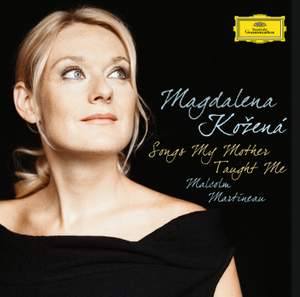
| |  | Magdalena Kožená - Songs My Mother Taught Me
Dvorak: | Songs My Mother Taught Me, Op. 55 No. 4 Struna naladena (Rein gestimmt die Saiten), Op. 55, No. 5 A les je tichy kolem kol (Rings ist der Wald so stumm und still), Op. 55, No. 3 Mne zdálo se žes umrela (I dreamt that you were dead) Prsten from Moravské dvojzpevy (Moravian Duets) Zajatá from Moravské dvojzpevy (Moravian Duets) | Eben: | Milovánie bez vídánie I dare not ask Quand ce beau printemps Ach Gott, wie weh tut scheiden Jakz sem te najprv poznal Stratilat sem milého | Janacek: | Lavecka (Bench) No. 37 from “Moravská lidová poezie v písních (Moravian Folk
Poetry in Songs)", 53 folksong arrs., c1892-1901 Jabúcko No. 12 from “Moravská lidová poezie v písních (Moravian Folk
Poetry in Songs)", 53 folksong arrs., c1892-1901 Muzikanti [Musicians] No. 50 from “Moravská lidová poezie v písních (Moravian Folk Aj co to je za slavicek V cernym lese | Martinu: | Devce z Moravy (Moravian Girl) Súsedova stajna (The Neighbour's Stable) Nadeje (Hope) Hlásný (The Night Watchman) Tajná láska (Secret Love) Bozi muka (The Wayside Cross) Zvolenovci chlapci (Lads of Zvolyn) | Novák, V: | Písen melancholická Zda není snem? (transposed) Vecer Podzimní nálada Až prejde den | Rösler: | An die Entfernte | Schulhoff: | Pasala volky (Out in the beechwood) (Národní písne a tance) from “Národní písne a tance z Tesinksa (Folksongs and Dances from the Tesinskso Region)“, WV120 Kdyz jsem byla mamince na kline (On my mother's knee) from “Národní písne a tance z Tesinksa (Folksongs and Dances from the Tesinskso Region)“, WV120 Sidej na vuz from “Národní písne a tance z Tesinksa (Folksongs and Dances from the Tesinskso Region)“, WV120 | trad.: | Kebych bola jahodú |
Magdalena Kožená, one of the most acclaimed recitalists of today, presents a personal collection of songs she has known since childhood and that form some of her earliest musical influences. A haunting collection of songs by Czech composers such as Dvorák, Janácek, Martinu, Schulhoff and Eben, all deeply rooted in the rich Czech folk song tradition. Like Magdalena explains in the press/booklettext about the songs on the album: “They are just the sort a mother would sing to her baby. My mother is not a professional singer, but she loved to sing and knew a lot of songs! There is a particular tradition of singing to children in our country, much stronger, I would say, than one sees any more in the West. It was really important that in each family these songs would be handed down, taught to the children.” Kožená’s musical partners on the album include her long-standing recital partner Malcolm Martineau, and soprano Dorothea Röschmann, who joins her in Dvorák’s Moravian duets. This is Magdalena Kožená’s most personal album so far, exploring the richness of her cultural background and her own musical memories. “Singing in a language she really did learn from her mother, Kožená sounds at her most relaxed… She also suggests a fierce connection with these songs, abandoning herself into music that showcases well her glinting top and dusky lower notes.” Gramophone Magazine, Awards Issue 2008 “it isn't just an atmospheric title; there are indeed songs that Kozena's mother sang to her as a child, plus others she heard in her village...Kozena, whilst her performances are always memorable, is lifted to an entirely different plateau with these songs in her home tongue and all the emotional resonance they hold for her.” Charlotte Gardner, bbc.co.uk, 28th November 2008 “Beautifully recorded and accompanied, this is not just a showpiece for an exceptional voice, but a fascinating conspectus of Czech song, with a Moravian twist.” BBC Music Magazine, November 2008 | | | Usually despatched in 2 - 3 working days. |
|
|
| |
|