Prices shown exclude VAT. (UK tax is not payable for deliveries to United States.) See Terms & Conditions for p&p rates. | |  | Chopin: 24 Preludes
Master pianist Maurizio Pollini turned 70 on January 5th, 2012 and DG are celebrating this milestone birthday with a new album of breath-taking Chopin. Pollini’s Chopin recordings are his best-sellers – the complete Nocturnes, released in 2005, have sold more than 100,000 CDs to date. Chopin: Preludes is a birthday programme of newly recorded solo works: Preludes op.28, four Mazurkas op.30, two Nocturnes op.27, and the Scherzo no.2 op.31. Pollini often feature Chopin’s works in his solo recitals – The Guardian raved, “... he still plays Chopin with the ease that floored even Rubinstein more than 50 years ago ...” “His sense of phrasing, structure and pacing is undimmed...There are other accounts of the 24 Preludes that are more impassioned, more vividly imagined and coloured, but few are more pure or devoted. Recorded sound is excellent. The fingers are not entirely all they used to be in terms of nimbleness, but that isn't too intrusive.” BBC Music Magazine, January 2013 **** “The best of it, especially the B flat minor Scherzo, is superb, the virtuosity effortless, the grip on the formal structure utterly secure, but elsewhere...there's sometimes a chilly relentlessness about the playing, an impatience almost, that keeps the music at a distance.” The Guardian, 1st November 2012 **** | | | In stock - usually despatched within 1 working day. |
|
|
| |  | Tribute to Dinu Lipatti
Bach, J S: | Partita No. 1 in B flat major, BWV825 | Chopin: | Waltz No. 3 in A minor 'Grande Valse Brillante', Op. 34 No. 2 Waltz No. 7 in C sharp minor, Op. 64 No. 2 Waltz No. 6 in D flat major, Op. 64 No. 1 'Minute Waltz' Nocturne No. 7 in C sharp minor, Op. 27 No. 1 Nocturne No. 8 in D flat major, Op. 27 No. 2 Mazurkas (4), Op. 30 Ballade No. 3 in A flat major, Op. 47 Nocturne No. 20 in C sharp minor, Op. post. | Mozart: | Piano Sonata No. 8 in A minor, K310 | Schubert: | Impromptu in G flat major, D899 No. 3 Impromptu in E flat major, D899 No. 2 German Dance D145 No. 7 German Dance D145 No. 8 |
The legendary Paul Badura-Skoda pays tribute to the Romanian pianist Dinu Lipatti, who sixty years ago gave his last recital in the Kursaal of Besançon. Here, Badura-Skoda performs the programme of this historic concert. | | | In stock - usually despatched within 1 working day. |
|
|
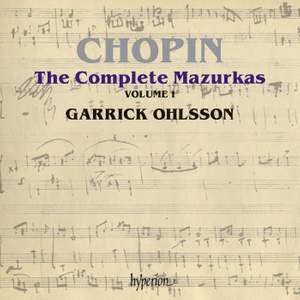
| |  | Chopin - The Complete Mazurkas Volume 1
Nineteenth-century works inspired by folk music come in many forms. As far as piano music is concerned, one thinks of such pieces as the arrangements of popular tunes that furnish Liszt’s Hungarian Rhapsodies and Brahms’ Hungarian Dances. But Chopin’s mazurkas are quite different in that a popular folk tradition, with the use of original thematic material, is developed and shaped by the composer’s invention. The mazurka takes its name from the area of Mazovia around Warsaw, acquiring its status as a national and stylized dance form in the late eighteenth/early nineteenth century (long after the polonaise had done so). The term ‘mazurka’ is really a generic title for many regional dances that share similar characteristics, most notably the mazur, oberek and kujawiak. The features common to all are triple time, the strongly accented second or third beat (accompanied by a tap of the heel), and a dotted rhythm. Some of these regional variations are fast and wild (like the obereks), others are tinged with melancholy. Chopin’s earliest essays in the form are the two mazurkas in B flat major and G major composed and published in Warsaw in 1826; the very last work he completed was the Mazurka in G minor Op 67 No 2, published in 1855. (See volume 2 for these.) In all, Chopin composed some 57 mazurkas (more if doubtful and spurious works are included) of which 41 were published during his lifetime in groups of three, four or five. The chronology of their composition is sometimes unclear. In some cases ideas Chopin had improvised waited some time before being committed to paper; further revisions and second thoughts meant additional delays before publication. Briefly, the nine mazurkas of Opp 6 and 7 were composed in Vienna in 1830 shortly after his final departure from Warsaw. The thirty-two mazurkas contained in Opp 17 to 63 were composed and published at fairly regular intervals between 1833 and 1847. The eight mazurkas of Opp 67 and 68, instructed by the composer to be destroyed but published posthumously by Julian Fontana, were written at various times between 1827 (Op 68 No 2) and 1849 (Op 67 No 2). A further thirteen have no opus numbers, mainly early works either published separately while Chopin was still alive or after his death—the one in A flat major, for example, composed in 1834 did not appear in print until 1930. The first two sets on this volume, while not as distinguished as some of the later ones, nevertheless contain many of the characteristic devices Chopin was to use frequently: the triplet figure that opens Op 6 No 1 in F sharp minor, for instance, and the drone bass of No 2 in C sharp minor and No 3 in E major, which lends a rustic flavour to the music. This set, composed between 1830 and 1832, was dedicated to Countess Pauline Plater, a fellow exiled Pole and one of Chopin’s favourite pupils. The Op 7 set was dedicated to a Mr Johns, an American whom Chopin introduced to his friend Heller as ‘a distinguished amateur from New Orleans’. No 1 in B flat major is one of the best known of all the mazurkas. The four mazurkas in each of the Op 17 (1834) and Op 24 (1835) sets mark a distinct advance in their depth of expression. Here Chopin begins to elaborate the mazurka from a short salon piece into something more ambitious and aristocratic in tone. Key changes from one section to another are subtly and poetically accomplished; codas of exquisite charm are introduced. Op 17 No 4 in A minor is one of the most important mazurkas and among Chopin’s most moving creations. There are few pages of piano music that are more despairing and helpless, a mood broken only by the central A major section. It is, says Charles Rosen, ‘an ideal Romantic fragment: complete and provocative, well-rounded and yet open’. Op 17 bears a dedication to the singer Lina Freppa, a friend of Bellini, Op 24 to the Comte de Perthuis, King Louis-Philippe’s director of music. Schumann reviewed both the Opp 30 and 33 sets. Of the former, published in 1835 and dedicated to Princess Maria Czartoryska, he wrote: ‘Chopin has elevated the Mazurka to a small art form; he has written many, yet few among them resemble each other. Almost every one contains some poetic trait, something new in form and expression.’ The Op 33 set returns somewhat to the mood of Opp 6 and 7. ‘His forms seem to grow ever brighter and lighter—or are we becoming accustomed to his style?’, asks Schumann. ‘These mazurkas will charm every one instantly, and seem to us more popular in character than his earlier ones.’ Countess Roza Mostowska, another aristocratic Polish pupil of Chopin, was the dedicatee. In a letter to his friend Julian Fontana written in June 1839, Chopin announced: ‘You know that I have four new mazurkas: one from Palma [Majorca, from where he and George Sand had recently returned], three from here [Sand’s house in Nohant]. They seem to me pretty, as the youngest children usually do when the parents grow old.’ The wonderful Op 41 mazurka in C sharp minor has a tune described by the critic James Huneker as ‘a little saddened by life, but courage never fails’; No 1 in E minor, the one written in Majorca, he characterizes as ‘sad to the point of tears’. “…Ohlsson brings a phenomenal variety of expression and depth of characterisation to these exquisite miniatures - an approach that manages to capture the folk elements of the composer's style to quite hypnotic effect.” BBC Music Magazine, February 2010 ***** | | | In stock - usually despatched within 1 working day. |
|
|
| |  | Miroslav Kultyshev: 16th International Chopin Piano Competition
Chopin: | Ballade No. 4 in F minor, Op. 52 Étude Op. 10 No. 8 in F major Nocturne No. 16 in E flat major, Op. 55 No. 2 Polonaise No. 5 in F sharp minor, Op. 44 Nocturne No. 10 in A flat major, Op. 32 No. 2 Waltz No. 5 in A flat major, Op. 42 Barcarolle in F sharp major, Op. 60 Polonaise No. 7 in A flat major, Op. 61 'Polonaise-fantaisie' Mazurkas (4), Op. 30 Impromptu No. 3 in G flat major, Op. 51 Impromptu No. 4 in C sharp minor, Op. 66 'Fantaisie-Impromptu' |
Miroslav Kultyshev (piano) | | | Usually despatched in 2 - 3 working days. |
|
|
| |  | Chopin, Xiaogang Ye & Qigang Chen: Piano Works
Xiaotang Tan lives in Peking and had his first piano lessons at the age of five. He performs regularly with China’s leading symphony orchestras and has appeared as a soloist in Japan, Australia and Europe. As well as performing works by Chopin, Tan performs works by two Chinese composers, who both have strong links with Messiaen. | | | (also available to download from $10.50) | Usually despatched in 2 - 3 working days. (Available now to download.) |
|
|
| |  | Yulianna Avdeeva: 16th International Chopin Piano Competition
Chopin: | Nocturne No. 17 in B major, Op. 62 No. 1 Scherzo No. 4 in E major, Op. 54 Waltz No. 2 in A flat major 'Grande Valse Brillante', Op. 34 No. 1 Fantasia in F minor, Op. 49 Mazurkas (4), Op. 30 Scherzo No. 3 in C sharp minor, Op. 39 Prelude Op. 45 in C sharp minor (No. 25) Ballade No. 4 in F minor, Op. 52 Nocturne No. 7 in C sharp minor, Op. 27 No. 1 Piano Sonata No. 2 in B flat minor, Op. 35 'Marche funèbre' Polonaise No. 7 in A flat major, Op. 61 'Polonaise-fantaisie' Piano Concerto No. 1 in E minor, Op. 11 Warsaw Philharmonic Orchestra, Antoni Wit |
| | | Usually despatched in 2 - 3 working days. |
|
|
| |  | Chopin: Mazurkas (Vols.1 & 2)
| | | Usually despatched in 4 - 5 working days. |
|
|
| |  | Chopin - Four Ballades
Alessandra Ammara (piano) Alessandra Ammara graduated from the "L. Cherubini" Conservatory of Florence and the Accademia Pianistica of Imola. She honed her talents in some of today's most important music schools, like the International Piano Foundation at Lake Como and the School of Music in Fiesole, with great musicians like Maria Tipo, Dmitri Bashkirov, Leon Fleisher, William Naboré and Fou Ts'ong. She has drawn the attention of the musical world after achieving brilliant results in some of the more important international piano competitions, such as the "G. B. Viotti" in Vercelli, the "J. Iturbi" in Valencia, the "Casagrande" in Terni, the "Van Cliburn" in Fort Worth. In 2000 she was a Laureate of the "Esther Honens" international piano competition in Calgary, Canada. She has collaborated with many great interpreters, including Ingrid Attrot, Rocco Filippini, Alban Gerhardt, Anton Kuerti, Shauna Rolston, the Takacs Quartet, the Sine Nomine Quartet. Since 1999 she regularly plays in piano duo with Roberto Prosseda. Ms. Ammara has recorded a successful CD for the Canadian label "Arktos" with music by Debussy, Scriabin and Chopin. She was chosen to take part in the new complete Chopin edition produced by Brilliant Classics, together with some of the greatest pianists in the world. Frederick Chopin’s four Ballades are mature works written between 1836 and 1842.after he left his Polish homeland. They represent pure music in its finest form without any suggestive narration, though it is clear that Chopin was inspired by the stories of his native Poland and particularly the poems of Adam Mickiewicz. The Ballades are considered to be some of the finest of Chopin's creations and among the most representative of romantic music. Chopin composed 58 Mazurkas (there seem to be at least another 2 unfinished sketches), and in them you get to know the very heart and soul of his native Poland. Many of his other works of different genres are either inspired by the Mazurka or have parts of Mazurkas within them. Chopin did not invent the mazurka form, however it was he alone who put it on the public stage and refined it into the highest level of music. “Alessandra Ammara… shows herself a vividly communicative artist who leaves no stone unturned in her search for the composer's inner heart and truth.” Gramophone Magazine, December 2008 | | | Usually despatched in 4 - 5 working days. |
|
|
| |  | Chopin: Complete Mazurkas
| | | Usually despatched in 4 - 5 working days. |
|
|
| |  | Chopin: Mazurkas & Ballades
DDD | | | Usually despatched in 8 - 10 working days. |
|
|
| |
|