Copland: Symphony No. 2 'Short Symphony'

This page lists all recordings of Symphony No. 2 'Short Symphony', by Aaron Copland (1900-90) on CD & download (MP3 & FLAC). Generally, more recent releases are listed first, but with priority given to those that are in stock.

Prices shown exclude VAT. (UK tax is not payable for deliveries to United States.)
See Terms & Conditions for p&p rates.

Copland: Appalachian Spring

Copland: Appalachian Spring


Copland:

Appalachian Spring

Susan Palma (flute), David Singer (clarinet), Frank Morelli (bassoon) & Wu Han (piano)

Symphony No. 2 'Short Symphony'

arr. Dennis Russell Davies

Quiet City

Raymond Mase (trumpet) & Stephen Taylor (cor anglais)

Three Latin-American Sketches


Aaron Copland was born in Brooklyn in 1900. His early works gained him a reputation as a modernist. His music featured angular melodies, bold outlines, forceful and piercing orchestration, and above all, jazz rhythms. He depicted in music urban, mechanised America.

His 2nd Symphony typifies this aspect of his music from this period. Deemed almost unplayable by most American conductors of the period, it was premiered in 1934 conducted by his friend and fellow composer Carlos Chavez. It was not until 1944 before it was performed again in the US this time under Stokowski. It is a remarkable work for its time, and the influence of Stravinsky, though his Symphonies in C and in 3 movements were yet to be written.

The three ‘American Ballets’ Billy the Kid, Rodeo, and Appalachian Spring are probably his best known works. The blend of American folksong and hymnody combined with the rhythmic precision of Copland’s orchestration produce music that sounds ‘American’ in that it could not have emerged from any other country. In a sense, Copland invented the soundtrack for American life in music as countless movie and TV series soundtracks draw upon his sound world.

Quiet City is a recasting of the incidental music Copland wrote for the play by Irwin Shaw. Scored for trumpet, cor anglais and strings, it is a nocturne depicting a sleeping city. It is tremendously atmospheric music. Finally the Three Latin-American Sketches are based on tunes from Venezuela and Mexico. Started in 1959 as two Mexican Pieces, he added the Venezuelan movement in 1971.

Recording made in 1988.

Booklet notes.

“The Orpheus Chamber Orchestra’s collection makes for a very distinctive Copland record….In all this music the cutting edge of Copland’s invention is enhanced in performances as immaculately drilled as these” Gramophone Magazine, August 1989

Brilliant Classics - up to 30% off

Brilliant Classics - 9207

(CD)

Normally: $7.25

Special: $6.16

Usually despatched in 4 - 5 working days.

Dennis Russell Davies conducts Copland

Dennis Russell Davies conducts Copland


Copland:

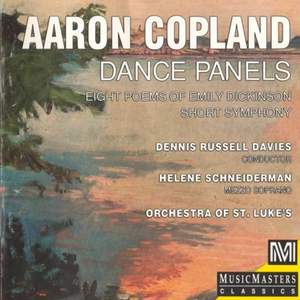
Dance Panels

Eight Poems of Emily Dickinson

Helene Schneiderman (mezzo soprano)

Symphony No. 2 'Short Symphony'


Dance Panels, is probably the least familiar of the works on this CD to a general audience. It was written in 1959 at the suggestion of Jerome Robbins and is scored for six woodwinds, five brass, two percussion and strings. It was first performed in Munich in 1963. Copland wrote that “it is more abstract, and it is lyrical and slower in tempo than most of my other ballet music. It does not tell a story or paint a picture of American life.”

Copland was originally attracted by Emily Dickinson’s poem The Chariot, which contains the famous line “Because I could not stop for death, he kindly stopped for me.” The original cycle, was written between 1948 and 1950; in the late 1960s, Copland orchestrated eight of the songs for the version performed here.

The Short Symphony of 1933 is unquestionably a major work; it may stand as one of Copland’s most assertive and radical expressions of his own distinctive modernism. It is now usually heard in Copland’s own 1937 rearrangement of the music for sextet. Copland was always proud of the original work and referred to it as one of his ‘neglected children’. “If I expended a great deal of time and effort on the Short Symphony, it was because I was determined to write as perfected a piece as I possibly could.”

Nimbus - NI2545

(CD)

$13.50

Usually despatched in 4 - 5 working days.

Hovhaness: Symphony No. 1

Hovhaness: Symphony No. 1


Copland:

Symphony No. 2 'Short Symphony'

Hovhaness:

Symphony No. 1 'Exile'

Milhaud:

Symphony No. 1

Serebrier:

Symphony No. 1

Houston Symphony Orchestra


This important new CD is set to become one of the the most significant releases in the hisoric recordings field for several years. The disc collects together no fewer than four symphonic premieres conducted by the legendary Leopold Stokowski: the American premieres of the first Symphony 'Exile' of Alan Hovhaness, the New York premiere of Darius Milhaud's wartime First Symphony, the American premiere of Aaron Copland's Symphony No 2 and the world premiere of the First Symphony of Jose Serebrier, written when hewas 16 years old and who thereafter became one of Stokowski's most significant proteges. The result is a disc of more than exceptional interest - a winner through and through.

“Stokowski makes strong cases for each of these symphonies, heard here in New York, US, or world premiere performances. Sound in the Hovhaness (1942) is particularly bright and clear.” BBC Music Magazine, December 2009

Guild Historical - GHCD2347

(CD)

$8.00

Usually despatched in 8 - 10 working days.

Copland - Symphony No. 1

Copland - Symphony No. 1


Copland:

Symphony No. 1

Symphony No. 2 'Short Symphony'

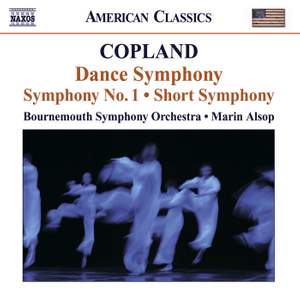
Dance Symphony


This second Naxos disc of Copland Symphonies (No. 3 is available on 8.559106) opens with Symphony No. 1, an arrangement of the 1924 Symphony for Organ and Orchestra. Copland was especially fond of his Short Symphony (Symphony No. 2) on account of its complex, irregular rhythms and clear textures.

The so-called Dance Symphony, described by the composer as ‘a large symphonic work’ (hence the Symphony title), is derived from his early vampire ballet Grohg, inspired by the 1921 German expressionist film Nosferatu. Copland wrote: ‘If the first movement is thin, dainty and pointed, the second movement is songful and sustained. The third movement is characterized by violence and syncopation.’

“[Marin Alsop's] typecasting as an interpreter of the American symphonists is warranted.” Philadelphia Inquirer

“Under Marin Alsop's incisive direction, the Bournemouth musicians perform all three works with just the right blend of power and finesse, and negotiate their sometimes extremely complex rhythms with confidence and precision.” BBC Music Magazine, December 2008 *****

“There are two attractions here: the only current recording of the Short Symphony and a fine recording of Symphony No 1 – at last. It started life as the Symphony for Organ and Orchestra, written for Copland's teacher Nadia Boulanger whose performances launched his career in 1925. Six years later the reworking of the score without organ was first performed but it has never made much headway. Alsop and the Bournemouth players make a fine case for this neglected score with many characteristics of mature Copland.
There are also two versions of Copland's ShortSymphony. It was first played in Mexico City under Carlos Chávez in 1934 but the rhythmic difficulties were considered so great that the American premiere had to wait 10 years. Meanwhile, despairing of orchestral performances, Copland made the version for sextet. There are no difficulties now for the Bournemouth SO but one might have hoped for more sparkle and a better recording.
There are odd circumstances about the DanceSymphony too. It was taken from the ballet Grohg – never performed – that Copland wrote during his student years in Paris. In the absence of a full recording of Grohg, the Dance Symphony completes an essential CD.”
Gramophone Classical Music Guide, 2010

“There are two attractions here: the only current recording of the Short Symphony and a fine recording of Symphony No 1 - at last.” Gramophone Magazine, December 2008

“It's that relatively unfamiliar work [Symphony No. 1] for which Alsop makes the most persuasive case here...The interest in the 1933 Short Symphony (also known as Symphony No 2) is predominantly rhythmic, with intricacies that inhibited early performances but that Alsop and the BSO take in their stride.” The Guardian, 31st October 2008 ****

20% off Naxos

Naxos American Classics - 8559359

(CD)

Normally: $8.25

Special: $6.60

(also available to download from $6.00)

Usually despatched in 2 - 3 working days. (Available now to download.)

Leonard Bernstein: Historic Broadcasts 1946-1961

Leonard Bernstein: Historic Broadcasts 1946-1961


Bartók:

Music for Strings, Percussion & Celesta, BB 114, Sz. 106

Beethoven:

Symphony No. 9 in D minor, Op. 125 'Choral' - Ode to joy (excerpt)

Irma Gonzales (soprano), Nan Merriman (mezzo), Raoul Jobin (tenor), Nicola Moscona (bass)

Piano Concerto No. 1 in C Major, Op. 15

Bernstein:

Symphony No. 2 'The Age of Anxiety'

Chávez:

Symphony No. 4: ‘Sinfonía Romántica'

Copland:

Preamble (For a Solemn Occasion)

Laurence Olivier (narrator)

Symphony No. 2 'Short Symphony'

Billy the Kid

Diamond:

Prelude and Fugue No. 3 in C sharp

Symphony No. 8

Fine:

Serious Song

Harris, Roy:

American Creed

Mahler:

Symphony No. 2 in C minor 'Resurrection'

rehearsal and performance

Adele Addison (soprano), Nan Merriman (mezzo)

Ich atmet' einen linden Duft (Rückert-Lieder)

Ich bin der Welt abhanden gekommen (Rückert-Lieder)

Das irdische Leben (Des Knaben Wunderhorn)

Um Mitternacht (Rückert-Lieder)

Piston:

Concerto for Orchestra

Ravel:

Piano Concerto in G major

rehearsal and performance

Schumann:

Symphony No. 2 in C major, Op. 61

Shostakovich:

Symphony No. 7 in C major, Op. 60 'Leningrad'

rehearsal and performance

United Nations March

Symphony No. 5 in D minor, Op. 47

Stravinsky:

The Rite of Spring

Weill, K:

The Threepenny Opera

and rehearsal excerpts of Turangalila & Mozart Piano Concerto No. 15


When it was announced that Leonard Bernstein was the become the new conductor of the New York Philharmonic in November 1957, Claudia Cassidy in the Chicago Daily Tribune wrote that it was “no great surprise” but injected a note of caution: “wish him luck, because no one needs it more than the musical director of a symphony orchestra.”

It turned out to be an inspired appointment. This set demonstrates what it was in about his music making and his personality that led the New York Philharmonic’s directors to choose him. It includes extensive recorded documentation of Bernstein’s career up to the time of his nomination in New York, mostly in live performances and rehearsal segments, working on music ranging from Mozart to Messiaen.

Bernstein’s work after his appointment to the NYP is represented in this set by performances of American music given as part of his “Survey of American Music” in the 1958–9 season (Fine, Harris and Piston), along with Copland in 1957 and Diamond in 1961; the 1959 recording sessions for two of his favourite twentieth-century classics (Shostakovich’s Fifth Symphony and Copland’s Billy the Kid) which show conductor and orchestra at their most efficient and effective; and hitherto unpublished live performances of music by Bartók, Beethoven, Chávez, and Mahler.

“Excitement? Charisma? Sweat? Here in plenty. But there is also meticulous musicianship, particularly on view in some of the set’s most precious documents...Speeds hurtle; the heart races; the spine tingles...you’re holding history in your hand.” The Times, 12th April 2013 *****

Released or re-released in last 6 months

20% off Music & Arts

West Hill Radio Archive - WHRA6048

(CD - 11 discs)

Normally: $83.50

Special: $66.80

In stock - usually despatched within 1 working day.

Copyright © 2002-13 Presto Classical Limited, all rights reserved.