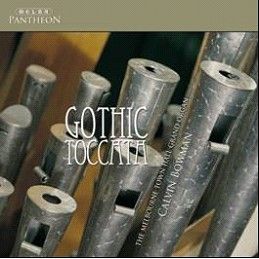
Gothic Toccata is the first major recording of Australian organ works on an iconic Australian instrument.
Pieces chosen to showcase the diversity of styles of 20th century and contemporary organ music, and the amazing plethora of colours which the Melbourne Town Hall organ is capable of producing.
Calvin Bowman knows the instrument intimately. Drawing on an enormous tonal palette, he has carefully chosen registrations to suit each of the works.
An outstanding instrument for organ music which is orchestral in effect (Hart), for transcriptions (Hill, Grainger and Batchelor), music which requires great clarity in terms of registrations (Brumby and Mills), and sheer unadulterated power (Schultz and Koehne).
The Melbourne Town Hall organ is one of the largest in the world. Built in 1929, it was entirely rebuilt in 2001 and re-launched by Bowman with a work by Philip Glass in the composer’s presence.
No less than eight world premiere recordings are included on the disc. Significant works by the Australian composers Fritz Hart, Alfred Hill, Phyllis Batchelor, Colin Brumby, Ross Edwards, Richard Mills and Andrew Schultz are being released commercially for the first time.
The Batchelor and Hill pieces are special arrangements made especially for this recording by Bowman, and the Ross Edwards works were commissioned by him.
A DMA graduate from Yale, Australian-born Calvin Bowman maintains an unusually diverse performance career which has taken him around the globe as organist, harpsichordist and pianist.
This first release on Melba’s new sub-label, Melba:Pantheon, is also the first CD of the organ using Direct Stream Digital (DSD) technology, ideally suited to reproducing its wide dynamic and tone colour range.
“This recital at Melbourne Town Hall delves into some obscure corners of Australian music, with Ross Edwards and Richard Mills proving especially rewarding. And it reclaims Sir George Thalben-Ball (of 'Elegy' fame) for his native country.” BBC Music Magazine, July 2009 ***
“Post-Prae-Ludium per Donau [is] one of the most haunting and fragile of [Nono's] late works, in which the instrument is surrounded by electronic reflections and transformations of itself.” The Guardian, 18th October 2012 ***