Chopin: Grand Duo in E KKIIb/1

This page lists all recordings of Grand Duo in E KKIIb/1, by Frédéric François Chopin (1810-49) on CD.

Prices shown exclude VAT. (UK tax is not payable for deliveries to United States.)
See Terms & Conditions for p&p rates.

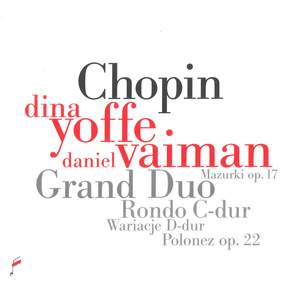
Chopin: Grand Duo, Rondo, Wariacje, Mazurki & Andanti

Chopin: Grand Duo, Rondo, Wariacje, Mazurki & Andanti


Chopin:

Andante spianato & Grande Polonaise, Op. 22

Mazurkas (4), Op. 17

Rondo in C major for two pianos, Op. 73

with Daniel Vayman (piano)

Variations in D major for 2 pianos

with Daniel Vayman (piano)

Grand Duo in E KKIIb/1


Dina Yoffe (piano)

This disc features the Andante spianato and Grande Polonaise brillante, Op. 22 and the Mazurkas, Op. 17 performed by Dina Yoffe, as well as works for four hands and two pianos, which the artist recorded with her son, Daniel Vayman. It is the second disc that this duo has recorded for the Fryderyk Chopin Institute; the first, with similar repertoire but on historical instruments, appeared in ‘The Real Chopin’.

Released or re-released in last 6 months

Frederick Chopin Institute - NIFCCD210

(CD)

$17.00

In stock - usually despatched within 1 working day.

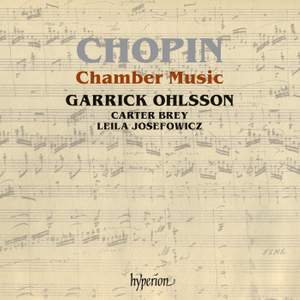
Chopin - Chamber Music

Chopin - Chamber Music


Chopin:

Cello Sonata in G minor, Op. 65

Carter Brey (cello)

Introduction and Polonaise Brillante in C, Op. 3

Carter Brey (cello)

Grand Duo in E KKIIb/1

Carter Brey (cello)

Piano Trio in G minor Op. 8

Leila Josefowicz (violin) & Carter Brey (cello)


While there is no composition by Chopin that does not involve the piano, the cello is the only other instrument for which he wrote any significant music. His first effort was a polonaise written in 1829 when he was visiting the home of Prince Radziwill, governor of the Principality of Poznan and himself a composer and cellist of sorts. Writing to his friend Tytus Woyciechowski in November, he is rather dismissive of his ‘alla polacca’ describing it as ‘nothing more than a brilliant drawing-room piece suitable for the ladies’. He hoped that the Prince’s daughter, Wanda, would practise the piano part (he was supposed to be giving her lessons) in which case she must have been an accomplished pianist, though her father would not have found the cello part over-taxing. The following year Chopin added an introduction, inspired by his friendship in Vienna with the cellist Joseph Merk. The Introduction and Polonaise brillante in C major for piano and cello Op 3 was dedicated to Merk. Carl Czerny (1791–1857) produced a piano solo version of the work but in the 1980s an arrangement by Chopin himself was unearthed.

The Piano Trio in G minor Op 8 was composed a year earlier, in 1828, for private performance at ‘Antonin’, the home of Prince Radziwill. This is Chopin’s only example of writing for the violin, and it shows a surprising lack of flair (in the first movement, for instance, the violinist rarely moves out of first position). It is a genial work in four movements (Allegro con fuoco, Scherzo, Adagio sostenuto and an Allegretto finale) but there is little of the interplay between the three instruments of the kind that makes the trios of Beethoven, Schubert and Hummel such a delight. Chopin seems hampered by the confines of classical procedures, working ideas through dutifully rather than with individuality and imagination, though various commentators have praised the Trio as ‘one of the most perfect and, unfortunately, most neglected of Chopin’s works’ (Charles Willeby) and wondered why ‘so graceful and winning a piece is not more of a staple in the concert hall’ (Emanuel Ax).

In the chronology of works for cello and piano, the Grand Duo in E major on themes from Meyerbeer’s Robert le Diable comes next. The opera had a sensational premiere in Paris on 21 November 1831. Set in thirteenth-century Sicily, the libretto, ‘in which the grotesque is carried to the point of absurdity’ (Kobbé), was saved by Meyerbeer’s brilliant score, and the work made a fortune for the Paris Opéra. Its themes attracted dozens of composers including Thalberg, Kalkbrenner, Herz and Liszt. Chopin was commissioned by his publisher Schlesinger to write this potpourri, a brilliant display piece of the kind that was so popular in the Parisian salons of the time. After the piano’s Largo introduction, among the themes used are the Romanza and the chorus ‘Non pietà’ from Act 1, and ‘Le mie cure ancor dei cielo’ (Act 5). Composed in 1831, it is one of only four Chopin works published in his lifetime without an opus number and the only one to be composed in collaboration, in this case with his friend the cellist August Franchomme.

‘I write a little and cross out a lot’, Chopin wrote to his sister during the composition of his final major work, the Cello Sonata in G minor Op 65, written in Paris in 1845 and 1846. ‘Sometimes I am pleased with it, sometimes not. I throw it into a corner and then pick it up again.’ No work of his gave him more trouble, as manifested by the extensive sketches. It was the last one to be published during his lifetime, written when his health was failing. The four movements (Allegro moderato, Scherzo, Largo and Allegro) show how far Chopin had developed in his ability to form a closely integrated sonata structure, with ideas developing from a variety of short but related motifs.

For some of Chopin’s contemporaries it was a difficult work to grasp. Moscheles found ‘passages which sound to me like someone preluding on the piano, the player knocking at the door of every key and clef, to find if any melodious sounds were at home’, yet he thought well enough of it to make an arrangement for piano four hands. The Allegro moderato, especially, puzzled even Chopin’s intimates—players today find it the most problematic in terms of balance—and he omitted the movement at the premiere given by himself and Franchomme, the work’s dedicatee, on 16 February 1848. This first movement clearly had some hidden significance for him. Various commentators have noted in it thematic references from Schubert’s Winterreise, notably the initial phrase of ‘Gute Nacht’, the opening song. The subject of the song-cycle, the disappointed lover in despair at leaving his beloved, would seem to reflect the circumstances of Chopin’s life when he was writing the Sonata. There is evidence that he turned to Winterreise at the time of his separation from George Sand. Could that be why the first movement was not played at the premiere? Is that why on his deathbed he asked Franchomme to play it but could not bear to hear more than the opening bars?

“…Ohlsson proves himself a sensitive chamber musician, joining forces with violinist Leila Josefowicz and cellist Carter Brey in an extremely convincing performance of the much underrated Piano Trio.” BBC Music Magazine, February 2010 ****

Helios - CDH55384

(CD)

$8.50

Usually despatched in 2 - 3 working days.

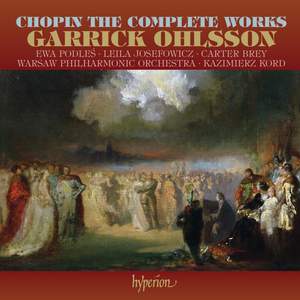
Chopin - The Complete Works

Chopin - The Complete Works


Chopin:

Piano Sonata No. 1 in C minor, Op. 4

Piano Sonata No. 2 in B flat minor, Op. 35 'Marche funèbre'

Piano Sonata No. 3 in B minor, Op. 58

Preludes (24), Op. 28

Prelude Op. posth. in A flat major (No. 26)

Prelude Op. 45 in C sharp minor (No. 25)

Marche Funebre, Op. 72 No. 2

Fugue in A minor

Rondo in C minor Op. 1

Rondo a la Mazurka, Op. 5

Études (12), Op. 10

Études (12), Op. 25

Trois Nouvelles Études

Fantasia in F minor, Op. 49

Ballades Nos. 1-4

Rondo in E flat major, Op. 16

Rondo in C major, Op. 73

Scherzi Nos. 1-4

Hexaméron KKIIb/2

Introduction & Variations ‘Der Schweizerbub’ KKIVa/4

Variations brilliantes in B flat major on 'Je Vends des Scapulaires', Op. 12

Allegro de Concert in A major Op. 46

Polonaise No. 3 in A major, Op. 40 No. 1 'Military'

Polonaise No. 4 in C minor, Op. 40, No. 2

Polonaise No. 5 in F sharp minor, Op. 44

Polonaise No. 6 in A flat major, Op. 53 'Héroïque'

Polonaise No. 7 in A flat major, Op. 61 'Polonaise-fantaisie'

Bolero, Op. 19

Tarantella in A flat major, Op. 43

Impromptus Nos. 1-4

Nocturnes Nos. 1-21 (complete)

Cantabile in B Flat Major (Andantino)

Moderato in E, KKIVb/12

Largo in E flat major, BI 109

Variations in A - Souvenír de paganini

Berceuse in D flat major, Op. 57

Barcarolle in F sharp major, Op. 60

Waltzes Nos. 1-19

Waltz No. 20 in F sharp minor, Op. posth., KK Ib/7 'Mélancolique'

Contredanse in G flat major, KKAnh.Ia/4

Écossaises (3), Op. 72 No. 3

Mazurkas Nos. 1-51

Mazurka No. 54 in D major

Mazurka No. 55 in G major, K.IIa/2

Mazurka No. 56 in B flat major, K.IIa/3

Mazurka No. 58 in A flat major

Mazurka No. 59 in B flat major, K.IVb/1

Mazurka No. 61 in C major, K.IVb/3

Mazurka No. 63 in A flat major, Op. 7, No. 4 (first version)

Mazurka No. 64 in D major, K.IVa/7

Variations on Mozart's 'La ci darem la mano' in B flat major, Op. 2

Piano Concerto No. 2 in F minor, Op. 21

Piano Concerto No. 1 in E minor, Op. 11

Fantasia in A major on Polish Airs, Op. 13

Krakowiak - Concert Rondo in F, Op. 14

Andante spianato & Grande Polonaise, Op. 22

Grand Duo in E KKIIb/1

Piano Trio in G minor Op. 8

Pieóni i piosnki (17) (Seventeen Polish Songs), Op. 74

Czary (Charms), KK.IVa/11

Dumka (Reverie), KK.IVb/9

Variations on Rossini's 'Non piu mesta' in E major

for flute & piano


“This monumental recording project first came about when the American record company Arabesque approached me with an irresistible offer to record the complete works of Chopin. I accepted with enthusiasm and an awareness of the magnitude of the task. My total immersion in the Chopin project was enhanced by a concurrent series of recitals of the complete solo works in the US and several European capitals from 1995 to 1997. I am delighted that these recordings are now available again as a boxed set on Hyperion.” GARRICK OHLSSON

Since his triumph as winner of the 1970 Chopin International Piano Competition, pianist Garrick Ohlsson has established himself worldwide as a musician of magisterial interpretive and technical prowess.

“This is an oustanding achievement, which any genuine Chopin lover and student of Romantic music should own … A landmark in the recording of Chopin’s music … Garrick Ohlsson and Hyperion deserve the greatest success in bringing this important undertaking to such a consistently impressive conclusion” International Record Review

“An attractively priced box set … Ohlsson is in a class of his own” Pianist Magazine

Hyperion - CDS44351/66

(CD - 16 discs)

$90.25

Usually despatched in 2 - 3 working days.

Copyright © 2002-13 Presto Classical Limited, all rights reserved.